

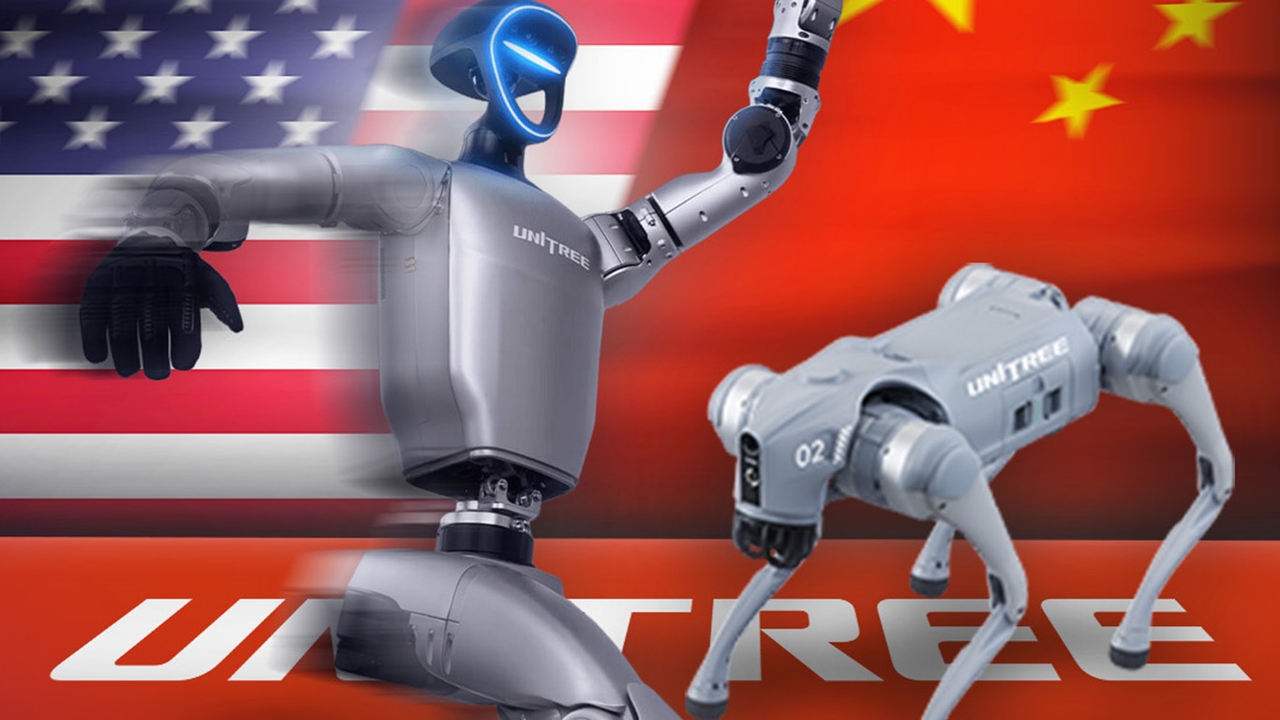
Unitree Robotics, a leading Chinese robot manufacturer, began trading on the Shanghai stock market on the morning of Wednesday, 19 Aug 2025 GMT+7. Its shares surged 629% from the opening price of 150.80 yuan, reaching a peak of 1,100 yuan per share before settling around 900 yuan per share.
Officially known as Yushu Technology, Unitree is the first robot developer to be listed on the STAR Market, a technology-focused stock exchange often referred to as the Chinese version of Nasdaq. This marks a significant milestone in China's government efforts to establish the country as a leader in robotics and AI industries.
Unitree raised 6.1 billion yuan (approximately 905 million USD) through this IPO, bringing the company's valuation to about 9 billion USD with its market debut.
Unitree’s stock performance on its market debut outpaced that of CXMT, a major Chinese chipmaker that recently listed on the Shanghai exchange last month, where shares surged 466% on the first day, making CXMT China’s most valuable company, surpassing Tencent.
Unitree's market entry comes amid intense competition between the US and China to dominate the global markets for robots, humanoids, and AI-controlled robotic models.
Unitree began by developing four-legged robots. Founder Wang Xingxing initiated the project while pursuing his master’s degree. By 2017, the company developed the XDog and started commercial sales.
Since then, Unitree has expanded continuously into humanoid robots, which have grown rapidly in China and globally. The company’s main strategy is to lower prices to increase volume, successfully bringing four-legged robots to the consumer market by 2020.
Unitree develops a range of products including sensors, automated robotic arms, four-legged robots, and humanoid robots. Last year, the company shipped over 5,500 humanoid robots amid rapidly growing demand.
Today, Unitree has shifted focus from four-legged robots to humanoid robots. Both types share foundational systems like joint drive mechanisms, mechanical structures, battery management, and proprietary software algorithms. The company controls production end-to-end, enabling fast model development and substantial cost reductions.
With production costs fully controlled, Unitree’s humanoid robots achieved a gross margin of 87.67% after launch. The company advanced from the full-sized H1 humanoid robot to the medium-sized G1 model within just nine months.
The H1 debuted in August 2023, selling only five units initially at an average price of 593,400 yuan due to limited availability. By 2025, the average selling price for humanoid robots dropped to 166,400 yuan, while sales volume surged to 5,215 units.
Unitree’s rapid growth occurred over a few years. In 2024, total revenue was only 393 million yuan, but the first quarter of 2026 alone generated 423 million yuan, surpassing the full-year revenue of 2024. Total revenue for 2025 reached 1.699 billion yuan, representing a 332.3% annual increase.
Unitree’s compound annual growth rate over three years reached 226.8%, far exceeding competitors. The 332.3% revenue growth in 2025 propelled the company from fourth to second place in the industry.
Breaking down revenue by business segment shows that the surge mainly came from robotics. In 2025, revenue from humanoid robots reached 868 million yuan, a 711.2% increase year-over-year, while revenue from four-legged robots was 698 million yuan, up 202.2%.
Previously, four-legged robots accounted for a larger share of revenue, but 2025 marked the first year humanoid robot revenue surpassed it, representing 51.09% of total revenue, or over half of the company’s income.
Prior to the IPO, Unitree reported overwhelming demand from retail investors after shares became available for subscription on 10 August 2025, with subscription orders exceeding 8,000 times the number of shares offered.
This set a new record for the highest IPO subscription on the STAR Market. Meanwhile, on the crypto trading platform Hyperliquid, Unitree’s perpetual futures contracts traded near 100 USD per share on Wednesday afternoon, four times higher than the Shanghai stock listing price.
These movements reflect investor expectations that Unitree shares would surge strongly on the first trading day due to high buying demand.
Such instruments are increasingly popular among investors outside China seeking to speculate on hot Chinese tech stocks, as foreign investors still lack free access to domestic Chinese stock markets and use these tools for speculation.
Unitree’s IPO coincided with a particularly vibrant period for China’s robotics industry. On the same day as Unitree’s market debut, Beijing hosted the World Robot Conference. Additionally, the World Humanoid Robot Games are scheduled for the coming weekend.
Chinese state media report that over 140 companies develop humanoid robots domestically, with players from various industries rushing into this market. Notably, some electric vehicle manufacturers like Xpeng have announced plans to mass-produce humanoid robots this year, and BYD, a major EV producer, is expected to launch its first humanoid model this month.
Morgan Stanley recently raised its global humanoid robot delivery forecast for 2026 to 50,000 units from the previous 28,000, projecting deliveries could reach 446,000 units by 2030.
This growth is driven by companies competing to build advantages through deployment scale and advancing robotic technologies from training phases to real-world application.
However, Sheng Zhong, Morgan Stanley’s head of China industrial research, cautions that while some companies entering humanoid robotics from other industries may succeed, many face significant challenges.
In the first half of this year, Morgan Stanley observed that fundraising activity in the private market is increasingly concentrated among a few leading companies. Experience from other industries may offer some advantages, but humanoid robotics is a wholly new field requiring rapid development of both hardware and software for success.
Unitree’s historic stock market entry occurs as US-China technology tensions intensify. Last month, the US Federal Communications Commission (FCC) banned imports of new foreign-made humanoid robots citing national security concerns.
This measure is seen as targeting Chinese-made humanoid robots. However, robots already FCC-certified or owned by users before the rule remain unaffected.
According to Unitree’s prospectus, key robot models including G1, H2, and R1 humanoids, as well as Go2, B2, and A2 four-legged robots, received FCC approval prior to the new rule, allowing legal sales in the US. Future models may face stricter trade barriers.
The broader picture involves not only competition over who can build the best or cheapest robots but also a strategic contest between technology superpowers, the US and China. Humanoid robots are viewed as potentially crucial technologies for the AI-driven economy of the future. For insights into this great power rivalry, expert discussions are available at Money Fest 2026, free to attend athttps://event.thairath.co.th/all/event/TREVENT017
A key strength of Chinese companies lies in producing robots with functions and features comparable to US competitors but at lower prices. Many Chinese firms also benefit from substantial government support. According to China Daily, this backing helped triple the number of robotics companies in China between 2020 and 2024.
,36Kr
Follow the Facebook page Thairath Money at the link -
https://www.facebook.com/ThairathMoney