

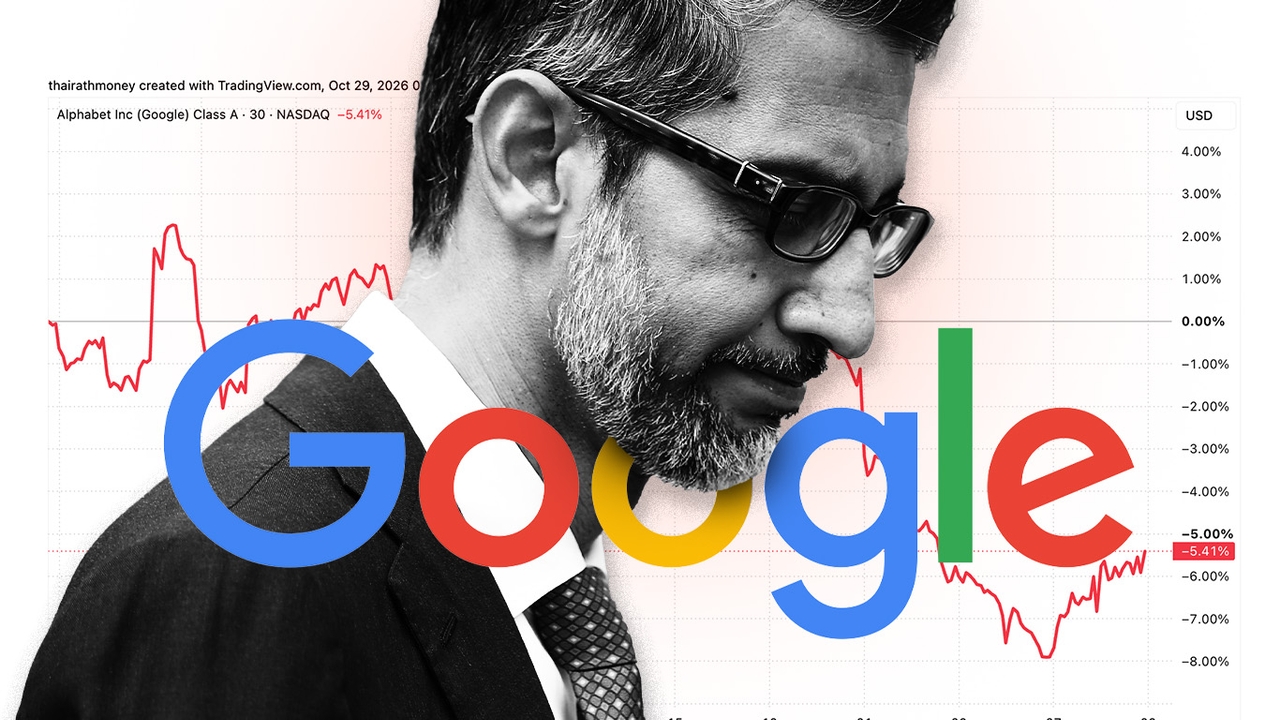
Alphabet, Google's parent company, saw its shares fall more than 10% after announcing Q3 2026 results that showed both total revenue and net profit below analyst expectations. Additionally, free cash flow declined into negative territory, raising concerns among investors closely watching the value of Big Tech's heavy AI investments.
Alphabet's earnings compared to the average analyst estimates from LSEG are as follows:
This marks the first time in nearly four years that Alphabet reported both revenue and profit below analyst expectations simultaneously.
Another key figure troubling investors is Alphabet's free cash flow, which swung to a negative $9.07 billion—significantly worse than the expected negative $2.7 billion.
Despite overall disappointing results, Alphabet continues to heavily invest in expanding its AI business. One clear beneficiary is Google Cloud, the company's hub for cloud services and AI products.
Thomas Kurian, CEO of Google Cloud, stated, “The company sees exceptionally high demand and strong growth from AI labs, capital markets, financial institutions, and diverse enterprises.”
Google Cloud revenue more than doubled, reaching $30.7 billion—exceeding the analyst forecast of $28.7 billion.
This rapid growth is helping Google Cloud steadily capture market share from larger competitors like Amazon Web Services (AWS) and Microsoft Azure.
However, despite strong cloud business numbers, this alone has not shifted investors' negative view of Alphabet's overall results.
While Google Cloud is a key growth engine, investors remain cautious, seeing growth in one segment as insufficient to offset weaker-than-expected results elsewhere, especially given the massive AI investment burden.
Amid rising questions about massive AI infrastructure spending, Alphabet reported Q3 capital expenditures (CapEx) of $51.36 billion, slightly below the analyst estimate of $55.09 billion.
Investors are increasingly focused not just on the scale of AI investments by tech giants but on whether these investments will generate sufficient returns to justify the enormous costs.
This is especially relevant for hyperscalers—large cloud infrastructure providers—competing to expand data centers and processing power to meet rapidly growing AI demand.
Alphabet maintains its full-year CapEx guidance, after previously raising its 2026 investment range from $190 billion to $195–205 billion in Q2.
CapEx is expected to exceed $200 billion this year, with plans to surpass $300 billion in 2027.
Meanwhile, Alphabet's debt burden rose sharply last quarter, with long-term debt jumping to $125.1 billion from $21.6 billion a year earlier—a roughly 479% increase.
Alphabet reported 12% growth in its Search business revenue, reaching $63.35 billion, but this fell short of analyst expectations of $64.96 billion.
CEO Sundar Pichai noted that the company's AI investments have significantly contributed to the highest growth rate in search query volume in five years.
This means that while AI is transforming internet search, Google views this technology not only as a challenge to traditional search but also as a key tool driving increased user search activity.
However, Alphabet still needs to prove that rising AI user numbers and search volume will translate into enough revenue and profit to cover the rising AI investment costs.
Another major factor impacting Alphabet's results is the volatility in the value of its investments in other companies.
In Q2, Alphabet recognized $99.03 billion in gains from equity holdings, largely driven by stakes in SpaceX and Anthropic.
However, in Q3, these investments became a drag, with Alphabet recording an $8.66 billion loss in this category.
For stock and investment news with Thairath Money to help you achieve “Good Finance, Good Life,” visithttps://www.thairath.co.th/money/investment
Follow the Facebook page: Thairath Money athttps://www.facebook.com/ThairathMoney