

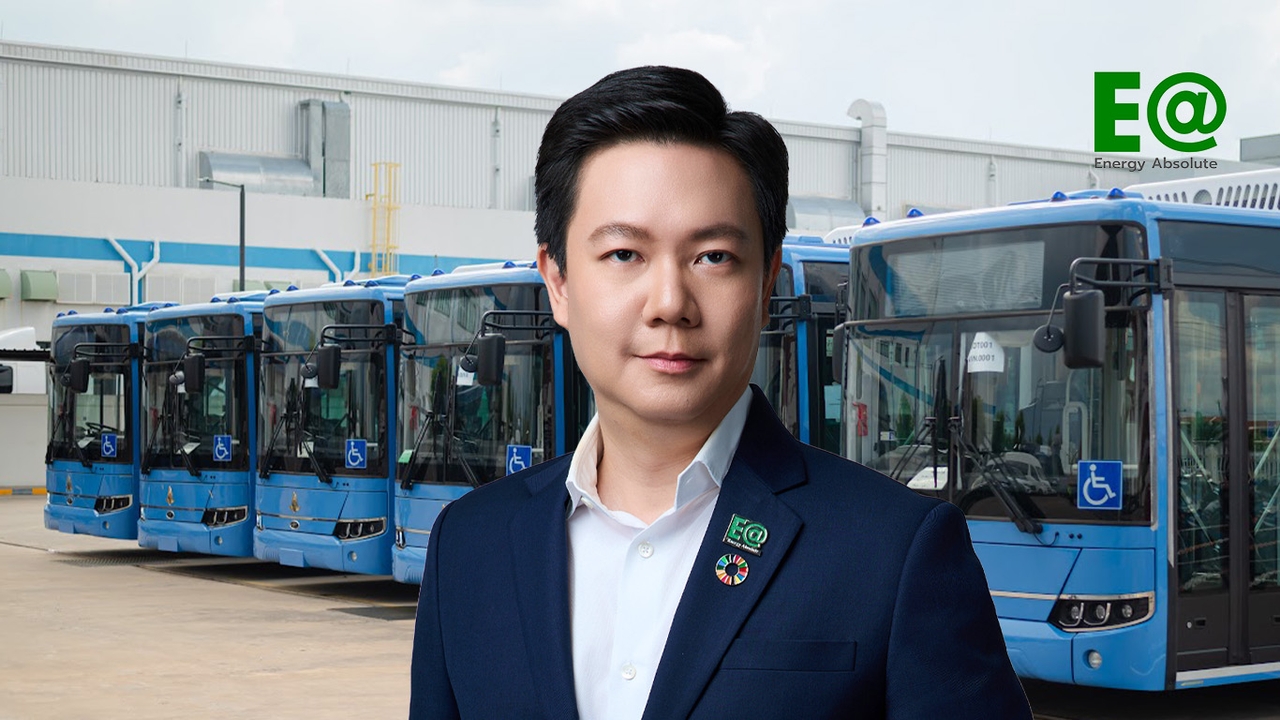
Amid competition in the electric vehicle market, Energy Absolute Public Company Limited (EA) is advancing to gain an edge in the commercial electric vehicle sector through a domestic production base boasting both strong manufacturing capacity and tax advantages.
Especially by using Thai parts and labor, achieving a Local Content ratio as high as 40%, which helps reduce cost constraints compared to fully imported vehicles. The company is leveraging Absolute Assembly Company Limited (AAB) as a key base to penetrate the commercial EV market.
This covers buses, coaches, tractor units, and large trucks, with the delivery of 1,520 BMTA electric buses as a major revenue driver. EA is also preparing to participate in new government tenders and is monitoring a 200-billion-baht government energy transition fund that will support the market.
At the same time, EA is not limiting its goals to the domestic market but is preparing to expand into ASEAN, currently negotiating with partners in two countries to export electric buses and coaches assembled in Thailand, expecting clarity by early 2027.
Chatpol Sripratum, CEO of Energy Absolute Public Company Limited (EA), said that the EA Group’s electric vehicle business currently has Absolute Assembly Company Limited (AAB) as a strategic production base.
AAB assembles commercial electric vehicles for the group, including buses, coaches, tractor units, and large trucks—vehicle groups with significant potential to transition from fuel to electric power.
AAB’s production capacity can handle approximately 7 to 10 vehicles per day through a process primarily using Thai labor and can adjust to assemble various types of commercial EVs as market demand requires.
Key factors supporting the commercial EV market come from three main directions: high and volatile fuel prices, pressure from greenhouse gas reduction measures in business sectors, and government policies increasingly focused on transitioning vehicles to clean energy.
Meanwhile, tax structure is another factor that may alter market competition, especially with recent adjustments to excise tax rates on electric vehicles, which importers must consider regarding costs and business decisions.
Chatpol noted that AAB’s key strength lies in being an electric vehicle assembly base in Thailand, located in a Free Zone and using Thai-made parts and skilled labor, achieving a Local Content value up to 40% as required. This provides a tax advantage compared to importing fully built vehicles.
Especially buses or tractor units imported from China, which may incur import taxes around 20–40%, whereas vehicles assembled under Free Zone rules qualify for tax incentives per law. The company operates under related regulations and is subject to Customs Department oversight.
Moreover, having a domestic assembly base allows the company to better control production processes, costs, and delivery times. The factory employs Thai workers and sources parts from domestic suppliers, adding value to Thailand’s automotive industry rather than merely importing complete vehicles for sale.
Another advantage for EA is that it does not compete only by selling vehicles but builds a complete EV business ecosystem. AAB serves as the vehicle assembly base, while the company has battery manufacturing within its group and a charging station network, EA Anywhere, which can be installed at client distribution centers and depots to support commercial vehicle use.
They also offer energy services and usage solutions such as special electricity rates for charging, maintenance services, and after-sales support to help operators transition from combustion engine vehicles to EVs at reasonable costs and reduce concerns about long-term vehicle upkeep.
Chatpol believes that the commercial EV transition does not end with selling one vehicle but must meet customer needs throughout the vehicle’s lifecycle—from vehicle and battery sourcing to charging systems and maintenance.
Thus, offering comprehensive services is a critical factor that differentiates competition and enables the company to provide customers with quality, price, and timely delivery solutions.
At the same time, EA sees opportunities to generate additional income from carbon credit management and has already delivered over 100,000 tons of carbon credits to Switzerland.
Chatpol said EA sees opportunities and is preparing to join tenders for the next phase of bus projects from the Ministry of Transport and BMTA, estimated at about 800–1,000 units, expected to open for bidding in early 2027.
They are also monitoring the government’s 200-billion-baht energy transition fund, which will support electric vehicle procurement for state agencies.
AAB has a normal production capacity of 3,000 vehicles per year and can ramp up to 6,000 per year, sufficient to meet large-scale demand through 2027–2028 without significant factory expansion investments.
Currently, the priority is to accelerate delivery of the 1,520 BMTA buses, starting to be handed over from late Q1 and completed by Q2 2027, expected to generate revenue of about 6–7 billion baht for the group.
The gross profit margin is in double digits, exceeding 10%, achieved through collaboration with Next Point Public Company Limited (NEX).
Beyond building the domestic business base, EA is opening doors to international markets. Executives revealed that negotiations are underway with partners in two neighboring ASEAN countries
to export fully assembled commercial electric buses and coaches from the Thai factory. Expected order volumes are in the hundreds, with agreements expected to be clear by early 2027.
However, Cha tpol pointed out that EA’s regional competitive advantage comes from tax benefits under ASEAN free trade agreements and a proven track record from operating over 2,000–3,000 electric buses in Bangkok, which builds credibility with international partners.
Read stock and investment news with Thairath Money for "Better Finance, Better Life" at https://www.thairath.co.th/money/investment
Follow the Facebook page Thairath Money at https://www.facebook.com/ThairathMoney