

As the financial world enters the era of Tokenization—converting assets like stocks, bonds, funds, or real estate into digital tokens on the Blockchain—the question arises: if these assets can be traded and transferred on the Blockchain, why must the money used to pay for them still pass through traditional banking systems?
This question has drawn the global financial sector's attention to the technology Tokenized Deposits or the conversion of bank deposits into digital tokens. This may become a bridge connecting traditional banking systems with blockchain-based finance. The technology not only speeds up money transfers but also enables deposits to directly interact with digital assets and automated financial systems.
In Thailand, Siam Commercial Bank Public Company Limited (SCB) or SCB a company under the SCBX Group, has applied to test Tokenized Deposits within the Bank of Thailand's Regulatory Sandbox, becoming the first to do so. If approved, the initial use will be tokenized deposits as payment tools for Investment Tokens, eventually expanding to global tokenized asset investments and new forms of lending services.
Tokenized Deposits are ordinary commercial bank deposits represented as tokens on the blockchain or Distributed Ledger Technology (DLT), enabling direct digital transactions such as transfers and payments.
Simply put, if you have a 1,000-baht deposit, this amount is converted into tokens worth 1,000 baht for blockchain transactions while remaining a bank liability to the customer as usual. It is not a new currency and does not fluctuate like cryptocurrencies.
According toNacha,the U.S. ACH payment network overseer, and ClearBank, Tokenized Deposits maintain a 1:1 relationship with bank deposits. Token holders retain claims against the issuing bank just like regular depositors, under applicable product terms and laws.
From a bank's perspective, Tokenized Deposits do not create new money but change how the bank’s liabilities to depositors are recorded and transferred, allowing blockchain-based transactions without altering the bank’s balance sheet assets simply by issuing tokens.
Therefore, the key difference between regular deposits and Tokenized Deposits lies not in the amount but in how the money can be used.
Another important feature is compatibility with Smart Contracts—programs that can execute automatic transactions once predefined conditions are met. For example, programming immediate payment upon asset receipt or releasing funds only after all parties approve.
This means deposits are no longer just account balances but can be part of programmable financial systems, often called Programmable Money.
However, converting deposits into tokens does not guarantee instant transaction completion every time. It depends on network design, connected banking systems, and inter-institutional settlement processes.
In Thailand, with PromptPay and Mobile Banking allowing near-instant transfers, the question is why banks should invest in developing Tokenized Deposits.
The answer is that Tokenized Deposits address not just transfer speed but the limitations of transacting between money and assets located on separate systems.
Atit Sriamphorn, Head of Digital Channels at Siam Commercial Bank Public Company Limited (SCB), explained that many financial assets are being tokenized on blockchain, including Tokenized Stocks, Bonds, Money Market Funds, and ETFs.
Even though these assets can change hands on blockchain, payments often still rely on traditional banking systems outside the blockchain, requiring transactions to occur on separate systems. Tokenized Deposits on the same or connected system enable simultaneous exchange of money and assets under defined conditions.
This mechanism is called Delivery versus Payment (DvP), where payment and asset delivery occur together. If one party fails, the transaction does not proceed partially, reducing the risk that one side delivers assets without receiving payment.
Moreover, Tokenized Deposits may be used in future applications such as cross-border payments, inter-organizational transactions, and financial collateral management, all requiring coordination across multiple systems.
This technology is not designed to replace existing real-time payment systems but to add new capabilities to bank deposits.
An interesting case in Thailand is SCBX Group’s move to use Tokenized Deposits for paying digital asset prices.
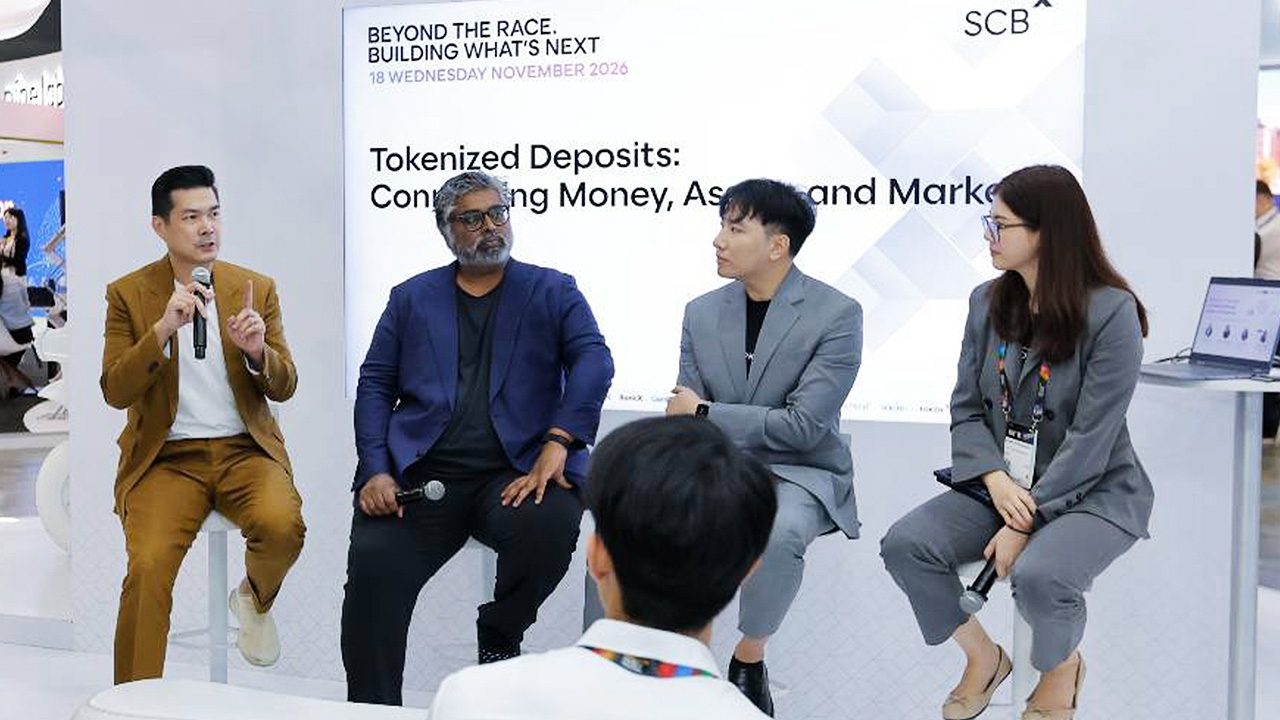
At the Singapore FinTech Festival 2026, where SCBX was Thailand’s sole representative with a booth, they explained the goal is not to create a new currency but to enable deposits to pay for assets on the blockchain.
The key idea is that Token X, a company within SCBX Group, operates its own blockchain called TKX Chain and already issues Investment Tokens, providing Asset Leg infrastructure.
What’s missing is the Cash Leg—money to pay for those assets on blockchain. SCBX chose to start by creating Tokenized Deposits to pay for existing Investment Tokens instead of developing new tokenized deposits and tokenized assets simultaneously.
Starting this way allows testing technology, bank system integration, and DvP settlement processes in a controlled environment.
Tinakorn Pornnathisakul from Token X explained at the panel that issuing Investment Tokens is just the beginning of building digital asset markets. The crucial next step is enabling investors to efficiently buy, sell, and pay for assets.
Previously, even with Investment Tokens on blockchain, payment still occurred in traditional banking systems. Introducing Tokenized Deposits connects these two components.
For customers, buying Investment Tokens becomes a single transaction delivering assets and payment simultaneously, with Smart Contracts ensuring both sides succeed together.
Behind the scenes, data integration between blockchain and the bank’s Core Banking System is required to keep deposit and token balances consistent, define transaction completion criteria, and handle errors.
Meanwhile, Atit Sriamphorn also noted that this test will help the bank understand Tokenized Deposits’ potential and limitations in real use, paving the way for customer-focused services. The timing of product or service launch will depend on test results, technology readiness, market demand, and regulatory frameworks.
Regarding project progress, executives told Thairath Money that SCBX Group has already submitted documents to the Bank of Thailand and is awaiting approval to enter the Regulatory Sandbox, with possible adjustments to the use case based on regulator feedback.
If approved, development is expected to begin with testing targeted for early 2027, followed by evaluation and requests for broader service expansion.
Although SCBX’s initial use case focuses on Investment Token payments, executives believe Tokenized Deposits can expand into other financial services, especially Corporate Banking, Trade Finance, and Cross-border Remittances.
This aligns with analyses from Nacha andOliver Wyman,a global consultancy, which see Tokenized Deposits improving complex payment systems, reducing system coordination steps, and enhancing liquidity management flexibility.
For banks, Tokenized Deposits could create new revenue models beyond traditional deposit and lending services by enabling roles in asset payment processing, collateral management, and blockchain-connected financial services.
However, challenges remain before wide adoption, notably interoperability. If each bank’s Tokenized Deposits operate only on their own blockchain, financial systems risk fragmentation rather than simplifying existing infrastructure.
Cybersecurity is another concern, especially securing connections between blockchains, encryption, and Smart Contract safety.
According to Niki Ariyasinghe, Vice President for Asia-Pacific and the Middle East at Chainlink Labs, in a panel discussion, developing blockchain financial systems must prioritize secure network connections, particularly when assets and money reside on different blockchains.
From financial institutions’ perspective, new systems must integrate with Core Banking Systems, existing payment systems, and regulatory processes without compromising data accuracy or settlement integrity.
Thus, the future of banking may not be fully blockchain-based but hybrid, blending blockchain capabilities with traditional financial infrastructure.
Tokenized Deposits do not replace existing banking systems or eliminate financial risks but add new functionalities to everyday deposits.
For Thailand, SCB’s application is a first step addressing more than whether baht deposits can be tokenized. The real challenge is how banks can connect traditional deposits with blockchain assets and develop services that customers and businesses can truly use.
If expanded from Investment Token payments to global asset investments and token-collateralized lending, Tokenized Deposits could shift banks’ roles from mere deposit and transfer agents to providers of financial infrastructure in the digital asset world.
Read stock and investment news with Thairath Money to help you "Finance Well, Live Well" athttps://www.thairath.co.th/money/investment
Follow the Facebook page: Thairath Money athttps://www.facebook.com/ThairathMoney