

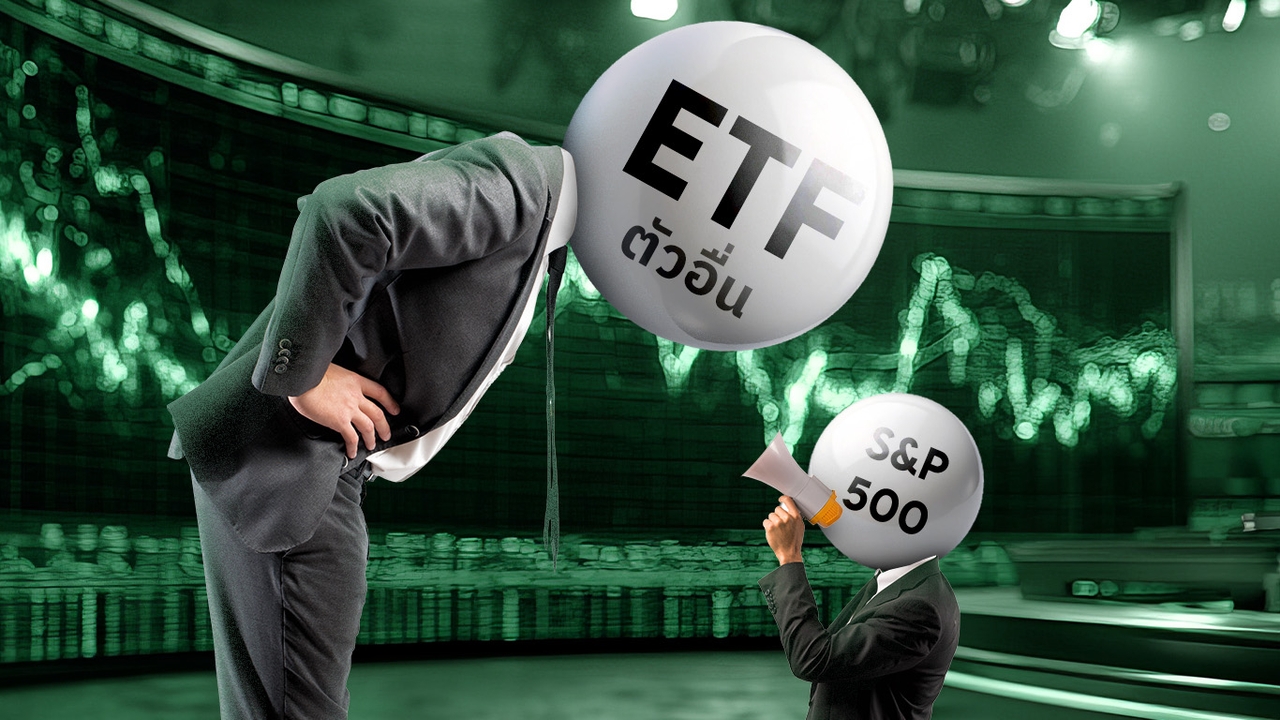
"When in doubt, just invest in the S&P 500" is a phrase often heard in investing circles today, which is understandable since the S&P 500 index aggregates 500 large U.S. companies in one basket and has delivered remarkable returns recently.
Simply put, if someone invested 1 million baht 10 years ago, today that sum would have grown to about 3.57 million baht, which is excellent for an investment that requires no stock picking.
If the S&P 500 is so strong, are there any funds that can beat it? Thairath Money reviews the 10-year returns of the 100 largest ETFs by market cap worldwide, comparing them clearly to offer investment ideas.
Among the 100 largest ETFs, since the start of 2026, 42 out of 99 funds have outperformed the S&P 500. Looking back 1 year, this rose to 57 funds, more than half. Over 5 years, the number of winners dropped to 37, and over 10 years, only 18 funds remained ahead.
In other words, holding the S&P 500 long term allows you to outperform most funds.
But that's not the whole story. Among the minority of funds that do outperform, some achieve clearly superior returns, and notably, some have done so consistently across multiple periods.
This shows that if you invest in the right funds, at the right time, and are willing to spend time learning and researching beforehand, you can achieve higher returns than expected.
Consider 1 million baht invested 10 years ago: in the S&P 500 with a 256.82% return, it grows to about 3.57 million baht today. But in a fund like VGT (Vanguard Information Technology ETF), which returned 754.19% over the same period, it would have grown to approximately 8.54 million baht. That 5 million baht difference comes solely from fund selection.
However, remember that few funds beat the S&P 500 over 10 years, and most winners are in the technology sector, which carries higher volatility. Therefore, choosing the "right" fund means more than seeing who performed best in a given year; you must understand what the fund invests in, the risks involved, and whether you can tolerate the volatility.
The hottest fund this year is not guaranteed to be the winner next year. Hence, researching and understanding before investing is a valuable investment itself, improving chances of higher returns and avoiding poor choices based on hype.
Although the S&P 500 has performed well, certain ETFs have clearly outperformed it, especially in technology, chips, and some country markets, both short- and long-term, such as:
1. VGT (Vanguard Information Technology ETF) invests in U.S. technology stocks, including software, hardware, and chip companies, holding several hundred stocks but weighted heavily in giants like Apple, Microsoft, and Nvidia. Essentially, it focuses exclusively on the U.S. tech sector from large to small companies, rather than diversifying across the entire U.S. stock market.
2. XLK (Technology Select Sector SPDR Fund) has a concept similar to VGT, investing in technology stocks, but only those within the S&P 500 index. Therefore, it holds fewer stocks and is more concentrated in large-cap stocks. Its performance is comparable and slightly better this year, with returns as follows:
3. 0050 (Yuanta/P-shares Taiwan Top 50 ETF) invests in the top 50 largest stocks on Taiwan’s stock market, with chip giant TSMC as its largest holding. This fund represents another way to invest in the booming chip and AI sectors this year. It trades on the Taiwan market, so returns may be influenced by currency fluctuations.
4. QQQ (Invesco QQQ Trust) tracks the Nasdaq 100 index, which consists of the 100 largest non-financial companies listed on Nasdaq, mostly tech and innovation leaders like Apple, Microsoft, Nvidia, Amazon, and Alphabet.
5. SPYG (State Street SPDR Portfolio S&P 500 Growth ETF) and IVW (iShares S&P 500 Growth ETF) share the same investment concept but are managed by different firms. They invest only in high-growth stocks within the S&P 500, not all 500 companies, resulting in significantly better performance than the broad index. Their returns are nearly identical:
6. Japanese ETFs 1320, 1321, 1330 are listed on the Tokyo Stock Exchange and track the Nikkei 225 index, which includes 225 major Japanese companies across automotive, electronics, and retail sectors. Their performances are similar as they track the same index, and this group has been notably strong this year.
Note: Data from Tradingview as of 5 Oct 2026 GMT+7.
Furthermore, with sufficient data to select the right funds and time investments accurately, returns could be even higher. For example, investing in SOXX one year ago would yield a 109.20% return today, and investing in SMH five years ago would have returned 395.44%.
However, this is retrospective. Moving forward, investors must choose funds aligned with their goals and risk tolerance, as investing carries risks and past returns do not guarantee future outcomes.
Read stock and investment news with Thairath Money to achieve "Better Finance, Better Life" athttps://www.thairath.co.th/money/investment
Follow the Facebook page: Thairath Money at this linkhttps://www.facebook.com/ThairathMoney