

"Gold" is an asset that has been part of Thai society for a long time. Wherever we go, we often see striking red gold shops that symbolize wealth and a unique closeness.
Today, the classic charm of gold is being driven by changing technology. The traditional behavior of people visiting stores to select jewelry or gold bars has rapidly shifted to digital platforms.
Buying and accumulating gold is no longer limited to older generations but is becoming a popular asset among younger people aiming to build long-term wealth.
Especially as gold prices continue to reach new highs, gold attracts attention as an asset that helps build and preserve wealth, particularly amid global economic uncertainty, inflation, and geopolitical conflicts that pressure investment markets, prompting both large and small investors to increase gold holdings in their portfolios.
Thairath Money explores the "future of gold" amid price volatility, offering insights on upcoming price directions and examining how the gold business adapts to the digital world to meet new generation investment behaviors.
Sirilak Pakotiprapa, Director of Analysis at Hua Seng Heng Gold Futures Company. She assesses that gold market trends in the second half of the year have a strong chance to reverse from a "downtrend" to a clear "uptrend."
The market began signaling a strong reversal after prices hit a low in July at around $3,960–4,000 per ounce and successfully broke through key resistance levels.
Additionally, important indicators like the US inflation indexes—CPI (Consumer Price Index) and PPI (Producer Price Index)—peaked in May and have since steadily declined, leading investors to believe gold prices have passed their lowest point.
Another significant market driver is Fund Flow, with global funds reversing from outflows during war concerns to clear inflows.
A clear example is the world's largest gold fund, SPDR, which saw net inflows of about 1.9 tons in July and an additional 16.83 tons in the first half of August.
Meanwhile, Dedollarization—the reduced dependence on the US dollar—continues strongly, evidenced by central banks worldwide buying gold for reserves, led by the Chinese central bank, which has made its largest purchase in 33 months.
However, investors need to watch four key factors that will support gold prices moving forward:
From a technical perspective, gold has support at $4,100 per ounce, making a fall back to $4,000 per ounce very unlikely.
Resistance levels are at $4,400 (100-day) and $4,500 (200-day) per ounce, with a break above $4,500 confirming an official uptrend.
By year-end, prices may reach $4,900–5,000 per ounce, equivalent to about 74,000–75,000 baht per baht gold, with next year potentially seeing $5,700–5,800 per ounce, or around 83,000–84,000 baht per baht gold.
Regarding the goal of 100,000 baht per baht gold, this is expected within 2–3 years, supported by a 10-year average return of 16% annually and a 5-year average of 10% annually.
. Thanarat Pasawong, CEO of Hua Seng Heng Group, added an interesting point that price volatility is not a concern but rather an opportunity for both businesses and investors, as active price movements stimulate trading volume and investment management, unlike stagnant periods when markets become sluggish.
Such volatility encourages investors to recognize the importance of portfolio diversification by allocating investments across various assets, using gold to mitigate risks from currency depreciation due to inflation and to preserve wealth.
Looking at investment behavior in Thailand’s gold market, two standards have grown alongside each other: 96.5% purity gold remains the most popular due to its cultural connection through jewelry, later evolving into investment-grade gold bars.
Meanwhile, 99.99% purity gold, priced based on the US dollar per ounce, is increasingly understood and favored by younger investors familiar with global support and resistance price levels.
Thailand ranks among the top gold trading markets in ASEAN and is second in Asia only to China. This strength derives not only from paper speculation but also from actual gold trading and delivery volumes, reinforcing Thailand’s gold price competitiveness on the global stage.
Additionally, Hua Seng Heng has integrated gold shops directly with Siam Commercial Bank’s (SCB) financial platform, enabling over 17 million SCB EASY app users to conveniently and quickly access investments in high-quality real gold.
Through this collaboration, the SCB Gold Marketplace feature on the SCB EASY app offers real-time online trading of both 96.5% and 99.99% gold in US dollars via SCB’s e-FCD accounts.
Direct dollar trading helps build a wealth investment ecosystem allowing investors to seamlessly transact alongside other foreign assets without worrying about redundant currency conversion risks.
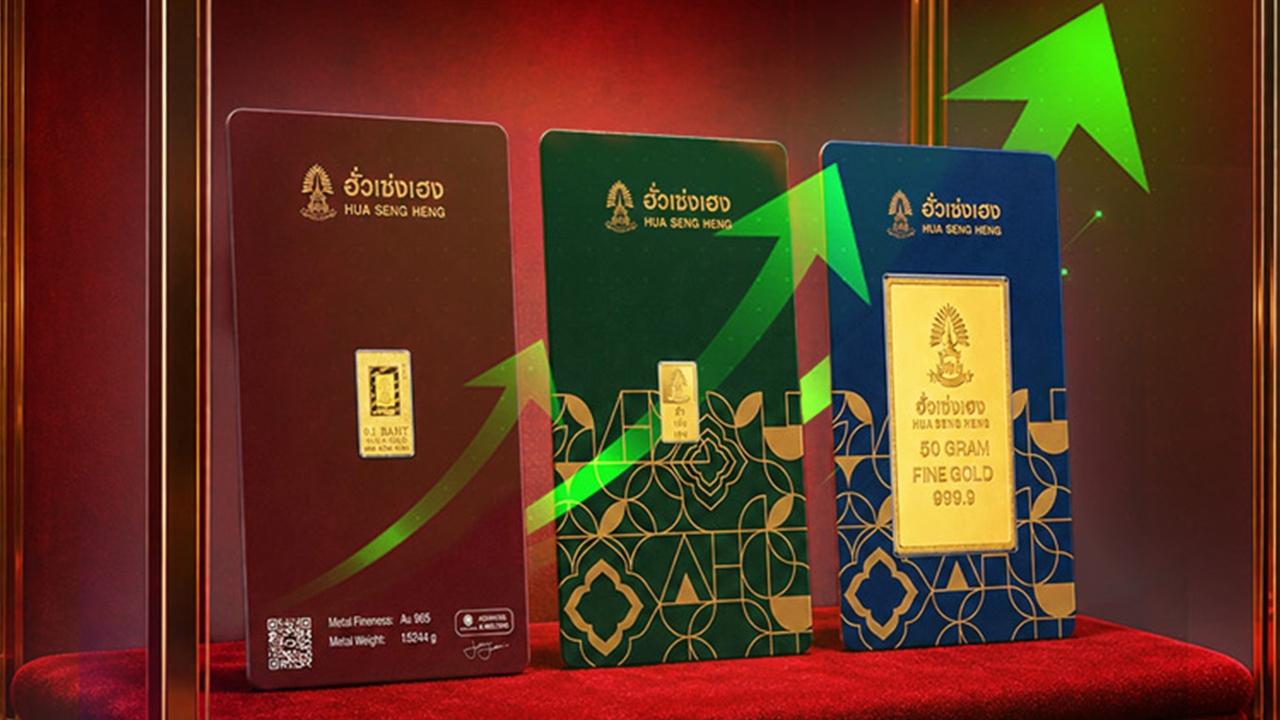
A key highlight is the new Blister Card product offering tiny gold units starting at only 0.05 baht or 0.05 ounces with no trading fees, operating under an omni-channel concept seamlessly linking online and offline worlds.
Investors trading and accumulating digital gold on smartphones can choose to pick up physical gold bars at any Hua Seng Heng branch or safely receive delivery by mail once they accumulate the desired amount.
Read stock and investment news with Thairath Money at
Follow the Facebook page: Thairath Money at this link