

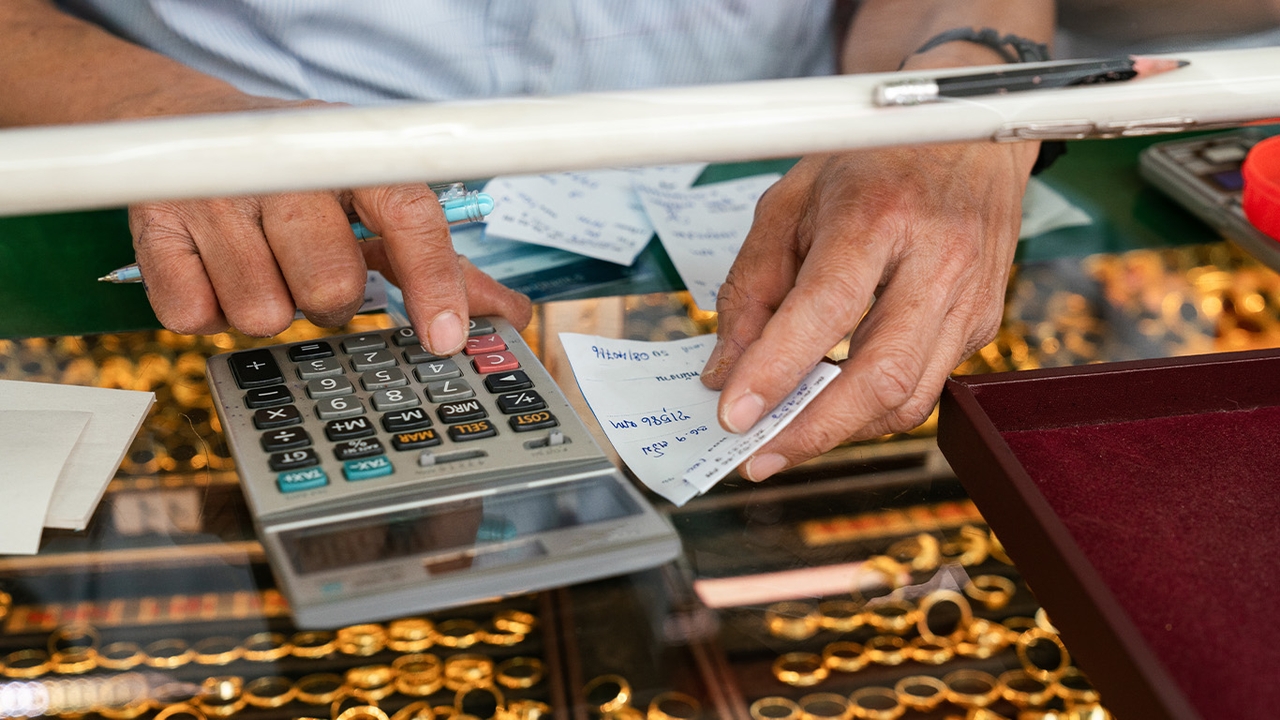
"Gold" has long been seen as a safe asset, a means to preserve wealth, and a solid financial guarantee familiar to Thai people. But with gold prices fluctuating, this belief is now being seriously challenged.
Earlier in 2026, Thai gold prices were forecasted to soar to 100,000 baht per baht-weight, after reaching a peak of 81,950 baht before facing significant sell-offs.
Prices then dropped to a low of 56,750 baht per baht-weight gold, a decline of 25,200 baht or about 30.8% from the peak.
This volatility has harmed not only investors who bought gold at high prices and face losses but also those who pawned their gold for cash.
Especially those who pawned gold when prices were above 80,000 baht per baht-weight but now see its value fall to around 50,000 baht.
An emerging trend online shows many pawners refusing to redeem their gold, considering it not worth the cost, some letting the gold lapse. Yet, pawnshop operators threaten legal action.
For example, a woman posted that she pawned 3 baht of gold when the price was 82,000 baht per baht-weight, receiving 72,000 baht per baht-weight as a loan.
When gold prices sharply declined, the pawnshop demanded she pay down the loan principal to match the current gold value.
She said she lacked funds to reduce the principal and wanted to let the gold lapse but was threatened with criminal charges.
The question is: If someone pawns gold but stops paying interest and doesn't redeem it, can the gold be forfeited immediately? Can pawnshops demand extra money if gold prices drop or sue the pawner?
Before addressing legal issues, it is important to understand why gold faced heavy selling pressure recently. The main factors are threefold:
1. U.S. interest rates pressure holding gold because gold yields no return during holding. As the Federal Reserve (Fed) likely keeps rates high longer than expected, investors shift to higher-yielding assets.
2. A strong U.S. dollar makes gold more expensive for holders of other currencies, reducing buying incentives.
3. Selling to maintain liquidity: amid financial market volatility, some investors must sell gold to cover losses or financial obligations, even amid uncertainty.
In Thailand, the baht exchange rate also affects domestic gold prices, as a stronger or weaker baht can cause Thai gold prices to deviate from global gold prices.
Despite a 30% price drop from the peak, no one can confirm if the bottom is reached. The World Gold Council (WGC) notes signs such as price weakness, a strong dollar, and reduced speculative positions may indicate selling nearing saturation but do not guarantee prices will stop falling.
Going forward, key factors to watch include Fed interest rate direction, the U.S. dollar, central bank purchases, and flows in gold ETFs—all influencing gold prices.
Regarding whether pawnshops can force customers to pay more as gold prices fall, and if not redeeming is illegal,
Legal expert lawyer Ronnarong Kaewphet explains the basics: pawning involves delivering property to a creditor as security for debt, under the Civil and Commercial Code Section 747.
Thus, once money is lent and gold held as collateral, a subsequent gold price drop does not automatically give the pawnshop the right to change repayment terms or demand more payment unilaterally.
Without an agreement on additional collateral or extra payments, pawnshops cannot claim price drops justify forcing extra payments.
Importantly, not redeeming the gold does not always end the debt; it depends on the type of pawning transaction.
First, for licensed pawnshops under the Pawnshop Act of 1962, special legal procedures govern forfeiture of pawned property.
Section 25 states if the pawner misses interest payments for over 4 months, the pawnshop must record the pawned property and follow legal steps.
If no seizure order is issued and the pawner does not redeem within 30 days after legal notification, the property becomes the pawnshop's right.
This means pawners cannot simply tell the shop they don't want the gold and expect immediate forfeiture; legal processes must be followed.
Second, general pawning under the Civil and Commercial Code has different rules than licensed pawnshops.
Section 764 requires creditors to notify and follow legal procedures before auctioning pawned property.
Section 767 says if auction proceeds are less than the debt, the debtor remains liable for the shortfall; if proceeds exceed debt, the excess must be returned.
Many pawners misunderstand that letting gold lapse or be auctioned always ends their debt, which is not always true.
Section 756 also limits pre-agreements that the pawned property immediately becomes creditor's ownership upon default.
Another issue is loan evidence. Section 653 states loans over 2,000 baht require a signed written document to sue.
Thus, lack of a paper contract doesn't mean no evidence; pawn tickets, chat messages, money transfer records, or electronic documents may serve as proof.
It is necessary to distinguish between suing for loan repayment and enforcing pawn contract rights, as these have different legal bases.
If pawnshops threaten criminal charges, civil debt issues must be separated from criminal fraud. Pawning one's own gold, receiving agreed money, then failing to redeem due to price drops is not automatically fraud.
Fraud under Penal Code Section 341 requires intentional deception to obtain property; defaulting on repayment differs from fraudulent misrepresentation from the start.
In summary, licensed pawnshops following the law can obtain ownership of forfeited gold through due process. General pawning may risk creditors suing for shortfalls after auctions. Simply not redeeming gold isn't fraud.
Before deciding to let gold lapse, pawners should clarify the contract type, evidence, and remaining debts, as the term "pawn" may have different legal meanings.
This gold price adjustment shows that while gold is a safe asset in portfolios, it is not immune to price volatility.
Especially small investors who bought at high prices or used borrowed or short-term funds face more risk than those investing with cold cash and holding long-term.
Before investing in gold, four factors should be considered:
Sources: Gold Traders Association, Civil and Commercial Code, investing.com, Consumer Council.
Read stock and investment news with Thairath Money for your "Better Finance, Better Life".https://www.thairath.co.th/money/investment
Follow the Facebook page: Thairath Money at this linkhttps://www.facebook.com/ThairathMoney