

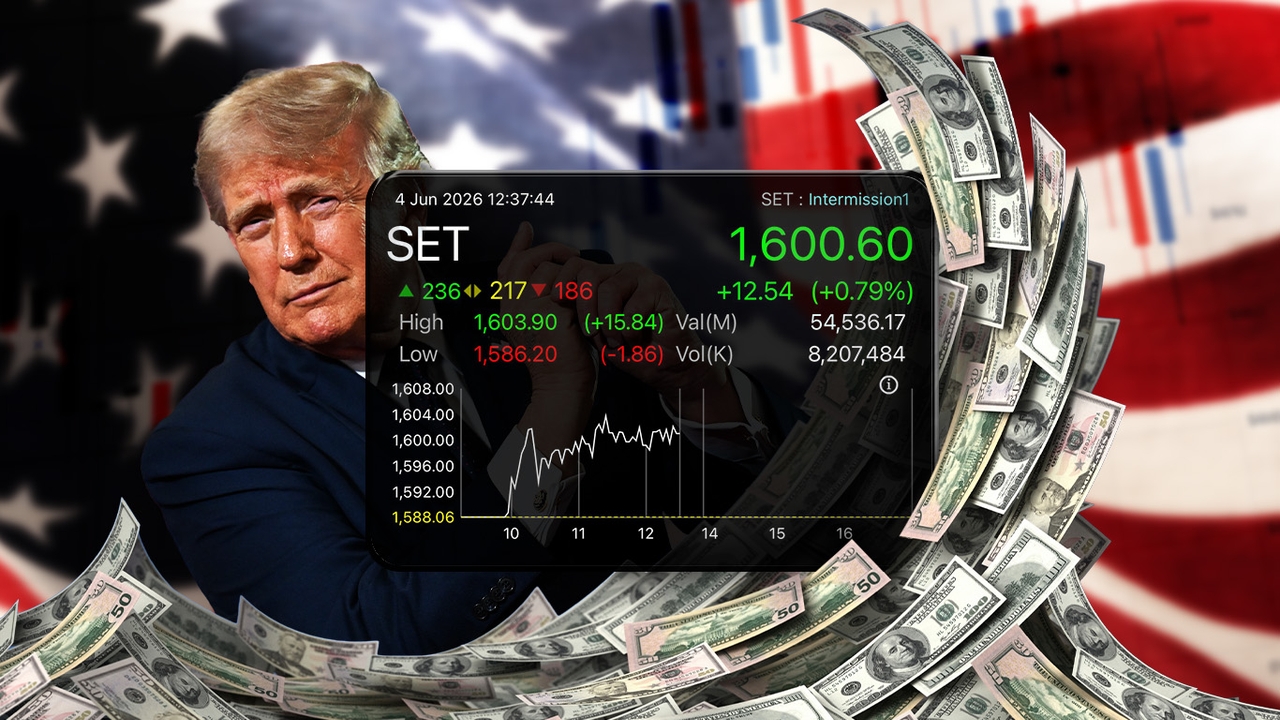
In early June 2026, the Thai stock market became a key destination for foreign capital (Fund Flow), ranking among the top in Asia for inflows. This contrasts with several regional countries such as Indonesia, India, South Korea, and Vietnam, which faced foreign investor sell-offs.
However, amid this positive atmosphere, a significant risk is drawing market attention: the US plan to implement a new set of import tariffs under Section 301 on 60 trading partner countries, including Thailand. This could directly impact Thailand's export-driven economy.
Analysts view that both the US import tariff risk and tensions in the Middle East may pressure Thailand's economic growth in the second half of 2026 and into 2027. The effects could extend to the financial performance of listed companies and the investment climate in the Thai stock market.
Section 301 is a provision under the Trade Act of 1974 that allows the US President to impose retaliatory measures on countries deemed to have unfair trade policies.
This time, Donald Trump chose this route after a US court struck down the previous Global Tariffs in February, prompting the administration to apply Section 301 while citing Forced Labor concerns as justification for imposing tariffs on 60 trading partner countries.
The tariff rates are divided into two main groups.
Certain products are exempt, including specific food and agricultural goods, aircraft parts, and rare earth minerals, to limit inflationary effects in the US.
Regarding the timeline, the public comment period for these measures closes on 6 July 2026, followed by a public hearing on 7 July. The tariffs are expected to be enforced within a few months thereafter, giving Thai exporters limited preparation time.
This issue is especially critical for Thailand because its economy heavily relies on exports, with the combined value of goods and services exports accounting for approximately 65-70% of GDP, higher than many ASEAN countries.
This means that any impact on the export sector could significantly ripple through the overall economy.
Moreover, the US is Thailand’s largest export market, representing about 21.4% of total export value. According to the US Trade Representative (USTR), in 2025 the US imported $91.3 billion worth of goods from Thailand, a rise of over 44% from the previous year.
Despite tariff concerns, the Thai capital market remains robust, with net foreign purchases accumulating to $933.3 million (around 30 billion baht) since the start of 2026, marking the strongest inflows in the region.
This pushed the SET Index to hit its highest level of the year, closing at 1,588.06 points on 2 June 2026, up 328.39 points or +26.07%. The positive momentum continued into the morning session, with the index breaking above 1,600 points during trading.
However, research from Asia Plus Securities Co., Ltd. assesses that environmental factors could pressure the stock market. Investors should monitor three key risks: Middle East tensions, domestic inflationary pressures, and the Section 301 tariff risks potentially impacting Thailand's export sector.
June could mark the beginning of a global Fund Flow Rotation, shifting investments from growth-focused assets, high-beta stocks, and non-yielding assets toward more stable investments.
Currently, attractive investment groups include:
This perspective reflects that investors are beginning to reduce portfolio risk and prioritize profit stability and dividend cash flows over chasing growth stocks amid ongoing global economic uncertainty.
For stock market and investment news, visit Thairath Money at
Follow the Facebook page: Thairath Money at this link