

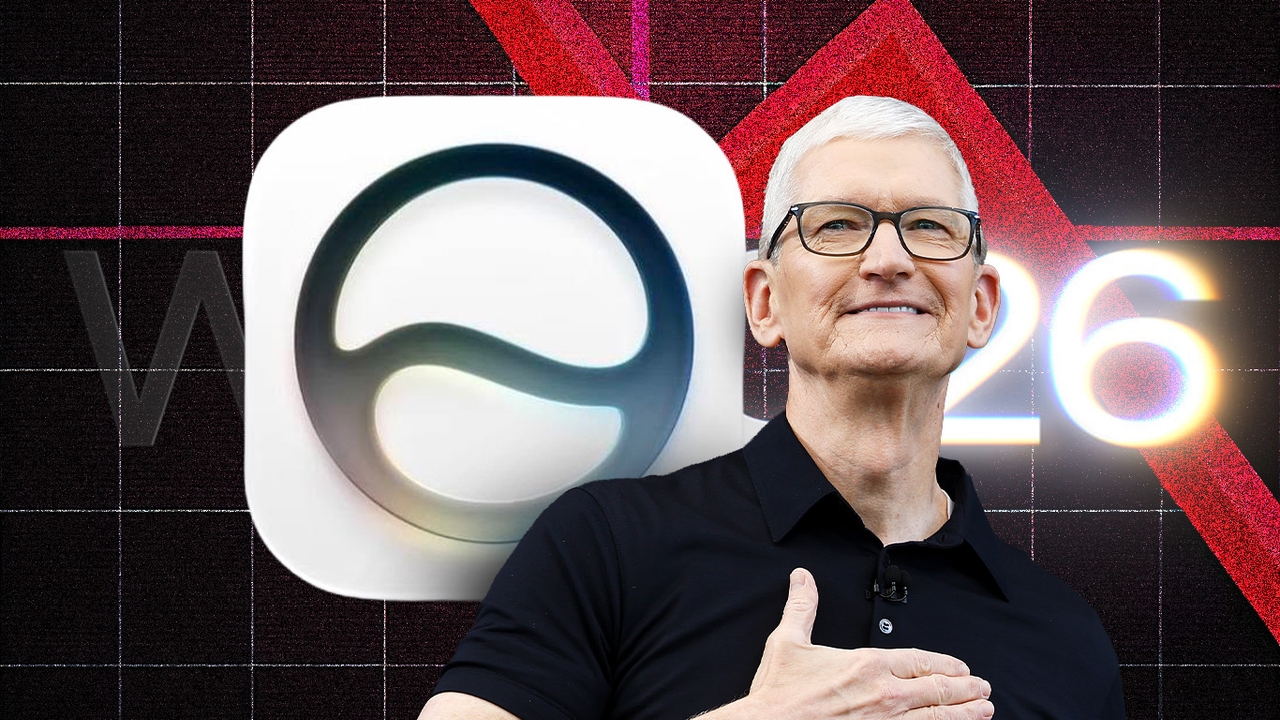
Last Monday night in Cupertino, Santa Clara, California, at Apple's headquarters, it was time for the company's major annual event, the Worldwide Developers Conference, or WWDC 2026. This year was special as Apple finally unveiled the AI product it had promised two years ago.
Although the reveal of Siri AI excited followers, Apple's shares fell 2% on Monday, marking the worst day in three weeks, as the company still could not confirm a firm launch date for Siri AI.
Over the past two years, since 2024 when Apple introduced Apple Intelligence and AI to the world, anticipation had built. But repeated delays have led investors, who were previously optimistic, to worry that Apple might fall behind its rapidly advancing AI competitors.
At this year's WWDC, many investors expected Apple to launch Siri AI by September. Apple's official website confirmed a Beta release by the end of this year, yet no definite schedule was given, and usage will be limited in some regions.

Siri has undergone a major overhaul for the first time in years, officially becoming Siri AI, powered by Apple Intelligence. This transition shifts Siri from a pre-programmed voice responder to an AI agent that understands context and deeply integrates with Apple's entire system.
Craig Federighi, Apple's software chief, revealed that Siri AI will work with Gemini, a foundational model developed closely in partnership with Google. Siri AI will leverage Gemini's technology for advanced reasoning and global knowledge.

Among Siri AI's highlighted features on stage is its ability to understand on-screen context—it can read what's displayed on the user's device and interpret their intent. It can also follow previous conversations and retrieve scattered details from various apps, such as extracting a friend's address from old messages even if not saved in contacts.
Moreover, Siri AI can handle multi-step tasks across different apps, like drafting emails or replying to messages mimicking the user's natural communication style.
Additionally, for the first time, Siri will have its own standalone app, which will sync data across iPhone, iPad, and Mac. This app will serve as a hub to review past conversations, track tasks, and utilize integrated writing tools.
However, Apple noted that Siri AI has certain limitations. Heavy users may need to pay for an upgrade to access unlimited high-capacity processing.
Furthermore, Siri AI will launch in an English-only Beta version by year-end, but due to regulatory hurdles, it won't initially be available on iOS/iPadOS in the European Union and is entirely banned in China.
Apple's main AI strategy for the next era is to fully integrate Apple Intelligence across all systems—a systemic integration to enable seamless cross-device experiences within its ecosystem.
Besides Siri AI's cross-app capabilities, Apple has integrated Apple Intelligence into various systems, including

Apple also upgraded Liquid Glass, renaming the next Mac software version to macOS Golden Gate. Security enhancements include the default 'Ask to Browse' feature, requiring children to request parental permission before visiting new websites. Additionally, violent or gory images and videos are automatically blurred by default.
Besides unveiling new Apple products, this WWDC marks the last for Tim Cook, Apple's CEO, whose term ends this September, with John Ternus set to succeed him as CEO.
On stage, Tim Cook spoke of the developer community powering Apple's ecosystem: “Over the years, you have helped people connect, create, learn, and experience the world in incredible new ways.”
“With the amazing capabilities we've unveiled today, and much more to come, I truly believe the best is yet to come.”
“For Apple, creating the best products in the world to deliver experiences that enrich people's lives has always been our guiding compass,” Cook said.
He concluded by calling his time at Apple the “greatest honor of my life.”
Follow the Facebook page: Thairath Money at this link -https://www.facebook.com/ThairathMoney