

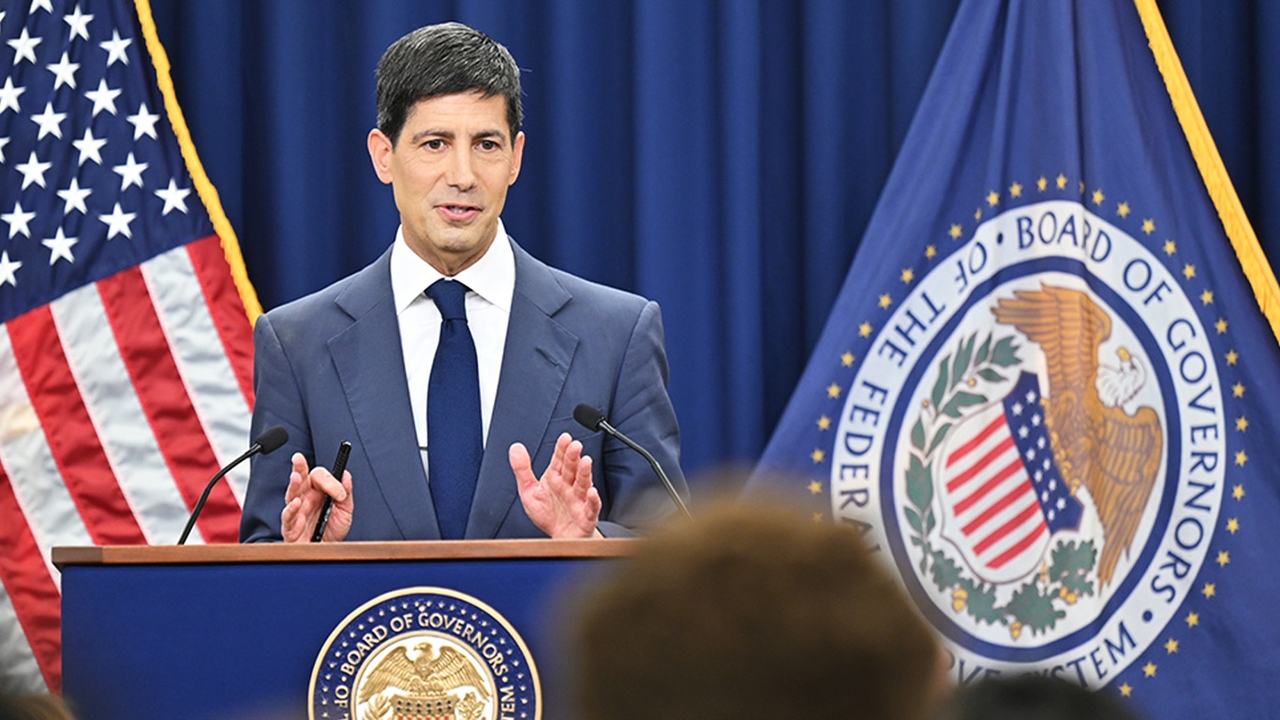
Investors closely monitored the latest Federal Reserve (Fed) meeting on 16-17 June 2026, where the Fed unanimously voted 12-0 to keep the policy interest rate unchanged at 3.50%-3.75%. While this outcome aligned with market expectations, the first meeting under new Fed Chair Kevin Warsh brought several interesting changes. What are the key points we need to know?
Although the Fed maintained the interest rate at 3.50%-3.75% for the fourth consecutive time this year, it lowered the U.S. GDP forecast for 2026 to 2.2% from the prior 2.4%, and revised the unemployment rate forecast down to 4.3% from 4.4%. However, it raised the Core PCE inflation forecast to 3.3% from 2.7%.
A crucial point for investors is the Fed Dot Plot, which reflects the views of the 18 Fed officials on the future path of policy rates. Their opinions break down as follows:
Meanwhile, the median of the Dot Plot rose to 3.8% from about 3.4%, indicating the Fed's continued focus on inflation control and a more hawkish tilt.
Dr. Jitipol Pruksamethanun, Chief Product Officer at Finansia Syrus Securities Public Company Limited, explained that Kevin Warsh's statement introduced several new dimensions. For example, Warsh chose not to submit his own Dot Plot and suggested reconsidering whether the Dot Plot remains useful. He also changed the Statement wording to signal that he does not want the market to trade Fed words as before, where the Fed previously gave advance indications of its thinking.
At the same time, the prospect of rate cuts in 2026 has faded, as the market increasingly anticipates rate hikes within the year. This new stance may reflect a turning point for the Fed going forward.
According to InnovestX, U.S. stock markets closed sharply lower, with the Dow Jones down about 1%, the S&P 500 dropping 1.2%, and the Nasdaq falling roughly 1.3%. Although the Fed held rates steady, it signaled readiness to raise rates further in 2026 to curb inflation, leading investors to anticipate possible rate hikes as early as September to October 2026. Meanwhile, the U.S. dollar showed signs of strengthening in line with the rising interest rate trend.
In the U.S. Treasury bond market, yields rose sharply, with the 2-year government bond yield climbing to around 4.19%, reflecting the Fed’s hawkish signals. Half of the FOMC members still expect at least one rate hike in 2026.
Oil prices for Brent and WTI rose slightly after Iran and Israel agreed to a temporary ceasefire at U.S. President Donald Trump's request. However, the market remains cautious about geopolitical risks, as the ceasefire may not be permanent and uncertainty persists over the reopening of the Strait of Hormuz, a key global oil shipping route. Meanwhile, crude oil inventories at the Cushing storage in Oklahoma declined for the eighth consecutive week to about 20 million barrels, near the low operational levels considered by traders, supporting oil prices.
Regarding gold prices, Hua Seng Heng Group noted that global gold prices declined due to a rising U.S. dollar index (DXY) and higher 10-year U.S. Treasury yields. In the short term, gold prices may pull back after the Fed signaled tighter policy. Support levels are at $4,260 and $4,220 per ounce, with resistance at $4,360-$4,370 per ounce. They recommend gradually buying some gold at $4,220 per ounce. Thai gold prices stand around 65,800 baht per baht-weight.
"Hawkish" derives from the word "hawk." In economics, hawkish policies prioritize controlling inflation over stimulating the economy by Finnomena summarizes that hawkish views reflect concern about accelerating inflation in the future and favor contractionary monetary policy methods such as
Going forward, it will be important to monitor how the Fed adjusts its communication and economic outlook, which investors must follow closely for any changes.
ReferencesFederal Reserve,InnovestX, Hua Seng Heng Group, Finansia Syrus,Finnomena
For stock and investment news, visit Thairath Money athttps://www.thairath.co.th/money/investment
Follow the Facebook page: Thairath Money at this linkhttps://www.facebook.com/ThairathMoney