

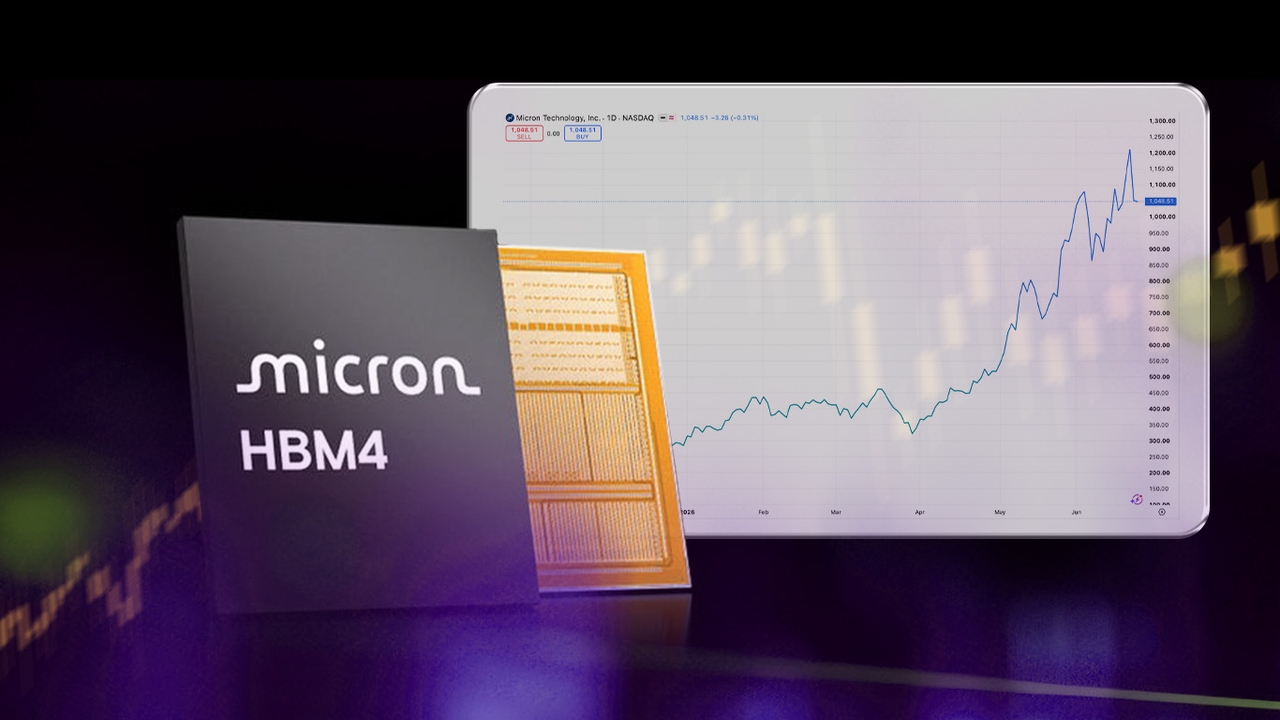
When discussing the biggest winners from the AI wave, Nvidia is often the first name investors worldwide think of. However, Wall Street is now focusing on a new fast-growing winner: Micron Technology, a major US memory chip manufacturer whose stock price has surged over 700% in the past 12 months, pushing its market capitalization beyond $1 trillion.

Recently, Micron reported its fiscal 2026 third-quarter results ending 28 May 2026, posting record-breaking figures almost across the board. This marks Micron’s transformation from a traditional memory chip maker subject to semiconductor industry cycles into one of the most crucial companies underpinning the global AI infrastructure.
The company’s revenue reached $41.46 billion, up from $9.3 billion in the same period last year—more than quadrupling and significantly exceeding analyst expectations. GAAP net income soared to $28.24 billion, or $24.67 per share, while Non-GAAP net income was $28.86 billion, or $25.11 per share.
Operating cash flow rose to $25.39 billion from just $4.61 billion the previous year. At quarter-end, Micron held cash and liquid assets totaling over $30.2 billion. Following the earnings announcement, Micron’s stock jumped 15.8% in after-hours trading to approximately $1,213.97.
What surprised the market most was Micron's record-high profitability. The company reported a gross margin of 84.9%, up from 39% last year, exceeding nearly all major tech peers. This margin surpasses Nvidia’s approximately 75% and Meta’s roughly 82% gross margins.
In this quarter, Micron’s main revenue driver was its Cloud Memory and Data Center businesses, which together accounted for over 60% of total revenue, approximately $25 billion. This indicates Micron has evolved into an AI data center-driven company rather than one focused on mobile or PC markets. Its standout product, the HBM4 high-performance memory for AI chips, has begun commercial shipments and is a key growth driver this year.

For a company once viewed as operating in a commodity business competing on price, reaching this level of profitability marks a major shift for the memory industry.
A key reason Micron emerged as a global capital markets star is the structural transformation within the AI industry.
In AI’s early phase, the market focused on Nvidia’s GPUs as the main processors for training and running AI models. However, as AI models grew larger and required massive data processing, demand for high-bandwidth memory (HBM) surged dramatically.
AI chips from Nvidia, AMD, Google, as well as data center servers worldwide, rely on memory from only a few manufacturers—Micron is one of them. Consequently, global production capacity is nearly fully utilized while demand continues rising, causing memory prices to spike sharply.
Although this situation has made memory the "new bottleneck" in the AI industry, as many reports have noted, it has simultaneously elevated Micron from a behind-the-scenes component maker to a critical resource holder essential to major customers worldwide.
Another important change capturing investors’ attention is Micron’s shift in business model. The company disclosed signing 16 Strategic Customer Agreements (SCAs) with clients, including data center providers, automakers, and major industrial customers.
These contracts span 3 to 5 years with commitments to pre-agreed purchase volumes, totaling over $22 billion. Micron expects that once fully implemented, at least half of its revenue will come from these long-term agreements—a significant change for the memory industry, which has traditionally faced volatile pricing cycles driven by economic and supply-demand fluctuations.
Major customers are now willing to enter long-term contracts and lock in prices to secure sufficient memory for future AI development. These clients include leading global AI firms such as Nvidia, AMD, and Google, who are rapidly building AI data centers worldwide and require vast quantities of DRAM and SSDs, as well as major cloud providers like Microsoft, Amazon, and Meta.
Customers agree to lock volumes and prices upfront because they believe memory shortages for AI will persist for years. They view memory increasingly like Nvidia’s GPUs—as a resource that must be procured in large quantities rather than a commodity component.
Sanjay Mehrotra, Chairman and CEO of Micron, stated that the strong earnings and improved outlook for the next quarter reflect the strategic value of memory in the AI era. The company is investing at unprecedented levels in technology, products, and capacity to meet rapidly growing customer demand.
From an investor perspective, Micron has become Wall Street’s new favorite stock after being overlooked for decades. The market now recognizes that AI creates winners beyond GPU makers, with new leaders emerging across the critical supply chain. Micron is being valued as one of the most essential infrastructures in the AI economy.
. Sources: Micron , CNBC [1] , [2]
Follow the Facebook page: Thairath Money at this link -