

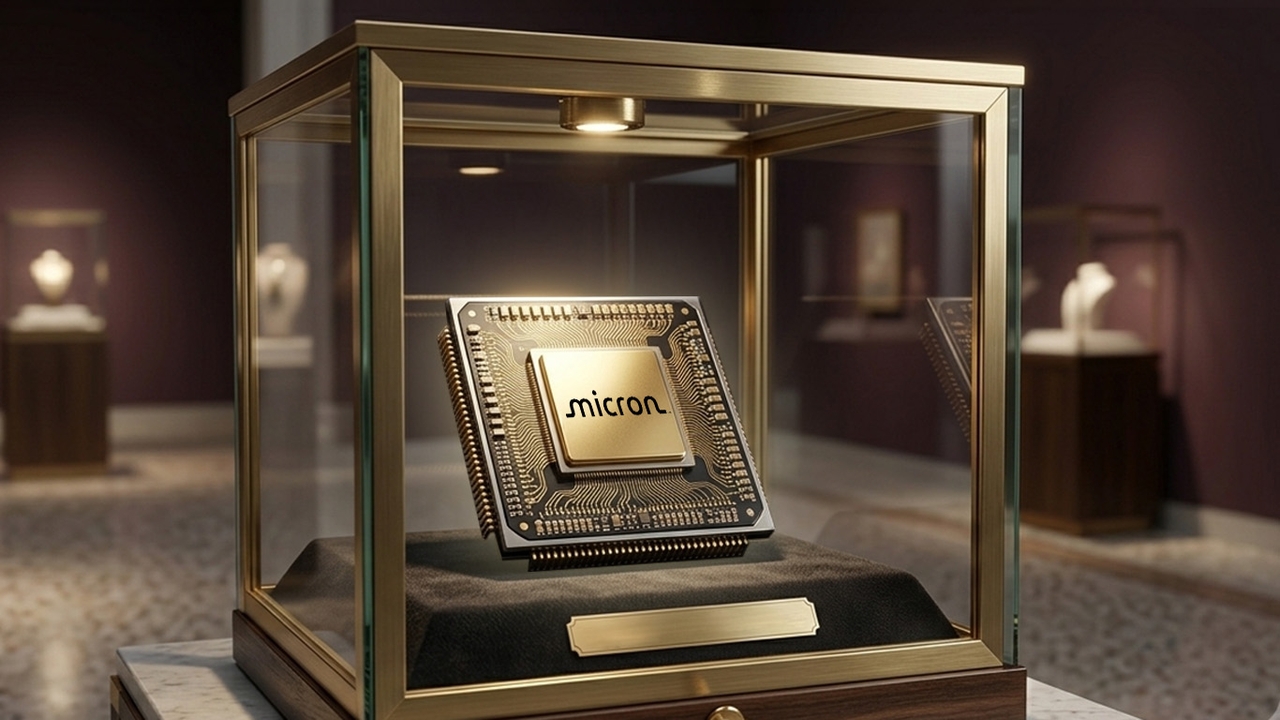
Previously, the AI trend led global investors to focus on processor chip makers, particularly GPU producers like Nvidia, which became one of the world's most valuable companies because GPUs are considered the "brain" used to train and process AI models.
However, that picture is rapidly changing as "memory chips" or Memory have risen to become another essential component in modern AI systems. As AI models grow larger and more complex, the demand for high-speed memory increases accordingly, becoming a new bottleneck in the semiconductor industry and directly benefiting memory chip manufacturers from AI growth.
This shift is transforming Micron Technology, a leading U.S. memory chip maker, which was once seen merely as a "cyclical stock" with earnings fluctuating based on market supply and demand, into a new Wall Street star. Its share price has surged dramatically, and many analysts now call it the "next Nvidia."
Historically, the DRAM (Dynamic Random-Access Memory) and NAND flash memory chip business was considered cyclical, with profitability depending on market supply and demand. When prices were high, producers invested heavily in new factories, but increased capacity often led to oversupply and price drops. However, the arrival of Generative AI has fundamentally altered the industry's structure.
A key component, the "AI server," now requires many times more memory than typical computers, especially High Bandwidth Memory (HBM), a high-speed memory working alongside GPUs to train and process large AI models. As AI models increase in parameters, memory requirements grow correspondingly.
This demand mainly comes from major cloud service providers like Microsoft, Amazon Web Services (AWS), Google, Meta, Oracle, and Nvidia, all rapidly expanding their AI data centers.
Consequently, memory chips, particularly HBM, are almost entirely pre-ordered. PC makers like Dell and HP, along with other electronics manufacturers, are stockpiling inventory to mitigate supply risks. Recently, Apple raised product prices because it can no longer absorb rising hardware costs.
Some analysts have termed this situation"RAMageddon"—a memory shortage crisis expected to last until 2027, causing increased costs for many electronics products.
The rising demand for HBM, a critical component in new AI chips, is driven mainly by Nvidia's extensive use of HBM with its advanced GPUs. Building new DRAM and HBM factories requires years and tens of billions of dollars in investment, preventing rapid supply increases despite soaring demand.
This situation benefits memory chip producers, especially the few HBM manufacturers globally, led by Samsung Electronics, SK hynix, and Micron.
This buzz follows Micron's latest quarterly earnings report, which exceeded expectations with revenues quadrupling year-over-year and net profits soaring. The company also projected a strong business outlook driven by memory chip demand, causing its stock price to surge over 236% within one month and pushing its market capitalization past one trillion U.S. dollars, rivaling major tech giants like Meta and Tesla during trading.
More importantly, investors see Micron differently from past memory producers—not just due to profit growth but because of a changing business model. The company disclosed signing 16 Strategic Customer Agreements (SCAs) with major clients across data centers, consumer, and automotive sectors, including key customers like Nvidia and Anthropic.
Analysts agree that chip demand is growing faster than the industry's capacity to expand. Moreover, long-term contracts with major customers increase revenue certainty, reduce market price volatility, and offer the potential for sustainable profit growth.
However, despite investor confidence making Micron one of the hottest AI stocks this year, a key question remains. The memory industry remains cyclical; if major producers ramp up capacity significantly or AI data center investments slow, chip prices could decline again.
Meanwhile, many view positively that AI investment trends are shifting. Capital is no longer flowing into large tech giants heavily investing in AI but is turning toward companies that are "equipment suppliers" to the AI industry.
This is evident from the combined market value loss of about $2.3 trillion among the "Magnificent Seven" in June. Conversely, the companies with the largest stock gains are often the opposite of the Magnificent Seven, being key component makers such as memory chip and networking equipment producers led by Micron and Sandisk, as well as semiconductor manufacturers like Intel, Marvell Technology, and AMD, which delivered the best returns in the second quarter.
Wall Street's bet may not be solely on short-term earnings but also on the belief that AI has transformed "memory" from a mere commodity into indispensable infrastructure for the AI era.
If this hypothesis holds, Micron may no longer be just a memory chip maker but one of the biggest beneficiaries of the AI revolution after Nvidia, explaining why many investors now refer to it asthe "Next Nvidia."
Source: CNBC [1] [2] [3] , Techcrunch , Yahoo Finance
Follow the Facebook page: Thairath Money at this link -