

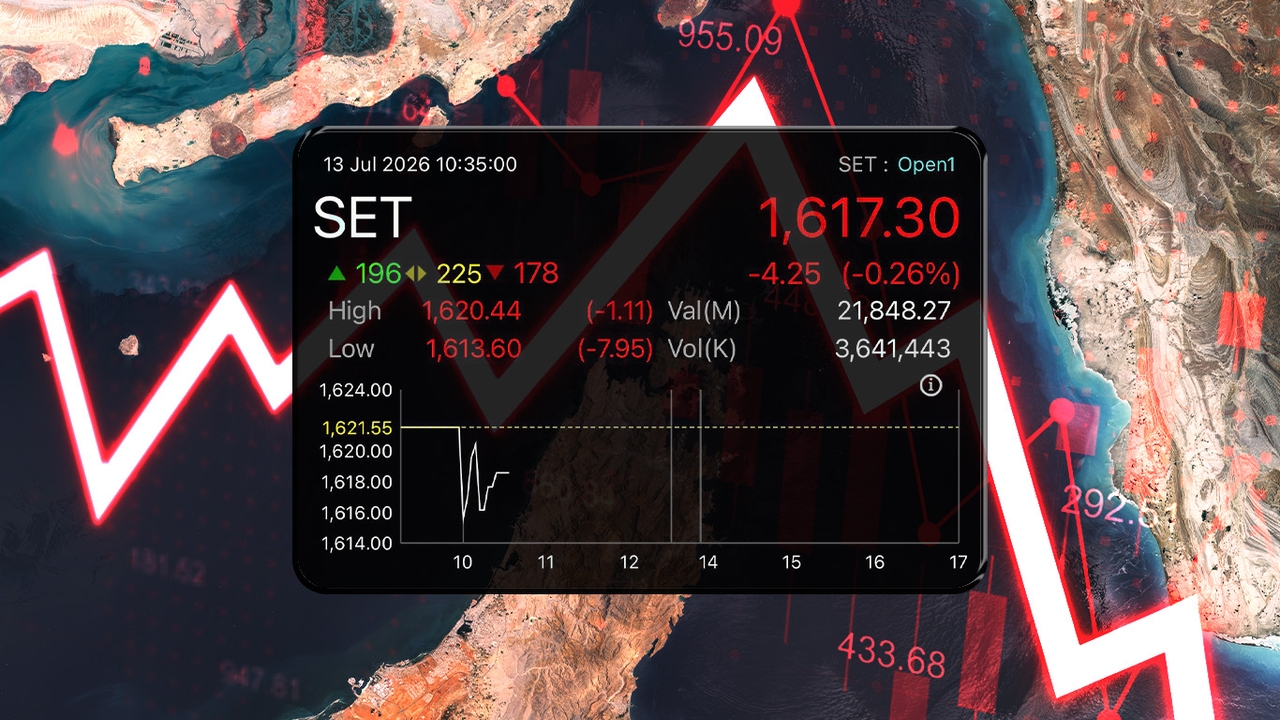
Unrest in the Middle East has flared up again following a rapid escalation of conflict between the U.S. and Iran. Airstrikes, missile retaliations, and news of the "closure of the Strait of Hormuz" have immediately caused global stock markets to fluctuate.
This morning at 10:35 a.m., the Thai stock index stood at 1,617.30 points, down 4.25 points or -0.26% from the previous day, mirroring declines in Asian markets such as Japan (-1.83%), Hong Kong (-0.25%), and South Korea (-7.19%).
Investors' concerns extend beyond geopolitical risks to the impact on "energy prices" and ultimately "inflation," which may become a renewed problem.
Although it remains unclear whether the conflict will drag on or end through negotiations, the market is currently reflecting a forward-looking risk assessment.
If oil prices remain high, central banks worldwide may need to keep interest rates higher than previously expected, which explains why any developments around the Strait of Hormuz become major news investors should not overlook.
The focal point of concern is the Strait of Hormuz, a vital oil transport route accounting for about 20% of global crude oil shipments. Although Iran has announced the closure and insists on using this measure to pressure the U.S.,
the U.S. military maintains that commercial navigation can continue under military protection, making the current situation neither a definitive "closure" nor "opening," which adds uncertainty to the global energy market.
Tensions have increased due to military retaliation from both sides. Despite signals of willingness to negotiate, the clashes have led the market to weigh "oil supply risks" more heavily than hopes for peace.
For investors, the concern is not only the closure of the Strait of Hormuz but also how long oil prices will stay high. If energy prices remain elevated for an extended period, global production and transportation costs will gradually rise.
These increases will then feed into inflation, a key variable that the U.S. Federal Reserve and central banks worldwide consider when making monetary policy decisions.
This means that even if war does not directly disrupt oil supply, the mere uncertainty is enough for markets to start adjusting investment portfolios in advance.
Looking back at the Russia-Ukraine war in 2022, rapidly rising oil and natural gas prices pushed global inflation to its highest level in decades, forcing many central banks to raise interest rates sharply, which slowed the global economy.
The current situation may not be as severe, but the market is assessing similar possibilities: if the conflict drags on and damages energy infrastructure, oil prices may remain high.
This would make inflation hard to reduce and could delay interest rate cuts by central banks worldwide.
Research from Krungsri Securities sees that although Iran's announcement to close the Strait of Hormuz has pushed Brent crude prices up and caused global financial market volatility,
the broader outlook leans toward de-escalation rather than prolonged confrontation, as both the U.S. and Iran seek advantages before scheduled talks on July 14-15, which have not been canceled.
Therefore, the impact on the Thai stock market is expected to be limited because energy stocks make up about 20% of the market capitalization, helping support the index amid rising oil prices.
Meanwhile, foreign capital inflows continue to support Thai stocks, along with expectations for accelerated government investment through the Thailand Fast-pass project, which will drive stocks in industrial estates, power plants, construction, and communications sectors.
Short-term strategies recommend focusing on energy, refinery, and petrochemical stocks such as TOP, SPRC, SCC, PTTGC, PTT, and PTTEP for speculation, while banking stocks like KBANK and KTB, as well as insurance shares, also benefit from rising bond yields.
Dao Securities (Thailand) assesses that although tensions in the Middle East have re-escalated, this factor alone is insufficient to change the positive outlook for the Thai stock market.
This is supported by continued foreign capital inflows and clearer government investment plans after the Constitutional Court ruled that the 400 billion baht loan decree is constitutional.
Strategically, rising oil prices will benefit upstream energy and petrochemical stocks like PTTEP and PTTGC but will pressure sectors with high energy costs, including power plants, airlines, and energy-intensive industries.
Additionally, stocks that outperform the market this round are expected to be high-dividend groups, especially banks, along with PTT and PTTEP.
Research from Asia Plus Securities views that the escalation between the U.S. and Iran and uncertainties over navigation through the Strait of Hormuz are key factors pushing oil prices higher.
If the conflict prolongs and damages energy infrastructure, global inflation could decline more slowly than expected, forcing many central banks to maintain tight monetary policies, increasing pressure on risky assets worldwide.
However, the Thai stock market's strength lies in having energy and commodity stocks accounting for over one-third of market capitalization, which may limit the negative impact of rising oil prices compared to other countries.
Moreover, Thai stock valuations remain attractive compared to foreign markets, so investors are advised to focus on value plays, particularly in energy and petrochemical groups such as PTTEP, PTT, SPRC, BCP, TOP, PTTGC, and IVL.
Also, banking and insurance stocks like BBL, TTB, KBANK, BLA, and TLI are likely to benefit from potentially stable high interest rates and offer attractive dividend yields.
For stock and investment news, visit Thairath Money at
Follow the Facebook page: Thairath Money at this link