

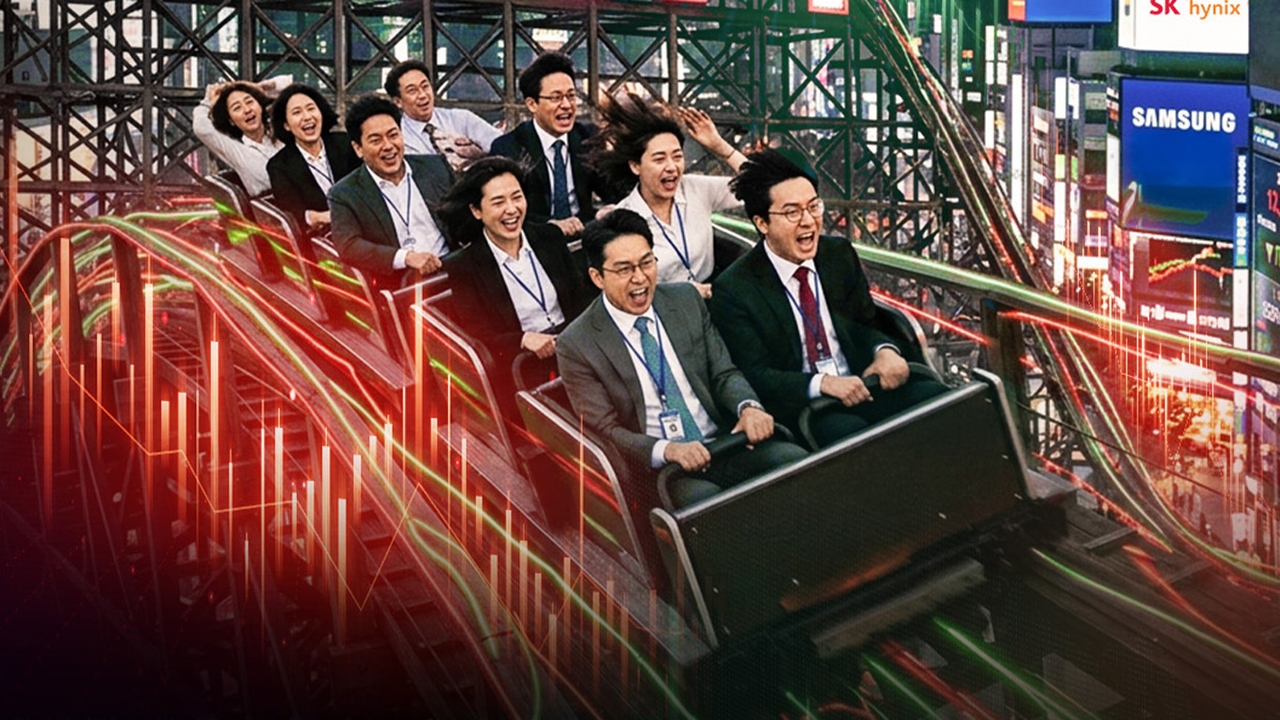
Just days before the rebound, South Korea's stock market faced heavy selling due to concerns that AI stocks were overvalued and high leverage use led to forced liquidations in semiconductor stocks, spreading to global markets. However, after better-than-expected earnings from U.S. tech firms, investor sentiment quickly shifted from worry to buying.
The Kospi index soared by 14%, the largest daily gain on record, while SK Hynix, the world's second-largest memory chip maker, experienced its strongest recovery ever. Samsung Electronics also showed notable gains.
However, this surge does not mean risks have passed; rather, it signals the market's entry into a "new era of volatility." Stock prices now move not only based on fundamentals but also on capital flows, leverage, and investor confidence, causing both positive and negative news to have amplified effects on the market.
Jung In-yoon, fund manager at Fibonacci Asset Management, said the recent recovery was not due to immediate changes in fundamentals but resulted from several concurrent factors: short covering, foreign investor re-entry, leveraged ETF portfolio adjustments, and new margin rules for leveraged ETFs effective in South Korea from 31 July.
He likened the recent market behavior to a "bipolar patient" rapidly switching from panic to exuberance overnight. While such gains may not continue consistently, the recovery could proceed if foreign capital keeps flowing after the short covering buying pressure eases.
Most analysts still believe the AI investment supercycle is ongoing, but the market's movement patterns have changed. Positive AI investment news can quickly drive stock gains, while minor negative news or concerns can trigger immediate selling, leading to what is called a Volatility Regime Shift.
In this environment, foreign capital flows, leverage use, and ETF movements have become key short-term market drivers, outweighing company fundamentals alone.
Analysts see concentrated risks mainly in markets benefiting most from the AI theme.
Though most analysts agree the AI investment cycle is far from over and see no signs that major tech firms will reduce spending on data centers or AI infrastructure, they warn future investment growth may not be as smooth as earlier stages of the AI trend.
Paul Gambles, co-founder of MBMG Family Office Group, stated the market may face several more episodes of severe volatility due to persistently high leverage and asset prices moving away from fundamentals. He cautioned that if investor confidence wavers again, the combination of high leverage, concentrated AI stock investments, and ETF movements could trigger another market correction.
Focus on "capital flows" over earnings figures
Following recent events, analysts believe the key short-term market variables are not just company earnings but also foreign capital flow direction, leverage levels, and ETF activity, which can intensify market swings in both directions.
The situation in South Korea illustrates that although the AI supercycle continues, the market is entering a phase where liquidity and market structure influence stock pricing as much as business fundamentals. Going forward, investors should track not only earnings but also capital flows, investor sentiment, and leverage levels since these factors may determine market direction faster than before.
Whether foreign capital will continue flowing into South Korean stocks after the short covering buying subsides remains critical. Sustained inflows could turn this recovery into a more durable uptrend, but if capital starts to exit, the market may revert to volatility.
Follow the Facebook page: Thairath Money at the following link -