

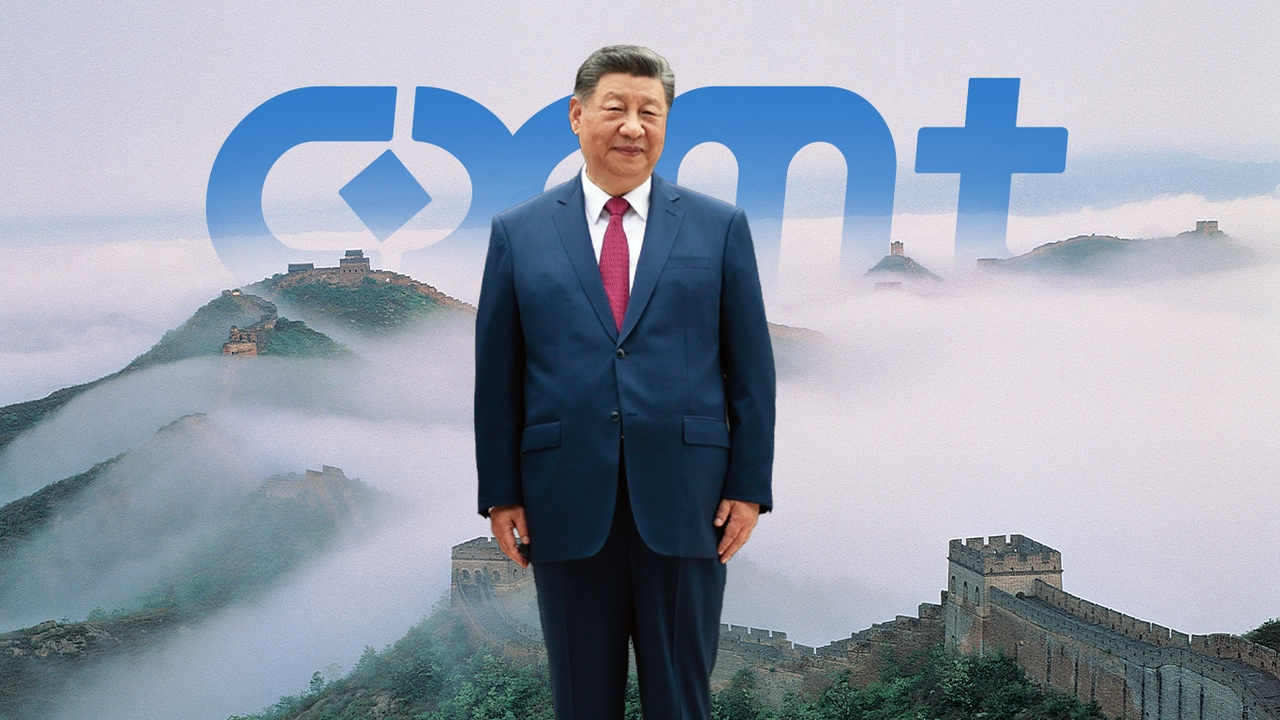
ChangXin Memory Technologies, or CXMT, a major Chinese memory chip manufacturer, exemplifies a business linked to AI. It was listed on the Shanghai Stock Exchange last month, sparking significant market interest as the largest IPO in Asia and becoming the highest-valued company in China.
Within just a few hours of its trading debut, CXMT’s stock price surged over 500%, making it the most valuable publicly traded company in mainland China, surpassing the Industrial and Commercial Bank of China (ICBC), a long-time leader in market capitalization.
This surge marks the peak of China’s major government efforts to mobilize capital from the stock and bond markets, collectively valued at around 28 trillion U.S. dollars, to support strategic national industries.
Chinese regulators have been speeding up IPO approvals continuously to allow strategically important companies, mostly in technology, to list and raise funds, while also expanding channels for these firms to issue bonds and raise capital.
When tech stocks plunged sharply in July, Chinese authorities intervened swiftly to restore investor confidence.
One of the U.S.’s key advantages in tech competition has been massive access to capital. China is now working to close this gap as AI becomes the most capital-intensive industry in history and a potential new economic engine as well as a critical factor for national security and military advantage.
According to Bloomberg, over the past two years Chinese tech companies have raised about 217 billion U.S. dollars through IPOs and bond issuance. However, this figure remains far behind the U.S., where tech firms have raised more than six times that amount, with Amazon and Alphabet playing major roles.
This shift represents a significant change in how China’s government supports strategic industries, which historically relied mainly on subsidies, tax benefits, and state investment rather than capital markets.
The new approach allows tech firms to tap into China’s household savings, totaling about 26 trillion U.S. dollars—the world’s largest pool of personal savings—while also benefiting from some of the world’s lowest borrowing costs.
China has demonstrated that a mix of government support plus high manufacturing capabilities can build globally competitive industries, as seen with the electric vehicle sector led by BYD.
However, AI competition is more complex, as the U.S. is trying to restrict China’s access to advanced chips. Chris Miller, a professor at Tufts University and author of "Chip War: The Fight for the World’s Most Critical Technology," noted that U.S. companies have historically had greater funding access, but financial costs are rising.
If Chinese firms can sustainably improve access to capital, it will become a major competitive advantage, even though AI processing costs in China remain significantly higher due to lower chip quality.
The Chinese government began preparing CXMT’s listing months ahead of trading by granting it preliminary review status, a pilot program reserved for strategically important companies.
This process allows regulators to address key issues before the formal IPO application, enabling CXMT to complete its IPO in less than eight months from filing to trading—a notably rapid pace compared to typical Chinese IPOs that can take years.
The IPO raised about 9.8 billion U.S. dollars, making it one of China’s largest share offerings in recent years.
However, CXMT’s IPO also highlights contradictions in China’s capital markets. Its stock closed the first trading day up 466%, indicating the initial offering price was set far below what the market was willing to pay.
China traditionally prices IPOs conservatively to minimize investor losses on new shares, but this can limit the amount companies raise compared to true market potential.
Compared to competitors like South Korea’s SK Hynix, which recently raised 26.5 billion U.S. dollars in the U.S., CXMT’s IPO proceeds remain significantly smaller.
Days before CXMT’s trading start, sell-offs in Chinese tech stocks pressured the investment climate and risked disrupting market momentum, prompting the government to implement one of the most comprehensive market support measures in years.
Regulators, state funds, and major investors acted swiftly to stabilize and restore confidence, reflecting a broader government strategy.
Since 2025, Chinese regulators have created more coordinated policy frameworks to support tech firms from early stages through growth, using tools including bank loans, bond issuance, capital markets, and long-term investments.
Key agencies behind these efforts include the People’s Bank of China (PBOC), the China Securities Regulatory Commission (CSRC), and the Ministry of Finance.
Bloomberg reports that if China’s economy slows in the second half of the year, the government is likely to use targeted monetary policies to support sectors like technological innovation rather than broad economic stimulus.
The Chinese government views a robust capital market as essential to technology strategy because household savings will flow into strategic industries only if investors believe their investments will yield returns—and investors now seem to be gaining that confidence.
The STAR 50 Index, comprising key tech and innovation companies, hit an all-time high in June and has risen about 30% this year, while the CSI 300 Index increased around 1.4%.
Several other Chinese tech companies, such as Z.AI and MiniMax, are preparing to list on the A-share market after having listed in Hong Kong.
Moonshot AI, owner of the Kimi K3 model that made waves in Silicon Valley, told investors it aims to go public within about six months, while DeepSeek is also laying the groundwork for its own IPO.
Hong Hao, Chief Investment Officer at Lotus Asset Management, said that in the U.S., major tech firms typically bear most AI infrastructure costs, but in China, if these investments do not come from the government, funding must ultimately come from the market.
The bond market story aligns with this trend, as China promotes issuance of green bonds and technology bonds, encouraging banks and investors to support tech and science firms and opening markets for companies new to bond issuance to raise more capital.
So far this year, Chinese tech companies have issued at least 38 billion U.S. dollars in bonds domestically and abroad—the highest level since 2016 for this period—though this represents only about 7% of the 578 billion U.S. dollars raised by U.S. tech firms in bonds, one-third of which came from Amazon, Alphabet, and SpaceX.
These capital market efforts occur as China tries to reduce debt reliance after years of debt-driven growth amid an economic slowdown and rising local government debt burdens, prompting policymakers to seek new industry funding methods beyond relying solely on public budgets.
One of China’s advantages over the U.S. is much lower funding costs. Large Chinese tech firms have bond interest costs averaging about 1.9% this year, over three percentage points lower than U.S. tech companies, a significant gap according to Bloomberg.
This partly reflects China’s lower interest rates and inflation. For example, Contemporary Amperex Technology (CATL), the world’s largest battery maker, issued five-year yuan bonds at just 1.58%, while South Korea’s LG Energy Solution must pay 5.25% on similar dollar bonds.
Zhu Lei, Head of Asian Fixed Income at Fidelity International, said these lower financial costs provide a meaningful competitive advantage, allowing Chinese tech firms to borrow more cheaply than many Western counterparts.
China also benefits from “patient capital,” long-term investment that does not seek quick returns, enabling more aggressive AI investment, capacity expansion, and R&D, with even smaller companies beginning to benefit from this approach.
Stock market investors are following government direction, shifting funds out of real estate, consumer stocks, and traditional industries that once drove China’s growth into chip makers and advanced technology firms.
Currently, tech stocks’ weighting in the CSI 300 Index has risen to nearly match financial stocks and has even surpassed them at times.
This clearly shows investor interest in tech is no longer focused solely on major markets like the U.S. China is rapidly mobilizing to close its gap, allocating massive capital to support the industry as a national strategy. For investors seeking insights on which superpower will win and create wealth, Chinese and U.S. investment experts will share their views at Money Fest 2026. Registration is available athttps://event.thairath.co.th/all/event/TREVENT017
However, analysts warn of risks amid this enthusiasm. Gary Tan, a fund manager at Allspring Global Investments, noted that CXMT trades at valuations much higher than other global memory chip makers, indicating short-term price movement may be driven more by government policy expectations and stock scarcity than business fundamentals.
Furthermore, massive capital injections into government-backed industries can lead to overcapacity, declining profit margins, and excessive investor interest in the same assets.
For example, the solar panel and electric vehicle industries, which have received continuous Chinese government support for years, ultimately faced fierce competition, excess capacity, and shrinking profits.
The key question is: will capital alone close the technology gap?
Hongxu Wei, Senior Economist at Anbound, an independent research institute, said, “Capital is a necessary condition but not sufficient.” Besides money, land, technology, and skilled personnel also represent forms of capital.
The real challenge lies in turning technological advances into commercially viable products and businesses.
However, China may not need to spend as much as the U.S. to achieve comparable results. Companies like DeepSeek and Moonshot AI claim they can develop competitive AI models at a fraction of Western tech firms’ costs.
UBS Group AG estimates that China’s AI model training costs are less than 10% of those used by global leaders like OpenAI and Anthropic, while average API prices for major Chinese AI models are under 20% of comparable global rivals.
This cost efficiency could become one of China’s most important advantages, allowing it to leverage large-scale manufacturing, integrated supply chains, and a vast talent pool to rapidly industrialize and deploy AI, rather than trying to out-innovate the U.S. in every aspect.
Source:Bloomberg
Follow the Facebook page: Thairath Money at https://www.facebook.com/ThairathMoney