

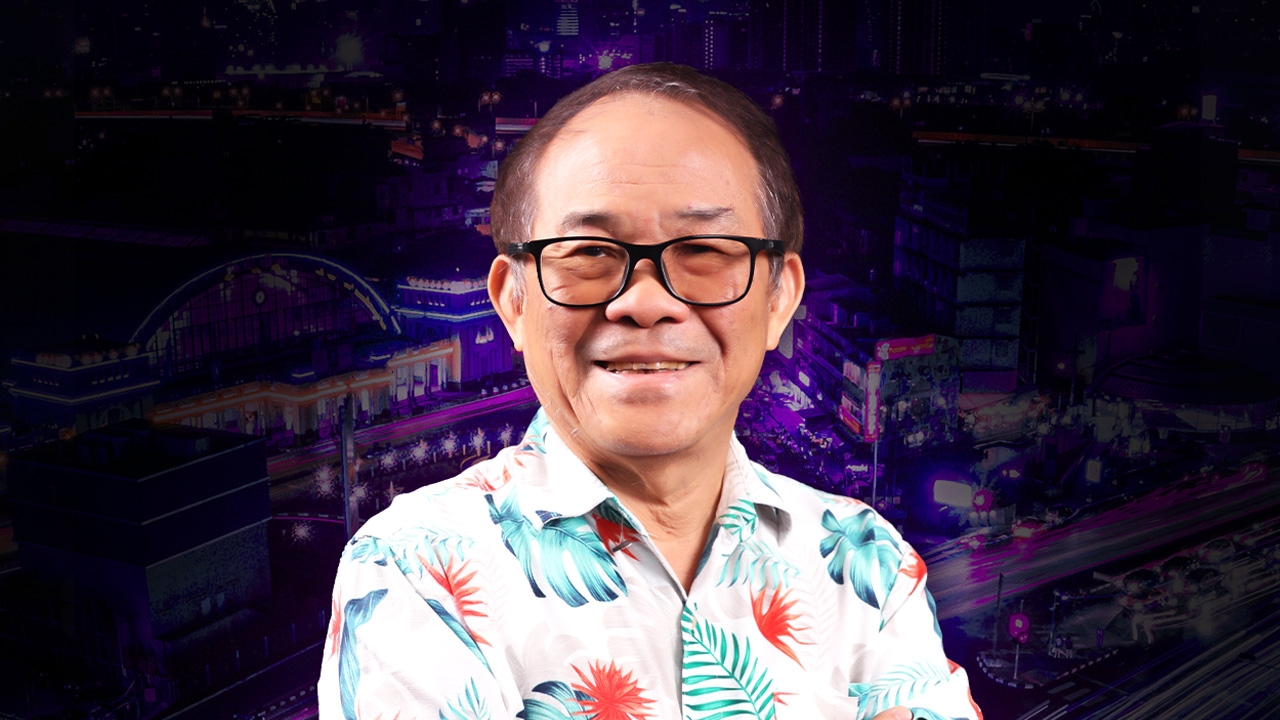
When thinking of value investors (VI), many might picture the legendary Warren Buffett. But in Thailand, many also think of the still-living legend, Dr. Nivesh Hemwachiravorakorn. He focuses on value investing and is among those who have long overcome market crises.
At his core, Dr. Nivesh underwent a major mindset shift, no longer seeing himself as a "stock trader" chasing daily price fluctuations but as a "business owner" who happens to use the stock market as a tool for capital allocation. This "business owner" perspective helped him endure severe market volatility since the late 1990s.
Amid widespread speculation seen as a "strategy" today, this man remains steadfast in Value Investing, becoming one of Thailand's earliest pioneers. He transformed economic crisis scars into more than 30 years of capital market lessons that serve as a blueprint for wealth today.
But before becoming the architect of a multi-billion-baht portfolio, this Thairath Money article in theHow to Make Moneycolumn looks back at Dr. Nivesh’s beginnings—from a boy with only determination to survive, to a man who embraces crises and uses them to build wealth worth billions, sharing four real-life lessons that go beyond finance and investing.
Looking back to the beginning, one thing Dr. Nivesh Hemwachiravorakorn always emphasizes is the saying, “We do not get to choose where we are born.” He often recounts that his life’s capital was unlike others’. Born in 1953 to a family of immigrants from China, they arrived in Thailand with nothing but a one-way boat ticket.
Dr. Nivesh was the youngest of three children. His parents worked daily labor jobs; if they didn’t work, there was no income. Yet the family never went hungry because relatives supported each other. Unlike his older siblings who had to work and could not attend school, only Dr. Nivesh had the chance to study, so he focused intensely on education.
He often shared that because he was small, he couldn’t work, so he was the only one to attend school. This opened doors for him beyond others, motivating him to study diligently. His excellence in math and science paved the way for further education that shaped his thinking to this day.
“Education is the biggest investment in life... It’s an investment of labor. We don’t need money... and no one can steal this asset.”Dr. Nivesh said.
For those born with little, dedicating oneself to learning is the highest-return path to success. Dr. Nivesh began at Wat Don School. Despite financial disadvantages, he used academic results to break social ceilings.
Because of his academic excellence, he passed the entrance exam to Wat Sutthiwararam School, then to Triam Udom Suksa School. His math skills and love for science helped him enter Chulalongkorn University’s Mechanical Engineering Faculty.
After graduating, Dr. Nivesh worked as an engineer but found the job limited to factory work with slow salary growth. Noting finance’s rapid income growth, he decided to pursue an MBA at the National Institute of Development Administration (NIDA).
He didn’t resign immediately but worked three days a week and studied three days, accepting half pay in exchange.
After completing his master’s, his ambition continued. He earned a PhD scholarship to study finance at the University of Mississippi in the U.S., returning to Thailand at age 32.
Upon return, Dr. Nivesh was financially empty, having spent all savings on education. He lived extremely frugally, even choosing to buy his wife’s wedding ring from a U.S. warehouse because it was cheaper than regular jewelry stores.
Back in Thailand, he worked in finance at the Industrial Finance Corporation of Thailand, a major financial institution. This job immersed him in the capital market, where he witnessed the first financial crisis, Black Monday, a historic global stock market crash.
In the following decade, he started investing steadily but conservatively with small savings, mainly to hedge risks. When he moved into investment banking, the Thai stock market soared, but he never recorded his investments, so he didn’t know whether he profited or lost during that period.
Ten years after Black Monday, in 1997, the financial market faced another crisis—the Asian Financial Crisis, or Tom Yum Kung Crisis. Just as he had begun saving, Dr. Nivesh lost his job unexpectedly at age 42. This was the first time he turned a crisis into opportunity.
With family responsibilities and children in school, he started “investing for life” with one lump sum amid a worsening economy and a plummeting Thai stock market. This marked the birth of his value investing approach.
He recalled that during that time, many panicked as the Thai stock market crashed heavily. Yet, within the temporary crisis, some companies still made profits and paid good dividends—some as high as 10% annually. That meant if you had 10 million baht, you’d receive 1 million in dividends yearly, and after expenses, still save several hundred thousand baht.
Dr. Nivesh went all in, choosing 6–7 stocks he considered quality, waiting for dividends. Starting with 10 million baht, he adhered to the principle of “buying without planning to sell.” One reason was that profitable businesses reinvested to grow and continued paying dividends, so he invested for long-term income. Another was that even good stocks were cheap, but buyers were scarce; sellers dominated.
Decades later, his returns grew over 400 times as the companies expanded and profits increased, boosting dividends. He always emphasized not to see investments as mere stocks. “When we invest, we’re not just buying stocks... we’re investing in businesses, buying a share of a business, then letting it operate.”
Dr. Nivesh has weathered four economic crises. In Thairath Money’s Money Secret EP.21, he said every crisis is an opportunity for long-term investors. Crises are good because quality stocks are sold off cheaply. Though portfolios may decline or grow slowly during crises, after recovery, they often grow rapidly.
Dr. Nivesh’s portfolio returns:
He added that to get rich from stocks requires two things: high expertise combined with timing and very good luck.“Only a tiny minority become rich enough to transform their lives through the stock market. The stock market isn’t a place where everyone can always get rich; there are times people become poorer too.”
“Even now, I’m still waiting for luck. The last few years have been bad—luck hasn’t come, but I’m still here.”Dr. Nivesh said.“Just be patient enough and wait properly, and luck will come by itself.”
Today, Dr. Nivesh continues to hold his long-accumulated portfolio following VI principles, focusing on three main markets to diversify risks:
Looking back, although Dr. Nivesh receives millions annually in dividends, after surviving the Tom Yum Kung Crisis, he returned to work, serving as a bank executive for several years before retiring at 51 to pursue what he loves.
His lifestyle contrasts sharply with his financial status; he dresses simply, lives modestly, and maintains frugal habits from childhood.
His thriftiness isn’t about deprivation but a philosophy that“Wealth does not always equal happiness.”Money may buy convenience or alleviate suffering from illness but cannot fulfill true happiness that comes from inner peace and family.
Dr. Nivesh sees that lavish spending doesn’t bring him as much joy as watching his investments grow. This simple life reflects strong financial discipline from his early savings and confirms that“True financial freedom is having enough money to live life on your own terms without chasing societal norms.”
Success has no fixed formula, but we can learn from those who succeed and adapt. If you want to decode the legendary VI’s path to beating the market and building wealth, meet Dr. Nivesh Hemwachiravorakorn at Money Fest 2026 on 12 September. Admission is free athttps://event.thairath.co.th/all/event/TREVENT017
Related articles:
Follow the Facebook page Thairath Money at this link -https://www.facebook.com/ThairathMoney