

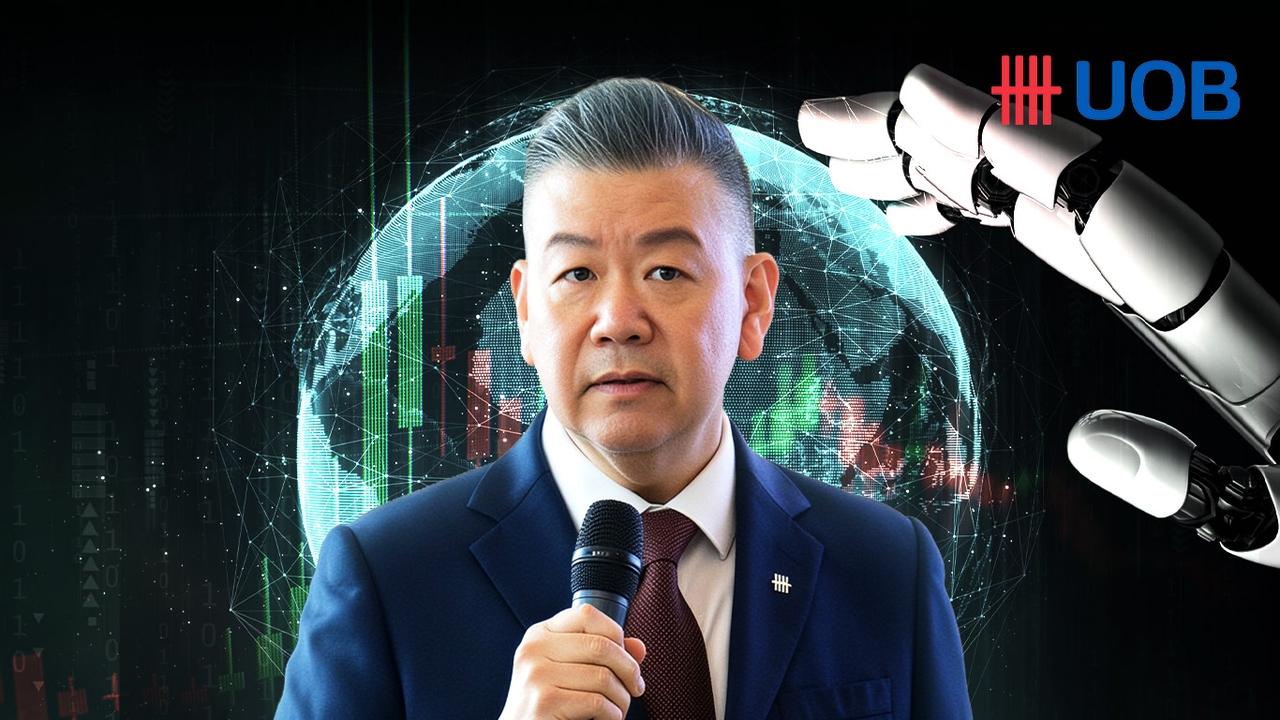
AI is no longer just about "technology stocks" but is expanding into the entire economic infrastructure, from chips and data centers to energy and systems that enable AI to advance.
This year may be when investors must choose carefully where the "next big money flow" will go.
Recently, UOB Thailand sees that despite ongoing global economic uncertainties, investment opportunities remain, especially from AI entering a phase of real revenue generation and genuine investment.
They maintain an overweight position in equities focusing on the US and emerging Asia, while advising greater caution in bonds amid persistently high inflation and the likelihood of sustained high interest rates.
Able Lim, Head of Deposit and Wealth Management at UOB Thailand, assesses that the US economy is likely to slow to 1.7% growth in 2026 but will still be supported strongly by a robust labor market and AI investment.
Meanwhile, US general inflation is expected to remain elevated at around 3.5% due to energy price pressures.
This will pressure the US Federal Reserve to maintain high policy interest rates throughout the year, with potential rate cuts only beginning in 2027.
To manage this interest rate environment, UOB recommends investors reduce bond average duration to 4–5 years to lessen long-term portfolio volatility.
China’s economy is forecast to grow about 4.6%, driven mainly by industry and exports, but the diverging trends between A-shares and H-shares indicate investors need a more nuanced view rather than treating China as a single entity.
Regarding Thailand’s economic outlook, UOB has raised its 2026 GDP growth forecast to 1.9% from a previous 1.5%, due to rapid gains from AI-driven growth and swift incoming trade demand.
Positive signs also come from the Board of Investment accelerating the conversion of approved foreign direct investment (FDI) into actual capital inflows supporting real investment in Thailand’s economy.
Additionally, the Ministry of Finance’s proactive policy to increase government expenditure from 22% to 30% of GDP will help sustain economic recovery effectively.
Able Lim confirms that the current AI technology boom is far from a bubble and cannot be compared to the dot-com crash of 2000.
A key difference is that during the dot-com era, only 14% of tech companies were truly profitable, whereas today, large cloud service providers—Hyperscalers—show clear net profits and tangible revenue streams.
Moreover, these tech giants reinvest real cash flow generated from their operations rather than relying on excessive borrowing or leverage, avoiding the debt burdens seen in the past.
He also notes that the AI cycle is transitioning from focusing solely on software and chip production to depending on actual infrastructure such as data centers, energy sources, and cooling systems.
Therefore, it is advised to use price corrections as buying opportunities in five asset groups that will strongly benefit in the long term:
For asset allocation in the second half of 2026, UOB recommends maintaining an overweight position in equities, focusing on quality companies with strong profits, especially US firms benefiting from AI infrastructure investments. They also continue to overweight emerging Asian stocks, with opportunities expanding from technology into other industries alongside profit recovery.
Regarding Chinese stocks, they advise a barbell strategy combining A-shares aligned with government innovation and new economy policies with attractively priced H-shares outside mainland China that have high recovery potential.
For other assets, UOB recommends a neutral stance on investment grade bonds, money markets, and gold, setting a long-term gold price target of $4,600 per ounce in Q1 2027 to enhance portfolio stability and risk management.
Read more about stocks and investments at Thairath Money.
Follow the Facebook page: Thairath Money at this link.