

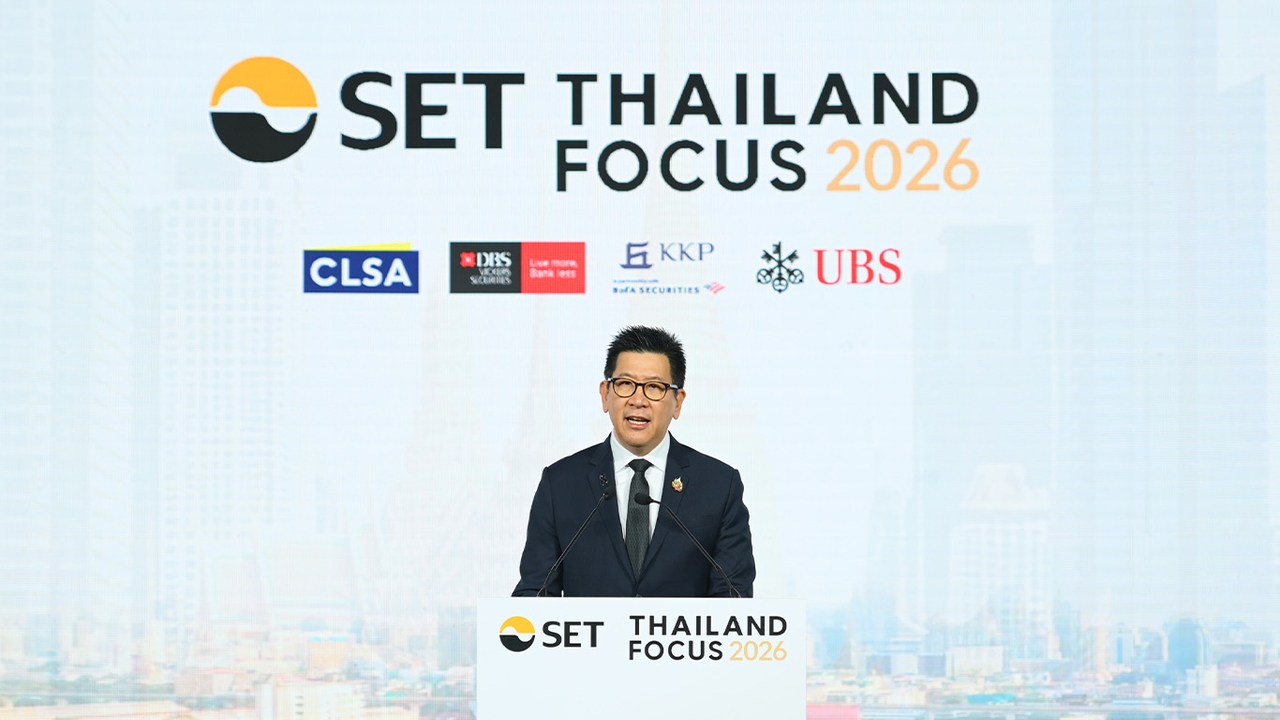
Dr. Akeniti Nitithanprapas, Deputy Prime Minister and Minister of Finance, delivered a vision statement at the THAILAND FOCUS 2026 forum under the theme "Reignite Thailand," unveiling plans to drive Thailand's economy amid global volatility and spark major investment momentum.
"Although I had commitments earlier this morning, due to the importance of the Stock Exchange of Thailand and the Thailand Focus event, I skipped lunch to come on stage here. I hope this effort pays off if it helps the stock market grow steadily until the SET index reaches 2,000 points within this year," Dr. Akeniti said.
Dr. Akeniti noted that the world is currently being reorganized by three main factors that inevitably impact the economy:
These major changes affect Thailand by exposing existing vulnerabilities, creating new investment opportunities, and necessitating a rethink of economic strategies.
Thailand's clear weakness is its dependence on imported energy, which, when global energy prices spike, directly affects living costs and pressures the current account, alongside a declining working-age population.
However, Thailand retains advantages as a "Trusted Connector"—neutral, strategically located, and maintaining good relations with all global stock markets and trade partners.
This is reflected in impressive figures from the first half of the year, with investment promotion applications (FDI) through the BOI soaring to 1.47 trillion baht (about 45 billion USD), a 37% increase from the previous year.
Actual investment under BOI-promoted projects exceeded 500 billion baht (approximately 15 billion USD), growing nearly 30% year-on-year.
Domestic private sector investment expanded nearly 14% in Q2, continuing double-digit growth from about 10% in Q1, marking the strongest expansion in over a decade.
The Ministry of Finance has framed economic policies to address short-term pressures alongside long-term structural reforms, dividing the policy framework into three interconnected strategic phases:
1. Stabilizing the present situation, focusing on helping households and small businesses overcome the energy crisis impact by shifting from blanket energy subsidies to targeted assistance measures,
such as the "Thai Chai Thai Plus" program and state welfare cards, alongside integrating AI technology into government applications to help small retailers analyze sales and manage accounts systematically, enhancing grassroots business capabilities long-term.
2. Transitioning to sustainability, aimed at reducing risks from energy import dependence through a proposed 12 billion USD loan bill submitted to Parliament to accelerate investments in renewable energy, eco-friendly infrastructure, clean transportation, and local green industries.
Additionally, this includes enabling direct power purchase agreements (Direct PPA) and granting third-party access to power transmission systems to meet clean energy demands from high-tech industries like semiconductors and AI data centers.
3. Investing for the future, with an ambitious goal to raise Thailand's investment rate from the current 20% of GDP to 30% within four years, to stimulate economic growth above 3% and elevate the country's competitiveness into the world's top 20.
The government will invest in key infrastructure to attract private sector co-investment through infrastructure funds and public-private partnerships.
Finally, Dr. Akeniti emphasized that a strong investment economy depends on an efficient capital market and outlined three main priorities for capital market reforms:
1. Expanding the long-term investor base, recently discussing with the SEC Secretary-General and Stock Exchange management to accelerate measures to increase long-term investments in the stock market, such as formalizing investment incentive regulations.
2. Attracting new-generation businesses to the capital market, advancing the "BOI to IPO" initiative as a funding source to support growth of technology companies and courting leading global firms met abroad to list on the Thai stock market.
3. Supporting listed companies, promoting the "Jump+" program to encourage listed companies to invest in innovation and efficiency to create long-term added value.
Moreover, the Cabinet recently approved draft laws to enhance corporate governance, disclosure, and market mechanisms for greater efficiency and transparency, building trust with foreign investors.
For stock market and investment news, visit Thairath Money at
Follow the Facebook page Thairath Money at this link: