

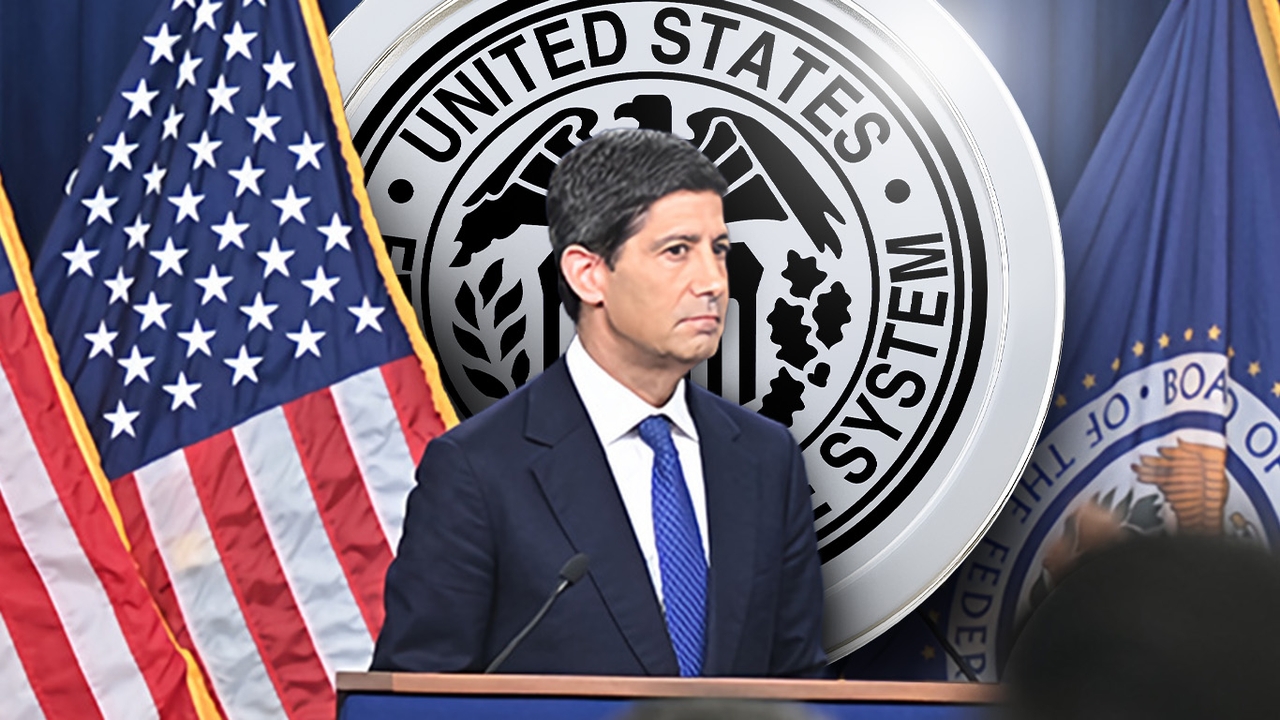
Global financial markets closely monitored the latest meeting on 16 Sep 2026, when the U.S. Federal Reserve raised interest rates by 0.25% to a range of 3.75 - 4.00%. Although this aligned with market expectations, it marked the first rate hike in over three years since July 2023 and was the initial increase under the leadership of the new Fed Chair, Kevin Warsh.
Poon Panichpiboon, Money and Capital Market Strategist at Krungthai GLOBAL MARKETS, Krungthai Bank (KTB) He summarized the global financial market movements following the Fed’s rate hike. On the stock side, U.S. markets faced pressure with the Dow Jones index declining 1.2%, the S&P 500 closing down 0.5%, and the Nasdaq Composite slipping 0.01%. In contrast, European stocks saw gains, with the STOXX600 index rising 0.5%.
Regarding bonds, the U.S. 10-year bond yield rose to 5.00% after the Fed’s expected rate hike and signaling readiness for further increases. The market continues to anticipate additional Fed hikes, estimating a possible 10-year U.S. bond break-even yield up to 5.30%.
In the currency market, the U.S. dollar strengthened, while the Thai baht is expected to depreciate mildly but remain within a limited range, forecasted between 33.25 and 33.50 baht per U.S. dollar today.
As for gold prices, the market's expectation that the Fed might raise rates more than indicated in the Dot Plot exerted downward pressure on gold. According to the Gold Traders Association, at market open, the gold bar selling price was 68,050 baht per baht-weight, down 350 baht from yesterday, and as of 10:42 a.m., the price stood at 67,950 baht per baht-weight.
Regarding global gold prices, Hua Seng Heng Group reported that global gold prices fell below resistance levels at $4,325 and $4,350 per ounce but remained above support at $4,230 per ounce. They assess that gold could rebound to retest previous resistance levels; however, if prices break below the next support at $4,200 per ounce, a further correction is likely. Falling below this point suggests a strategy to cut losses by selling.
Is the Fed ready for more rate hikes?
The Federal Open Market Committee (FOMC) unanimously voted 12-0 to raise the policy rate by 0.25% to 3.75 - 4.00%, amid strong economic expansion despite ongoing geopolitical uncertainties. Domestic spending continues to recover, with inflation targets at 2%. The Fed also raised its 2026 Core PCE inflation forecast to 3.4% and Headline PCE to 3.7%. U.S. GDP projections were increased to 2.3% for 2026 and 2.4% for 2027.
The market is focused on the Fed's signal that another rate hike may occur this year. The Dot Plot suggests the possibility of 1-2 hikes in 2027, despite political pressure from former President Donald Trump, who advocates for rates at or below 1%, often pushing for rate cuts.
Sittichai Duangrattanachaya, Chief Investment Strategist at InnovestX Securities views the Fed's upward revisions in GDP and inflation forecasts as an indication that the Fed believes there is room to raise rates without immediately harming the economy. However, this rate hike round may be more complex, as inflation is driven by energy prices and supply constraints, factors that higher rates cannot directly resolve. This raises the risk that the Fed may need to suppress economic demand more than usual to reduce inflation.
Regarding the S&P 500, he expects sideways to volatile movement over the next 1–3 months rather than an immediate broad rally. The market will likely favor companies delivering real profits, while stocks relying on valuation or long-term expectations face higher risk.
Four key factors to watch in the U.S. stock market are:
Data sources: Krungthai, InnovestX, Finnomena, Hua Seng Heng, Gold Traders Association.
For stock and investment news, visit Thairath Money athttps://www.thairath.co.th/money/investment
Follow the Facebook page Thairath Money at this linkhttps://www.facebook.com/ThairathMoney