

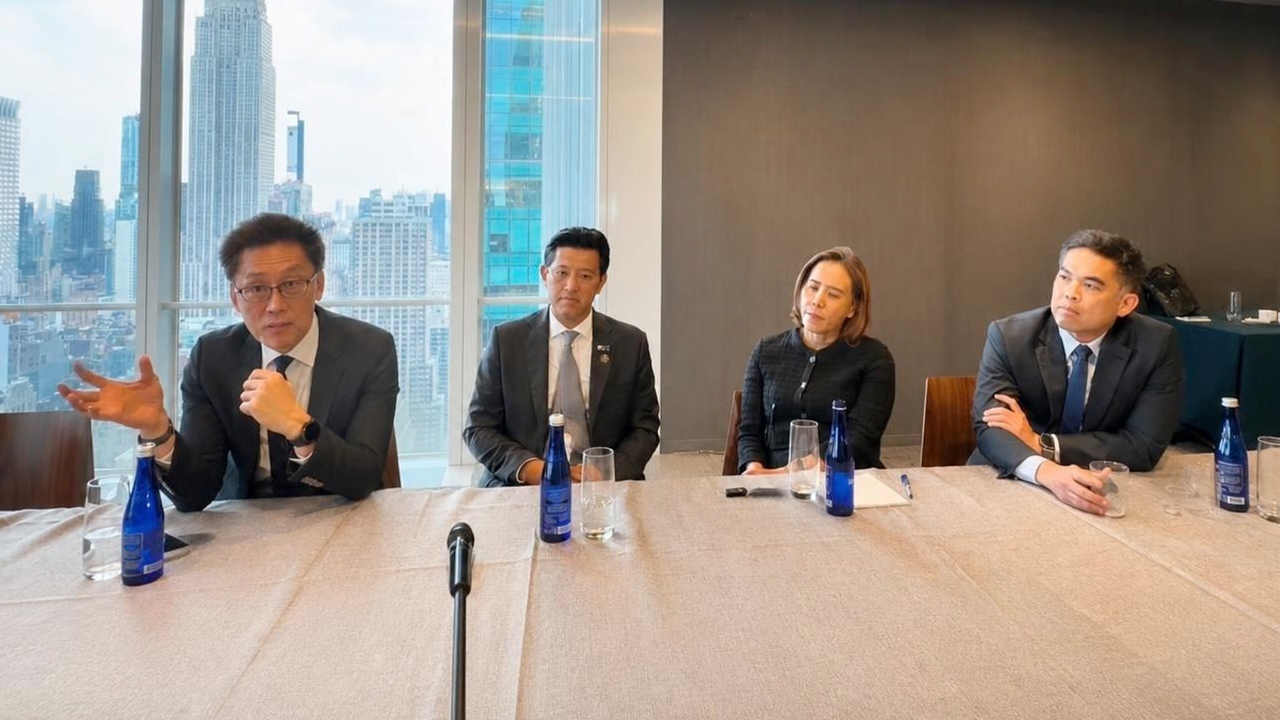
Yesterday (22 Sep 2026), local time in New York City, capital market executives traveling with Prime Minister Anutin Charnvirakul, who is also Minister of Interior, briefed reporters on meetings with executives from PIMCO, Bank of America, and 25 institutional investors managing over $40 trillion in assets worldwide.
Orkanya Pibultham, Country Head of Bank of America (BofA) Thailand branch, said despite limited preparation time, the roadshow attracted nearly all major global funds such as BlackRock, Blackstone, Citadel, and Fidelity, demonstrating strong institutional investor interest in Thailand.
Participants in the roadshow were mostly top executives, including one-on-one meetings with PIMCO, one of the world's largest bond funds managing over $2.5 trillion in assets. PIMCO CEO Manny Roman attended in person. PIMCO expressed interest in investing in Thai Data Centers through loans or bond investments and showed interest if the Thai government issued U.S. dollar-denominated bonds. Additionally, senior executives from tech giant Microsoft met with the Prime Minister, reflecting broad global investor interest in Thailand.
"PIMCO shared that while the U.S. economy accounts for about 25% of global GDP, global funds allocate 70–80% of investments there. PIMCO is therefore seeking opportunities outside the U.S. Given Europe's weak market, Asia including Thailand is attractive, especially if capital flows out of the U.S. long-term to seek new investments," Orkanya said.
, Assadej Kongsiri, Director and CEO of the Stock Exchange of Thailand (SET), said the Prime Minister presented the ambitious goal of advancing Thailand from a middle-income to a high-income country by 2037, highlighting projects like JUMP+ and BOI to IPO to attract new S-Curve industries into the capital market. On U.S.-China relations, the delegation clarified Thailand maintains balanced neutrality, which investors see as a key opportunity amid geopolitical volatility. They also proposed transitioning to renewable energy and smart grids to support Data Center energy demands. Meanwhile, SET is cooperating with BOI and the SEC to revise regulations supporting fundraising for new economy businesses.
Paiboon Nalinthrangkool, Chairman of the Federation of Thai Capital Market Organizations (FETCO), said U.S. funds focus on long-term investments. The presence of top executives personally attending indicates readiness to deploy significant investment capital.
Investors view Thailand's geopolitical neutrality as its greatest strength as an investment destination. Currently, capital is rotating within ASEAN, flowing out of Indonesia's stock market, which has dropped over 20%, back into Thailand's stock market, which has risen over 20%.
In the past three years, about 500 billion baht flowed out of Thailand, but this year only 50 billion baht has returned—just 10% of the outflow. There remains potential for the remaining 450 billion baht (90%) to flow back into Thailand’s capital market, depending on economic growth and government performance. The capital market is ready.
"Thailand’s stock market is not small; about 20 companies have market caps over $5 billion, and 65 companies exceed $1 billion, which institutional investors can invest in. The SET50 companies average a minimum market cap of around $2 billion, a sufficient size. Although most Thai stocks are in traditional sectors, they benefit from emerging new economy sectors like telecommunications and banks lending to Data Centers. While waiting for the new economy to grow, the Thai market offers sufficient investment products," Paiboon said.
Dr. Phiphat Luangnarumitchai, Chief Economist and Assistant Managing Director of Kiatnakin Phatra Financial Group (KKP), said Thailand is back on foreign investors' radar as one of the best-performing markets due to increased political stability and credit rating upgrades from agencies like Moody’s. The remaining challenge is for listed companies to demonstrate profit growth.
This roadshow also provided an opportunity for the government to reaffirm its policy direction. The Prime Minister clearly stated Thailand aims to be a regional business hub focusing on value addition, targeting high-income status by 2037 and increasing investment-to-GDP ratio to 30% to address historically low investment levels. Increased investment will expand capital market products, making them more attractive to investors. Economic reforms, including joining the OECD, are also underway.
Importantly, Thailand has a financial cost advantage with its 10-year government bond yield around 2%, compared to about 5% in the U.S., enabling Thai private sector borrowing at roughly half the foreign cost. However, this interest rate differential might cause some capital to flow back to the U.S. during volatility. Thus, maintaining fiscal discipline and political stability is crucial.
On the first day of the Prime Minister’s New York visit, meetings were held with leading financial executives including Manny Roman, CEO of PIMCO (Pacific Investment Management Company LLC), a top global investment and bond management firm from the U.S. and part of Germany’s Allianz Group. Senior executives from Microsoft Corporation, led by Ms. Lisa Monaco, President of Microsoft Global Affairs, and Mr. Azar Koulibaly, Regional Vice President & Associate General Counsel for Microsoft Asia, also met the Prime Minister.
Read more about stocks and investments with Thairath Money for your "Good Finance, Good Life" athttps://www.thairath.co.th/money/investment
Follow the Facebook page: Thairath Money at this linkhttps://www.facebook.com/ThairathMoney