

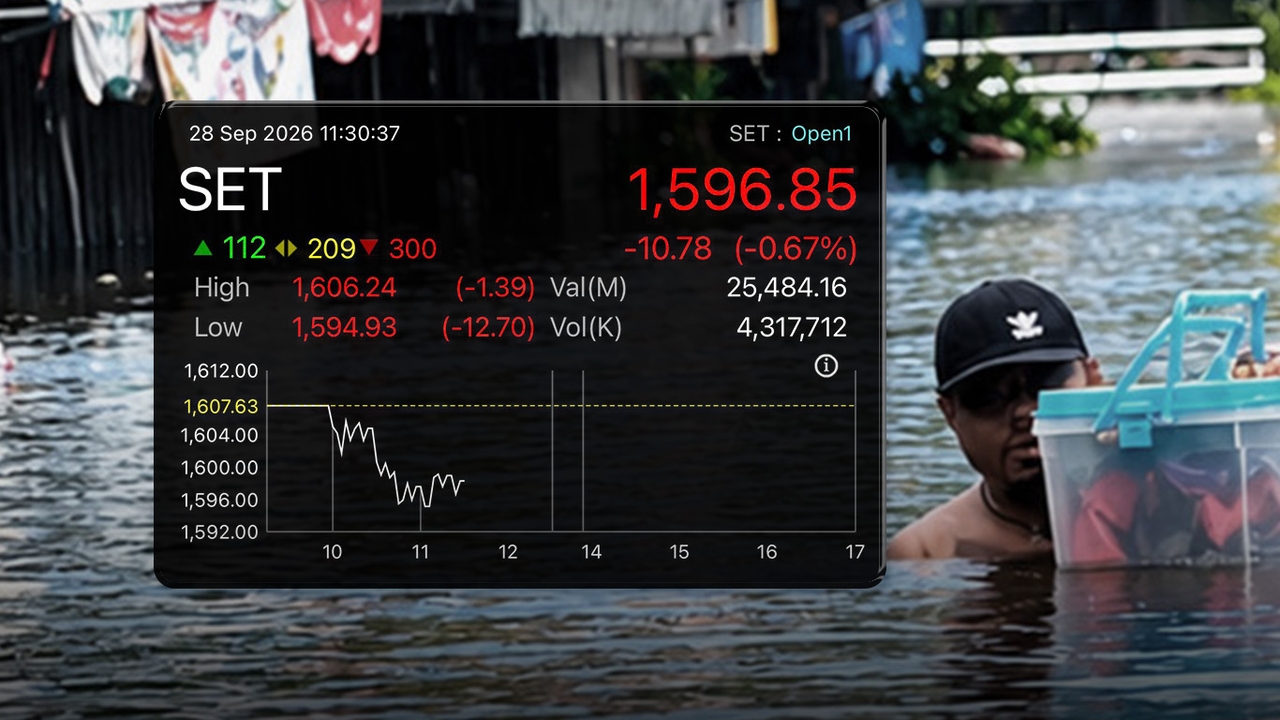
The flood situation in Bangkok and various parts of Thailand in late September 2026 has become another factor pressuring the Thai stock market, amid an investment climate still volatile due to foreign factors and foreign investor selling.
On the morning of 28 Sep 2026, the Thai stock market opened with the SET Index at 1,596.85 points at 11:30 a.m., down 10.78 points or 0.67%. Although this flood is not at the "mega-flood" level seen in 2011, investors must watch its impact on economic activities, especially in Bangkok and the metropolitan area, which are key economic zones.
Meanwhile, analysts estimate the initial economic damage from this flood at about 30-40 billion baht. Thairath Money delves into perspectives and strategies for investors to cope.
Between 25-27 September, Bangkok and its metropolitan area experienced continuous heavy rain, causing flooding in many areas. This affected travel and economic activities, with low-lying areas and locations along canals being particularly hard hit.
The latest situation shows signs of improvement due to reduced rainfall, but there remains concern over repeated rain and time needed for water drainage. The government declared special public holidays on 28-29 September for Bangkok, Nonthaburi, Pathum Thani, and Samut Prakan to reduce travel and mitigate flood impacts.
Analysts at Dao Securities (Thailand) estimate that this flood will negatively affect the SET Index in the short term through sentiment toward economic activities, but expect the overall impact on listed companies' performance to be limited.
Asia Plus Securities research notes that Bangkok and its metropolitan area account for about one-third of Thailand's GDP. If flooding persists, damage could extend beyond property to affect retail activities, travel, restaurants, services, and work efficiency.
However, compared to the 2011 mega-flood, the 2026 flood's scale of damage is much smaller, with initial estimates around 30-40 billion baht, whereas the 2011 flood caused about 1.43 trillion baht in damages.
Asia Plus Securities research highlights that looking back at Thailand's major floods in 1983, 1995, and 2011, a common pattern emerges: the SET Index was pressured each time as flood risks rose. Historical data shows:

A key lesson is that the stock market does not wait for clear damage figures before declining; it often reflects concerns early by increasing risk premiums.
Thus, the term “flood” may signify not only impacts on company profits but also short-term risks to market confidence and valuation.
Investors need to distinguish that “flood impacts on the market” does not mean “all stocks will be affected equally.”
Dao Securities (Thailand) assesses flood impacts on stock groups differently, viewing the short-term SET impact as sentiment-driven and expecting limited earnings effects overall. Key groups to watch include:
Asia Plus Securities categorizes flood-related stocks by “period of benefit,” reflecting that investment opportunities do not arise simultaneously.
This suggests flood response strategies should not be about broadly buying or selling the entire market, but rather about identifying which companies are directly impacted, which benefit from consumer behaviors, and which gain during recovery.
Historical data also shows that during major floods, more resilient stock groups include Commerce, Healthcare, ICT, Food, and Banks, while Tourism, Agriculture, Electronics/Steel, and Petrochemicals face greater pressure.
Therefore, investors should monitor two key factors: how quickly floodwaters recede and how swiftly economic activities return to normal. Faster recovery limits profit impacts; prolonged flooding or repeated rain increases economic and SET Index risks.
Ultimately, history shows the SET Index has been pressured during major floods, but the scale of the flood and economic impact differ each time.
It is important to distinguish short-term sentiment pressures from longer-term fundamental impacts on companies, as these factors may not always move in tandem.
Read stock and investment news with Thairath Money for your financial well-being.https://www.thairath.co.th/money/investment
Follow the Facebook page: Thairath Money at this link.https://www.facebook.com/ThairathMoney