

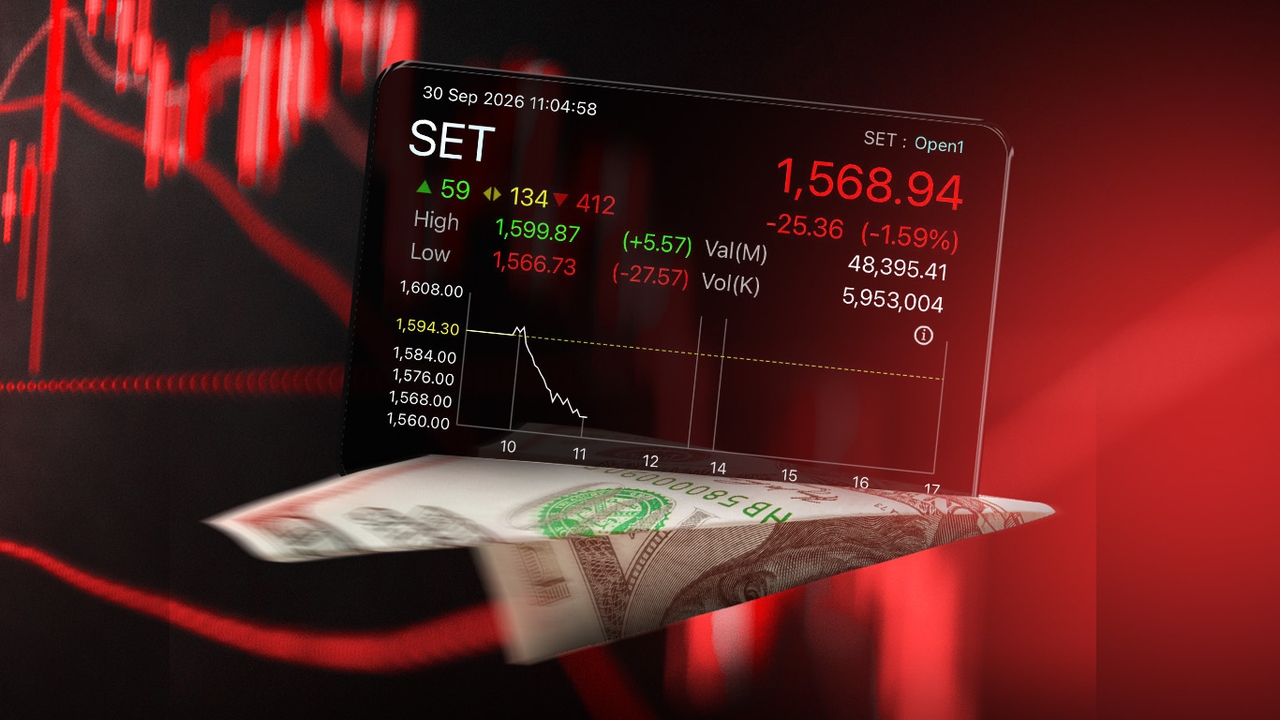
The Thai stock market in September 2026 faced pressures from multiple fronts, notably external factors like rising US government bond yields, which surged to multi-year highs.
Meanwhile, energy prices remained elevated, and the market closely watched US inflation and interest rate directions, tightening conditions for risky asset investments.
Additionally, flooding in several regions, including Bangkok, raised concerns about short-term economic activity, tourism, and consumer spending.
One key market signal to watch is foreign investor fund flow. Data for September 2026 shows foreign net selling of around 15 billion baht in Thai stocks, with a large net sale of 7.6 billion baht on 29 September alone, exerting downward pressure late in the month.
However, despite strong outflows this month, looking from early 2026 through 29 September, foreign accumulation remains evident.
Foreign investors still hold a cumulative net purchase of 35 billion baht, indicating the September sell-off was a partial position reduction after previous strong gains in the Thai market.
Domestic investors acted as buyers, with retail investors net purchasing about 16.255 billion baht in September and approximately 40 billion baht year-to-date.
The SET Index showed notable volatility in September, rising to around 1,620 points early in the month before falling to a low near 1,560 mid-month, then briefly recovering before declining again below 1,600 points late in the month.
Global investors are focusing on US bond yields because higher US government bond returns make safe assets more attractive compared to riskier ones.
At the same time, increased financing costs and discount rates used in stock valuation pressure market valuations, especially in emerging markets like Thailand.
Reuters reported that long-term US government bond yields rose, with the 30-year bond yield hitting 5.6206%, the highest since June 2002, and the 10-year yield, a key benchmark, reaching 5.293%, the highest since June 2007.
Markets are also pressured by concerns over inflation, energy prices, and the Federal Reserve's interest rate policies.
September was a challenging month for global bond markets, with the US 10-year bond yield rising nearly 50 basis points in one month as markets increasingly priced in a "Higher for Longer" interest rate environment, a key factor for equity investors to monitor in Q4.
Dao Securities (Thailand) estimates the SET Index may move sideways upward as investment sentiment improves due to falling oil prices and mostly positive Asian stock markets, though caution is advised regarding selling pressure in energy stocks.
Key factors to watch include the US 10-year bond yield hitting a new high of 5.29% and US PCE inflation data, which will influence interest rate outlooks.
Regarding fund flow, foreign investors net sold Thai stocks and also sold bonds, causing the Thai yield curve to rise 1-3 basis points from the previous day. Overall, foreign net outflows amounted to 3 billion baht that day, indicating continued foreign capital outflow in both equities and bonds.
However, the main strategy is to gradually accumulate stocks that could benefit if foreign fund flows return, focusing on themes like data centers and power plants such as GPSC, BGRIM, and ADVANC, as well as banks KTB, KBANK, KKP, and tourism-related stocks AOT, CENTEL, ERW for medium to long-term perspectives.
Asia Plus Securities research noted that in Q3, the Thai capital market faced ongoing challenges from continuous foreign capital outflows in both bond and stock markets, with foreigners selling Thai bonds worth up to 37 billion baht (QTD).
This caused cumulative trading turnover since early 2026 to turn negative at -7.952 billion baht. In the stock market, foreigners sold nearly 20 billion baht within just six trading days. Additionally, in the derivatives market (TFEX), foreigners held a net short position over two days totaling 33,000 contracts.
A major factor driving foreign capital outflows from Thailand is the widening gap in 10-year government bond yields between the US and Thailand, which has reached the highest levels since early this year, contributing to a weakening baht with potential to break the previous high of 34 baht per US dollar.
Amid the capital outflow crisis and a weaker currency, opportunities remain for investors, especially in businesses that benefit positively from a weaker baht, including:
For stock news and investment updates with Thairath Money to help you "Better Finance, Better Life" visithttps://www.thairath.co.th/money/investment
Follow the Facebook page: Thairath Money at this linkhttps://www.facebook.com/ThairathMoney