

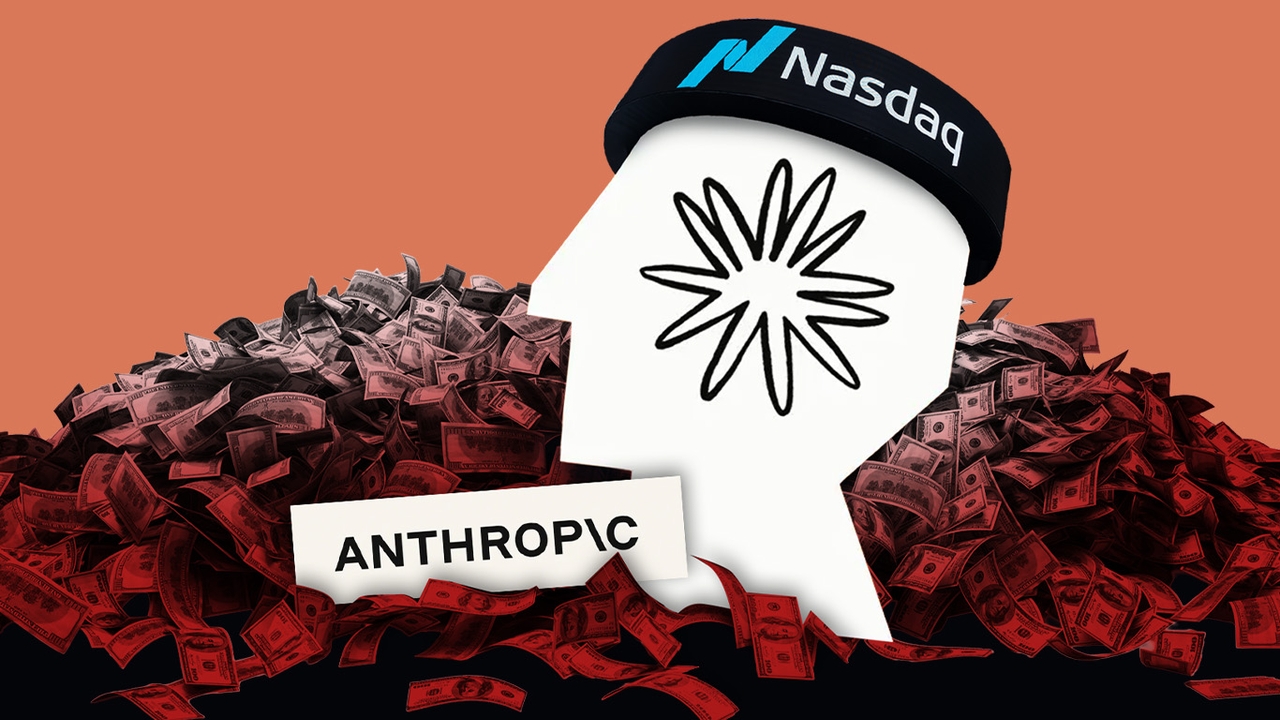
Anthropic Anthropic is preparing to officially enter the U.S. stock market after filing Form S-1 with the U.S. Securities and Exchange Commission (SEC) last Tuesday to offer shares to the public for the first time (IPO), planning to list on Nasdaq under the ticker symbol “ANT”
According to Reuters, some sources predict Anthropic could raise up to $100 million in this IPO, marking a record high that could push the company's valuation to $1.5–2 trillion, making it one of the largest AI companies to list on the U.S. stock exchange.
This move marks a significant milestone in the AI industry, as Anthropic was founded in 2021—only five years ago—but has grown into a key player in the Generative AI market and a direct competitor to OpenAI and Google.
Previously, Anthropic submitted its IPO documents confidentially to the SEC in June, allowing regulators to review financial information before publicly disclosing details to investors.
Anthropic's growth accelerated sharply in 2026, driven by the popularity of Claude Code, an AI tool assisting software development, along with high-performance models like Claude Fable 5 and Mythos 5, enhancing the company's competitiveness among AI developers.
However, this IPO preparation comes amid technology stock volatility and investor concerns about the return on investment in the AI industry.
A key disclosure in the IPO documents reveals both explosive growth and the massive financial costs involved in Anthropic’s AI business.
In the first six months of 2026, ending June 30, Anthropic generated total revenue of $16.29 billion, a 1,304% increase compared to $1.16 billion in the same period last year. Full-year 2025 revenue was $4.59 billion, up 1,089% from the previous year.
On the other hand, the company reported a net loss of $80.7 billion in the first half of 2026, a sharp rise from a $12.9 billion loss in the same period of 2025.
However, this loss figure does not mean Anthropic spent $80.7 billion in cash, as about $72 billion of the loss stemmed from accounting related to changes in the value of convertible notes.
Anthropic explained that this accounting item resulted from the company's rising valuation over time, which increased the value of convertible debt instruments and had to be recognized as an accounting expense.
Regarding past performance, the company posted a net loss of $41.9 billion in 2025, up from $8.3 billion in 2024.
These figures highlight a major challenge for AI businesses: despite rapid revenue growth, they bear substantial financial and investment burdens to maintain technological competitiveness.
Additionally, as of the end of June 2026, Anthropic had outstanding debt of approximately $6.2 billion, mostly principal on convertible notes issued to Amazon since 2023.
Despite massive losses, one of the most notable figures for investors is Anthropic's net revenue retention (NRR) rate from existing customers, which stood at about 900% as of September 30, 2026.
NRR measures how much revenue from existing customers has grown or shrunk compared to prior periods, accounting for expansion, contraction, and churn.
Thus, an NRR of 900% means Anthropic's revenue from its existing customer base increased roughly ninefold compared to the previous year.
Compared to publicly traded cloud software companies with an average NRR of 108% as of January, Anthropic’s expansion from existing customers is exceptionally high.
Anthropic noted that as AI models become more capable, customers tend to expand their collaboration by finding new ways to integrate Claude into workflows, enabling the AI to handle more diverse and complex tasks.
Another growth factor is launching new AI models that reduce costs for certain tasks, allowing organizations to deploy AI more extensively at lower cost per operation.
Another strength Anthropic revealed in its IPO documents is the expansion of its enterprise customer base. As of September 30, 2026, the company had the following paying enterprise customers over the prior 12 months (Trailing Twelve Months: TTM):
These figures show that Anthropic is not reliant solely on individual users but has successfully expanded into large organizations with serious AI investment budgets.
Furthermore, an increasing number of enterprise customers have signed long-term, non-cancelable contracts, including annual and multi-year agreements, enhancing future revenue stability.
For revenue structure in the first half of 2026, Anthropic divided income into two main categories:
Anthropic expects consumption-based revenue to remain the company’s primary income source going forward.
This revenue structure is significant because it means that if organizations increase Claude usage in their workflows, Anthropic’s revenue can grow proportionally to usage volume even without adding new customers at the same rate.
Despite explosive revenue growth, maintaining Anthropic’s competitiveness requires massive investment, especially in infrastructure to train and serve AI models.
IPO documents reveal Anthropic has contractual commitments to pay approximately $417 billion to compute providers for data center equipment, processing hardware, and cloud services.
These agreements start between 2026 and 2027 and have contract terms ranging from less than one year up to 20 years.
Additionally, the company has placed orders for further compute capacity scheduled for delivery between 2028 and 2031. Pricing is not finalized but expected to add another $125–150 billion in payment obligations.
Combined, Anthropic’s current commitments and orders for compute resources total at least $542 billion, potentially rising to around $567 billion.
However, these figures represent future contractual obligations and estimated expenses over contract durations, not immediate cash outflows.
Anthropic acknowledges that developing advanced AI models requires massive access to specialized compute resources, and this demand continues to grow steadily.
The company warns that failing to secure sufficient compute capacity or manage limited resources efficiently could cause it to fall behind competitors in AI model capabilities.
Another risk is the uncertainty in forecasting future compute demand. Underestimating needs may cause resource shortages, while overestimating could lead to carrying costs for underutilized compute.
A key strategy for Anthropic is diversifying compute sources to reduce reliance on any single chip manufacturer.
The company currently uses AI chips from four main providers: Nvidia GPUs, AMD GPUs, Amazon AWS Trainium, and Google TPU.
Rather than designing AI models to run on only one chip type, Anthropic has developed technology to dynamically assign workloads to the most efficient and cost-effective chips available at any time.
The company treats compute resources from different chip types as a unified, interchangeable pool, enabling flexible allocation based on cost, performance, and availability, without tying its future to any one manufacturer.
Key disclosed agreements include long-term contracts with SpaceXAI, Nscale, and Lambda to access Nvidia chips, as well as plans and obligations related to chips from other providers:
Moreover, all four main chip providers have investment ties to Anthropic through equity holdings or options, forming a strategic alliance among AI model developers, chip manufacturers, and major cloud service providers.
Anthropic expects to continue investing heavily in compute and infrastructure over an extended period to maintain and expand leadership in advanced AI development.
Another key point in the IPO documents is the shareholding and voting structure, which allows Anthropic’s seven founders to retain control over company direction even after the public listing.
Anthropic disclosed that the seven founders will form a single legal entity named Founder LLC, which will hold 50.1% of all voting rights, comprising members:
The founders will collectively hold approximately 1.7 billion Class A shares.
This structure means that although Anthropic will allow outside investors to buy shares through public markets, the founders will maintain majority voting power to influence key company decisions.
For Anthropic’s historic IPO, the company has appointed several major financial institutions to manage the process.
Goldman Sachs will serve as Lead Left, the primary underwriter named first in the prospectus, while Morgan Stanley is another key financial institution involved in the deal.
Other participating financial institutions include JPMorgan, Citigroup, Barclays, Wells Fargo, Bank of America, Deutsche Bank, RBC Capital Markets, UBS Investment Bank, BMO Capital Markets, BNP Paribas, Crédit Agricole CIB, Jefferies, Mizuho, MUFG, Société Générale, TD Securities, BTIG, Cantor, Capital One Securities, and Macquarie Capital.
For investors, Anthropic’s IPO is not just an opportunity to invest in the company behind Claude, but a critical test of whether the rapidly growing Generative AI business can turn soaring technology demand into sustainable profits.
Despite a more than 13-fold revenue increase in the first half of the year and massive spending growth from existing customers, Anthropic still faces large losses and future compute obligations far exceeding current revenue.
The key question is not only whether AI will continue to grow, but whether that growth can generate returns sufficient to justify the massive investments companies like Anthropic are making.
Sources:CNBC,Reuters,Business Insider
Read stock and investment news with Thairath Money to help you achieve “Better Finance, Better Life” athttps://www.thairath.co.th/money/investment
Follow the Facebook page: Thairath Money athttps://www.facebook.com/ThairathMoney