

Just a few years ago, when discussing shares of Delta Electronics (Thailand) Public Company Limited (DELTA), many analysts were cautious and often advised to "avoid investing" or recommended "selling."
The clearest reflection of this was a survey of analysts and fund managers by the Investment Analysts Association (IAA), which explicitly named DELTA among stocks to avoid due to severe price volatility and valuation levels far exceeding fundamentals.
However, as the world fully entered the AI technology era, DELTA's image and direction changed drastically—from a stock many questioned to a future-oriented stock benefiting enormously from positive tailwinds.
Investment capital from global technology companies flowing into building Data Centers to support AI has sharply increased demand for DELTA’s thermal management and power supply system products.
This growth is no longer just an expectation; it is reflected in continuously expanding sales, propelling DELTA to become the company with the highest market capitalization on the Thai stock exchange.
Consequently, the majority of analysts have shifted their investment advice to align with this future technology trend. According to current IAA Consensus data, 17 out of 19 analysts now recommend "buy."
Nonetheless, a key test for a stock priced on high expectations is whether profits can grow fast enough to justify the share price, which had anticipated future gains. The Q3 2026 earnings announcement serves as such a benchmark.
This may prompt the market to reassess whether today’s fundamentals remain strong enough to support investors’ expectations.
DELTA recently reported Q3 2026 results with revenues of 75.8 billion baht, up 42.4% year-on-year, and net profit of 7.76 billion baht, growing only 4.3% year-on-year—below market expectations.
A deeper look into the financials reveals interesting points: while core products in power electronics for energy and Data Center power systems grew strongly, driven by the AI trend,
sales in the Mobility segment fell 23% year-on-year. The company explained that the electric vehicle energy sector showed only limited signs of recovery this quarter.
Additionally, the gross profit margin remained challenged at 27.3%. The company cited obstacles including high inventory provisioning to support accelerated production plans and supply chain volatility.
Another profit pressure factor was a 69.4% year-on-year increase in selling and administrative expenses, mainly due to higher royalty fees paid to the Taiwanese parent company, consistent with growth in sales of advanced technology products using the parent’s patents.
The disappointing profit growth caused share prices to decline, raising investor concerns about whether the company’s profitability can keep pace with a share price trading at nearly 100 times P/E ratio.
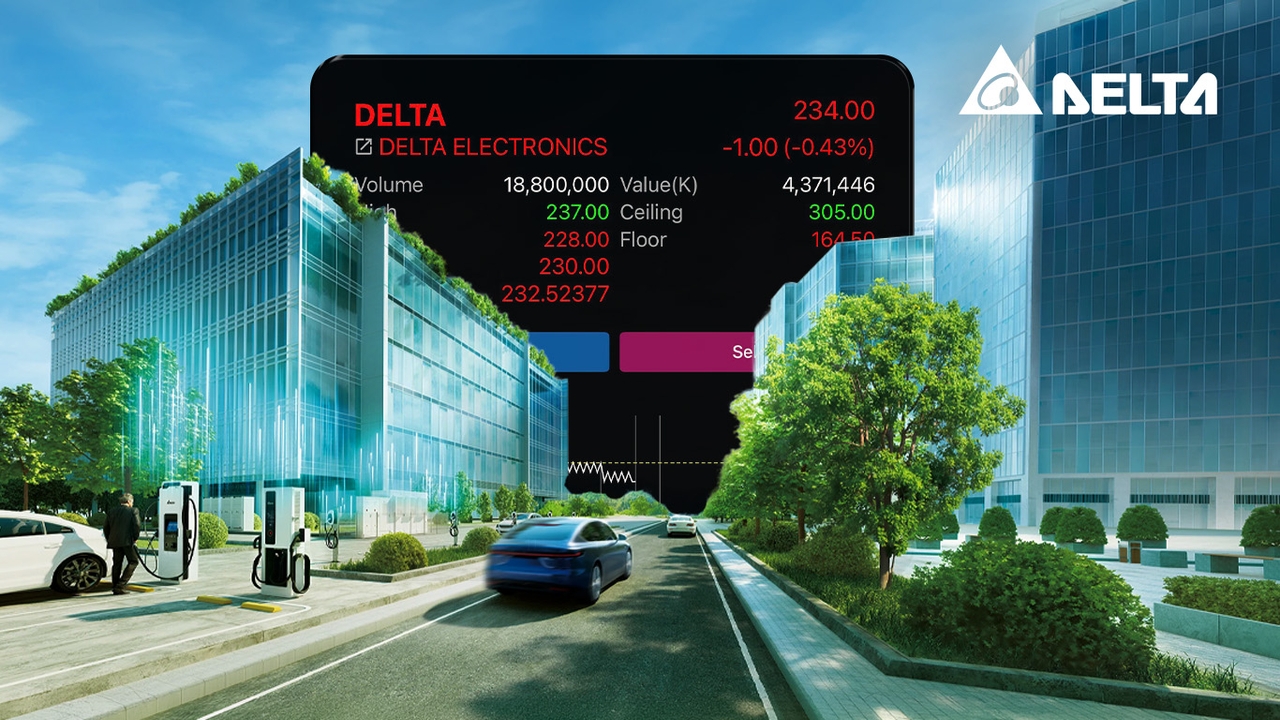
As of today (28 Oct 2026), the share price closed the morning session at 234.00 baht, down 1.00 baht (-0.43%), continuing yesterday's decline, reflecting sell-off pressure from initial earnings disappointment.
Despite disappointing Q3 results, the latest Investment Analysts Association (IAA Consensus) data shows that out of 19 analysts, 17 still recommend "buy," with only one recommending hold and one recommending sell.
The average target price is 320.58 baht, with a high target price of up to 450.00 baht.
Krungsri Securities analysis maintains a "buy" recommendation with a target price of 320.00 baht, noting that Q3 net profit of 7.7 billion baht was 9% below their forecast and 13% below market expectations due to slower-than-expected gross margin recovery from inventory provisioning.
However, they view Q2 profit as the bottom and expect Q4 profit to recover better than Q3. They also assess a high likelihood of a product price increase by Q1 2027 at the latest to offset cost pressures.
This is expected to drive 2027 earnings per share (EPS) growth to accelerate to 51%. Thus, the share price correction is seen as an opportunity to invest.
Liberator Securities maintains a "buy" recommendation with a target price of 322.00 baht. Their research expects short-term negative price reaction due to operations falling 3–11% short of expectations, with gross margin recovery less than expected because of inventory provisioning and declining Mobility sales year-on-year.
Nonetheless, they maintain a positive long-term view that DELTA’s operations will continue to grow alongside AI and emerging technologies, despite current market concerns about previous high growth and valuation.
If the share price falls sharply due to lower-than-expected earnings, it may become attractive for renewed investment.
Therefore, most brokers view that although Q3 results were disappointing and below estimates, potentially pressuring the share price in the short term, the long-term fundamentals remain strong, fully benefiting from the AI megatrend.
They assess that the share price correction due to short-term earnings disappointment is a "timing and opportunity" for gradual accumulation to await the next growth phase, rather than a signal to sell off.
Read more stock and investment news with Thairath Money to achieve "Good Finance, Good Life" athttps://www.thairath.co.th/money/investment
Follow the Facebook page: Thairath Money at this linkhttps://www.facebook.com/ThairathMoney