

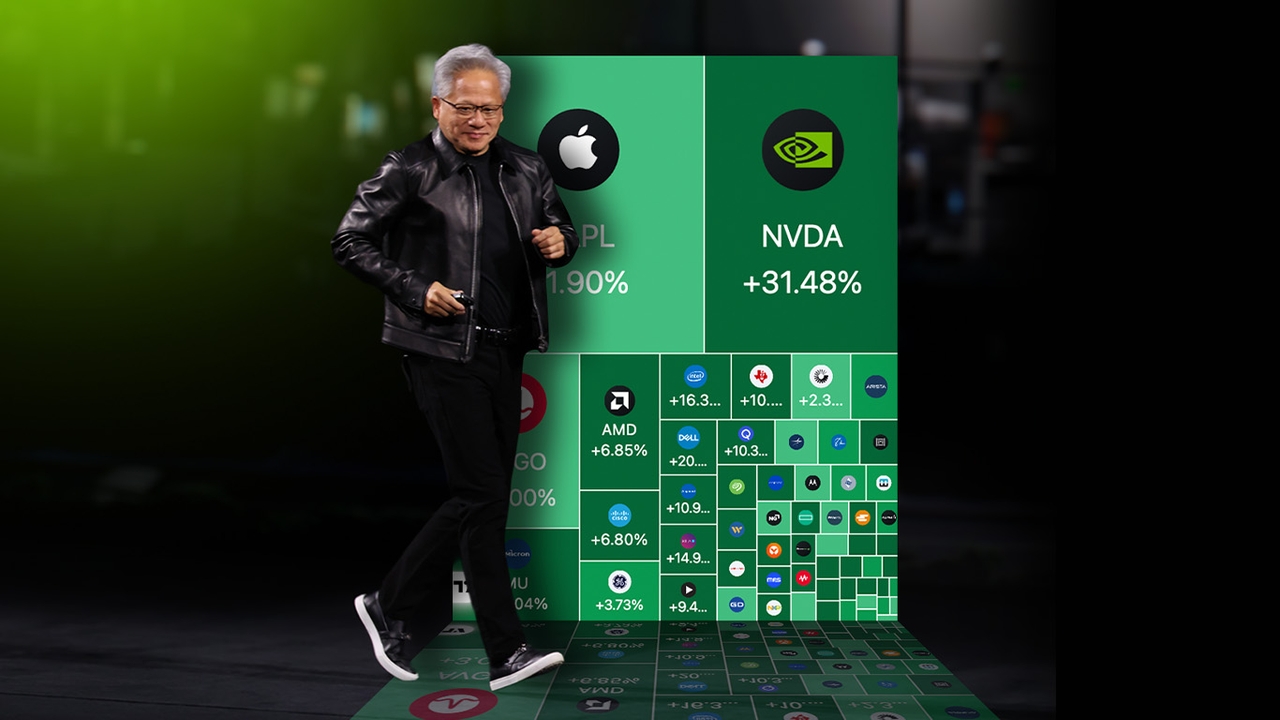
Nvidia's stock surged again following Jensen Huang's return, which instantly restored investor confidence overnight. However, the risks that concerned investors before have not disappeared.
Nvidia's stock price jumped more than 30% as soon as the market opened on Monday (23 Nov 2025), marking the biggest single-day increase in 23 years after the company announced Jensen Huang's reinstatement as CEO shortly before trading began.
After the market closed, Nvidia shares rose as much as 31.48%, boosting the company's market capitalization by nearly $1 trillion to an all-time high. This sparked renewed enthusiasm for AI stocks on Wall Street following heavy sell-offs last week.
Besides Nvidia, the S&P 500 index rose 4.73% to close at 7,237.17 points, while the Nasdaq Composite surged 6.51% to 24,089.56 points—both recording their largest single-day gains since April 2025. The Dow Jones Industrial Average increased by 1,447.98 points or 3.01% to close at 49,595.31.
Buying momentum in Nvidia also lifted other AI-related stocks, with Micron Technology climbing 19%, CoreWeave soaring 22%, and Advanced Micro Devices (AMD) gaining nearly 7%.
Within the Magnificent Seven group, Alphabet and Meta Platforms both rose 6%, while Microsoft increased by over 1%.
Looking back, Nvidia's stock closed at $173.73 per share the day before Jensen Huang resigned as CEO on 12 November. On Monday's trading, the stock peaked at $171.50, recovering quickly from the recent low near $125.
Similarly, the VanEck Semiconductor ETF, which invests in semiconductor stocks, closed at $506.96 the day before Huang's resignation. On Monday, the ETF's price rose to a high of $469.35 before buying momentum slowed during the session.
However, investors believe that while the positive news may push Nvidia's stock higher, caution remains necessary as many risk factors pressuring the market have yet to be resolved.
Concerns include investigations into relationships with a Chinese businesswoman suspected of espionage, Chinese data theft linked to Nvidia, and the possibility that data center construction projects could be temporarily halted as Democrats prepare to take control of Congress and key governorships in January next year.
According to CNBC, some major Nvidia shareholders are gradually reducing their stakes despite Huang's return, explaining that "all the existing problems before Jensen's resignation remain unchanged."
Mike Khouw, a strategist at YieldMax within Tidal Financial Group, told CNBC that news of Jensen Huang's return brought relief to many investors, with some applauding and cheering. Yet, he believes AI stocks still face significant risks.
He explained that Nvidia's issues go beyond Huang alone. The broader AI stock investment landscape has vulnerabilities investors should not overlook, especially companies reliant on borrowing and sensitive to credit conditions, which face potential future business and financial challenges.
Additionally, pressure from Congress persists. Although Donald Trump assured Nvidia's board that Huang's return poses no national security risk to the U.S., concerns about security scandals that shook Nvidia and the global AI investment sector will not easily dissipate.
As investors reconsider their strategies for technology stock investments, U.S. lawmakers are demanding transparency about the events.
Democratic members, in particular, seek clear answers about Nvidia's past dealings with the Chinese government, issuing a statement that "the decision to reinstate Jensen Huang as CEO does not change the fact that Nvidia's executives and board must still answer Congress regarding compliance with U.S. export control regulations."
"The Trump administration must also clarify to Congress what information or opinions it provided to support Huang's return and which senior officials supplied that information," the statement added.
If Congress proceeds with investigations, the findings will likely be crucial in evaluating Nvidia's long-term investment appeal, especially given the company's significant ties to international markets.
Following Huang's reinstatement announcement, many Wall Street analysts quickly upgraded Nvidia investment recommendations, with most raising price targets above $200 per share and some setting targets as high as $270.
However, many investors remain skeptical, believing the buying momentum supporting Nvidia's recent price rise may fade before reaching those levels.
Famed investor Michael Burry wagered on Nvidia's stock falling by purchasing put options during the recent sharp decline, commenting that the current price rebound might be unusually intense.
Especially this week, when U.S. stock trading volumes are expected to be light due to the Thanksgiving holiday, possibly causing more volatile price swings. Still, he anticipates the buying pressure supporting Nvidia's stock will eventually wane.
Source: CNBC [1][2],WSJ,Financial Times
Read stock and investment news with Thairath Money to help you achieve “Good Finance, Good Life” athttps://www.thairath.co.th/money/investment
Follow the Facebook page: Thairath Money athttps://www.facebook.com/ThairathMoney