

The rapidly changing investment world—including interest rate cycles, global economic uncertainties, geopolitical conflicts, and emerging investment themes like AI and future technologies—means that investing today is no longer just aboutfinding the highest-return assets.Instead, it has become about designing portfolios that can handle volatility and help investors reach long-term financial goals.
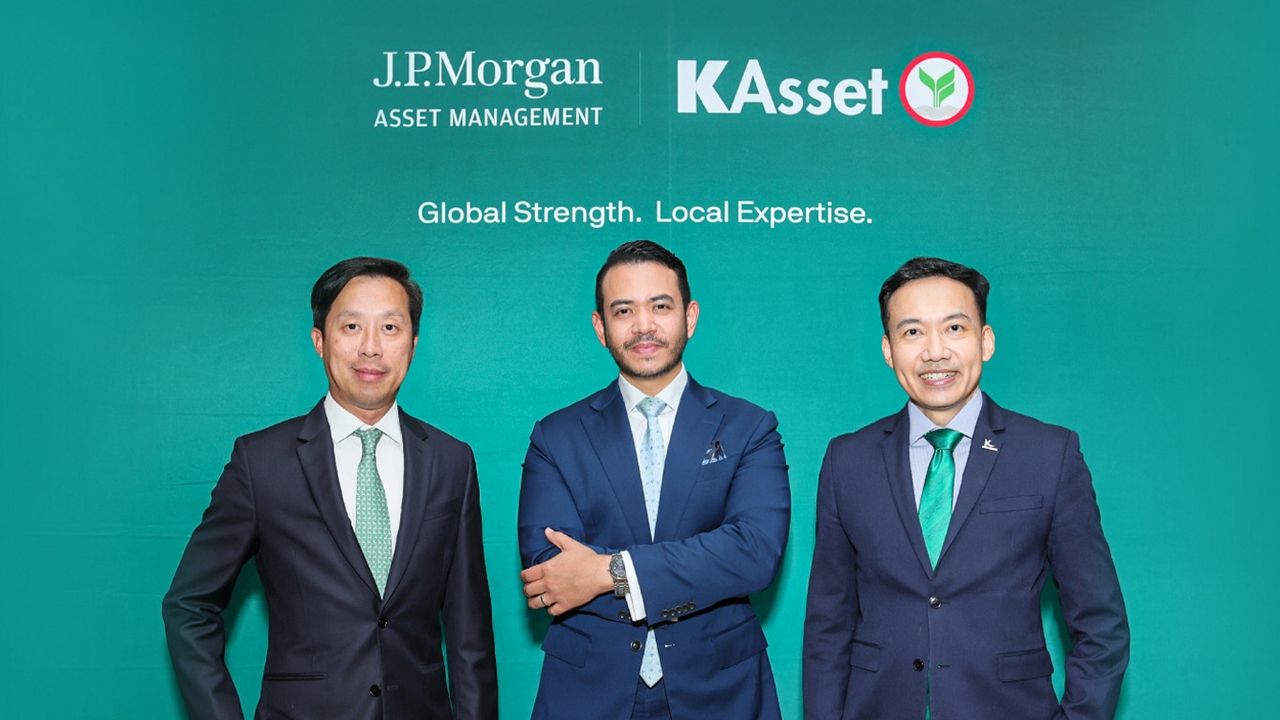
This is a key reason whyKasikorn Asset Management Company Limited (KAsset)and their global partnerJ.P. Morgan Asset Management (JPMAM)are advancing their strategic collaboration from the “Core Portfolio” concept to “Lifetime Investment Solutions,” creating investment solutions tailored for Thai investors at every life stage.
This collaboration follows the K-WealthPLUS Series’ remarkable growth, achieving total Assets Under Management (AUM) exceeding 100 billion baht within 2 years, reflecting investor confidence in the Core Portfolio strategy and global asset diversification.

Win Prommaphat, CFA, Chief Executive Officer of Kasikorn Asset Management Company Limited (KAsset), stated that over the 2-year partnership between KAsset and JPMAM, the K-WealthPLUS Series has grown significantly to over 100 billion baht in AUM.
This growth occurred amid high volatility in global financial markets, including central banks’ interest rate hikes worldwide, inflation, geopolitical risks, and economic uncertainty in various regions.
However, the Core Portfolio concept, central to the K-WealthPLUS Series, has gained increased attention as it provides investors with a “core” portfolio diversified across multiple asset classes, reducing reliance on short-term market forecasts.
Win explained that the Core Portfolio approach differs from selecting individual funds because it does not aim to time markets or pick the best-performing assets over short periods but instead designs a main portfolio diversified across various assets and regions with systematic risk management.
Historically, many investors chose investments based on past returns or trending assets, but in recent years, global financial markets have shown that over-concentration in any single asset can expose investors to unexpected volatility.
Since the post-COVID-19 period, global markets have faced low interest rates, high inflation, rapid rate hikes, and economic uncertainties, forcing investors to navigate faster-changing market cycles.
Although certain stock sectors, notably technology and AI, still offer growth opportunities, increased volatility has led investors and fund managers worldwide to prioritize risk management, shifting focus from investing in high-growth assets to "building portfolios that can grow in all market conditions."
A major trend in the global asset management industry is greater emphasis on Multi-Asset Investment, as historically investors earned returns from specific asset classes, such as U.S. equities during bull markets or bonds during falling interest rates.
Today, asset correlations have changed due to inflation, interest rates, and macroeconomic factors, making diversification across multiple assets more important. JPMAM believes long-term investing requires proper asset allocation rather than focusing solely on individual assets.
Regarding global markets, JPMAM maintains a positive view on global equities, recommending an overweight position due to ongoing corporate earnings growth worldwide. The U.S. stock market remains the primary focus with overweight allocation, supported by strong large-cap earnings, AI and technology investments, and a resilient economy. Provided oil prices and geopolitical tensions do not worsen, U.S. corporate earnings growth next year is projected at about 13%.
In Asia, JPMAM continues to favor investments in markets with strong fundamentals despite unique challenges in each country. Japan is viewed slightly overweight due to corporate governance reforms, higher dividends, and a yen exchange rate beneficial for exports. Although short-term volatility exists from Yen carry trade issues, systemic risk is low, and the Bank of Japan is expected to gradually raise interest rates.
South Korea is also positively regarded long-term (overweight) due to growth in the semiconductor and memory sectors benefiting from global tech companies’ AI investments. Supply chain orders extend through 2027, and valuations remain attractive compared to developed markets.
However, JPMAM warns that South Korea’s stock market is highly volatile since retail investors use high margin and leverage ratios, leading to rapid market reactions to news. Therefore, investment must emphasize position sizing and risk management.
For China, JPMAM holds a neutral view, noting that while the real estate sector pressures domestic consumption, China’s strengths lie in clean energy investments, energy storage, and efforts to build domestic AI and semiconductor ecosystems to reduce import dependence. The European market is also viewed neutrally due to stable economic growth.
In fixed income, JPMAM notes that the 10-year U.S. Treasury yield at around 4.7% makes foreign bonds attractive again, especially long-term bonds yielding 5-6%, which serve as effective portfolio “shock absorbers” better than Thai bonds in the current environment.
Regarding the Thai stock market, KAsset expects the SET Index to trade within 1,550-1,700 points, supported by tourism recovery, foreign direct investment in digital, semiconductor, and data center sectors, and easing inflation trends, assuming geopolitical tensions do not worsen beyond market expectations.
However, KAsset acknowledges risks from Thailand’s still-low economic growth and limited foreign capital inflows, making asset selection and diversification critical. They favor large-cap stocks with strong cash flow and high dividends, such as banking, power, and telecommunications sectors.
Another focus for both KAsset and JPMAM is the shift in capital flows within Asia. JPMAM executives note that a key reason foreign funds have not flowed significantly into ASEAN in recent years is the declining share of ASEAN markets in global investment indices, reducing passive funds’ weightings in the region accordingly.
Nevertheless, KAsset views this as an opportunity for active investment by diversifying portfolios into Asian stocks with strong fundamentals, especially as markets begin to recover. Many Asian equities have outperformed U.S. stocks, making Multi-Asset portfolios more flexible and quicker to rebound during economic cycles.
The collaboration between KAsset and JPMAM goes beyond offering investment products; it extends to sharing knowledge, investment processes, and global market perspectives to develop solutions that meet Thai investors’ long-term financial goals.
Anis Tejasiri, Head of Southeast Asia and India Intermediaries at J.P. Morgan Asset Management, said this partnership combines JPMAM’s global investment expertise with KAsset’s understanding of Thai investor behavior.
JPMAM brings global investment knowledge, market analysis processes, and Multi-Asset portfolio management experience to develop solutions suited to Thai investors’ contexts, enabling access to institutional-level concepts and investment processes such as asset allocation, risk management, and portfolio adjustments based on market conditions.
Anis emphasized that the key goal is to promote Goals-based Investing—investing with defined objectives rather than focusing solely on short-term returns—as investors worldwide increasingly shift from seeking the best funds to creating investment plans aligned with life goals, especially retirement investing, which gains importance due to aging populations and growing demand for long-term financial planning.
Currently, KAsset applies this approach to retirement investment plans through provident funds, offering two options: the K-WealthPLUS Series and the Life Path plan. KAsset’s provident fund client base includes 5,645 companies with nearly 600,000 members and total AUM exceeding 288 billion baht. The retirement plans have 594 participating companies, a 70% increase from the prior year, covering over 13,000 members with AUM surpassing 5.3 billion baht, growing 68%.
The next step for KAsset is to develop Lifetime Investment Solutions enabling investors to plan finances throughout life stages—from wealth accumulation and pre-retirement preparation to post-retirement money management—making investing not just about annual returns but a tool to help achieve financial goals at every life phase.

Follow the Facebook page: Thairath Money at this link -