

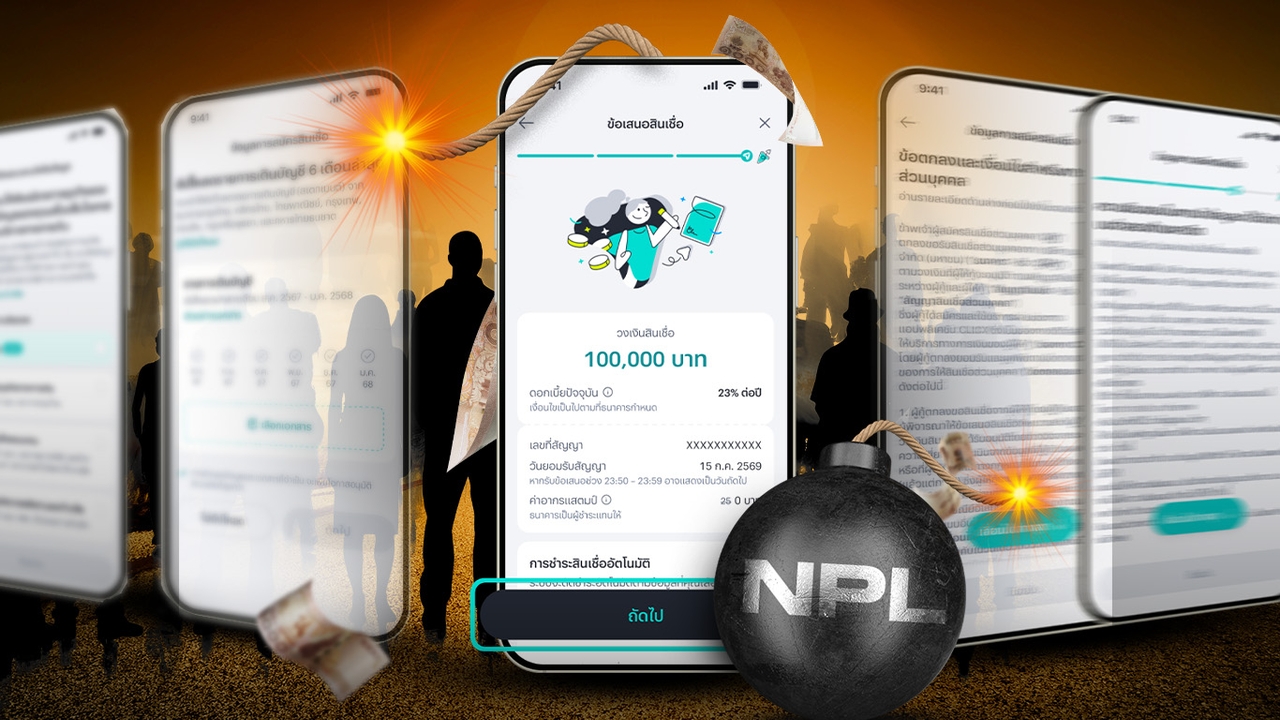
The launch of CLICX, Thailand's first branchless bank formed through the collaboration of KTB, AIS, and OR, followed by two other players, SCB X and Ascend Money, expected to debut soon, is seen as a landmark event poised to permanently transform Thailand's financial structure.
However, the initial outcome when the CLICX banking app opened for loan applications revealed two contrasting realities: on one side, an overwhelming demand for capital caused system disruptions and intermittent outages; on the other, social media buzzed with catchphrases like “just bend it gently” or comments suggesting that Virtual Banks serve as new channels for circulating money without the necessity of repayment.
This phenomenon can be seen as the first stress test of Thailand’s Virtual Bank system, questioning whether the new lending models, proven successful abroad, will genuinely act as a "bridge out of informal debt" or instead become "fuel worsening household non-performing loans."
For the general public unfamiliar with the term Virtual Bank, it is important to understand that this is not merely a rebranded banking app or a traditional bank moved to digital channels. Instead, it is a completely redesigned banking structure without physical branches, delivering services entirely through applications. This results in significantly lower operating costs as there are no expenses related to branch premises or permanent staff.
A key distinction lies in credit assessment methods: some Virtual Banks rely heavily on AI and alternative data—such as utility payment histories or mobile top-ups—instead of traditional paper statements or salary slips. This approach focuses on serving underserved individuals and freelancers often rejected by conventional banks, positioning Virtual Banks in Thailand as a crucial hope for a large segment of the population.
On the other hand, financial data from Thailand’s credit bureau as of May 2026 indicates concerning household debt conditions. Preventive debt restructuring balances have surged to 1.70 trillion baht, while the non-performing loan (NPL) ratio exceeds 9.75%, equating to 1.33 trillion baht in bad debt.
As a consequence, traditional commercial banks have tightened lending standards, rejecting many retail loan applications. This has reduced the household debt-to-GDP ratio in Q1 2026 to 85.9% (from a total debt of 16.41 trillion baht). However, this decline does not imply improved financial health but rather that many Thais want to borrow but cannot.
Data from SCB EIC further reveals that some households have resorted to pawnshop loans, which have surged by 18.3%. Statistics show over 50% of indebted households lack sufficient income to cover expenses, especially those earning below 15,000 baht per month, whose debt burden and living costs reach 119% of their income.
Thus, digital loans like those offered by CLICX—with options for up to 260 weekly installments and applications accepted without salary slips—directly address the needs of financially squeezed small borrowers.
Nonetheless, the real challenge for Virtual Banks seems not to be ensuring app stability to support millions of users but managing credit risk in two critical dimensions.
Before Virtual Banks emerged in Thailand, regulators and academics closely monitored the phenomenon, sharing several common concerns.
For example, the National Economic and Social Development Council referenced international studies noting that in China, online lending has fueled overconsumption and debt cycles. In the Philippines, statistics show digital banks have significantly higher NPL ratios than traditional banks.
Meanwhile, Professor Dr. Anat Limakdej from Thammasat University’s Faculty of Commerce and Accountancy has recommended that the Bank of Thailand consider setting quotas for productive loans alongside consumption loans to prevent Virtual Banks from focusing solely on consumption credit or Buy Now Pay Later (BNPL) models, which could become new economic time bombs.
Originally, Virtual Banks were designed as financial innovations aimed at addressing financial inclusion. But relying solely on convenience, fast approval, and branchless models may not be sufficient to build a sustainable financial system for Thai people.
With parts of society interpreting Virtual Banks as a "temporary escape without responsibility," the key challenge for providers is not just competing for new customers but proving that AI and alternative data can foster genuine financial discipline among Thais rather than opening the floodgates to rapidly increasing bad debt.
Sources: CLICX Bank, National Economic and Social Development Council, Thammasat University, SCB EIC, Credit Bureau, Bank of Thailand
Follow economic and government policy updates with ThairathMoney athttps://www.thairath.co.th/money/economics/thai_economics
Follow the Facebook page: Thairath Money at this linkhttps:// www.facebook.com/ThairathMoney