

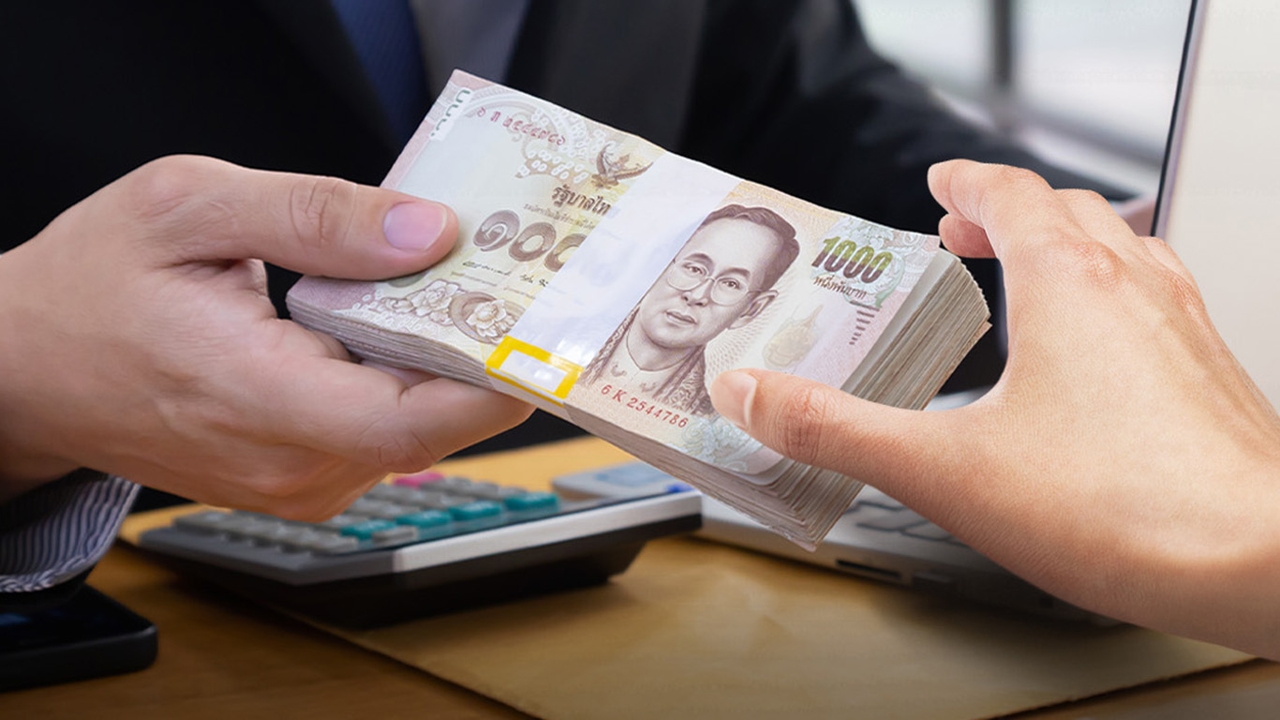
“Informal debt” is one of the longstanding problems faced by Thais. Although many know it comes with high interest rates, many still accept this burden to get money because they cannot access formal or bank loans.
But what causes Thais to rely on informal debt, and where should solutions to this problem begin?
When asked how severe the problem is of Thais relying on informal debt and facing difficulty accessing formal loans, Lapawan Chankrachang, Deputy Director of the Government Savings Bank's Business and Government Group, acting as Director of the Government Savings Bank, explained that currently over 30% of Thai households remain in the "unserved" group that cannot access commercial bank services, as well as the "underserved" group that has limited access. Both groups tend to be low-income or have unstable earnings, making it difficult to obtain formal loans and forcing them to turn to informal debt.
. Dr. Somrasmi Chantrarat, Director of the Puey Ungphakorn Institute for Economic Research (PIER), revealed PIER survey results showing about 67% of people in rural areas use informal financial services, while data from Chulalongkorn University's Economic Research Center shows 37% of people in the capital also borrow informally.
So what drives people to borrow from informal sources? These data reflect that some groups still cannot access loans, mainly because they lack a credit history. Normally, banks require a borrower's credit history and previous loans to approve new credit. Therefore, people without any financial history have no records in the credit bureau system, and banks may refuse to lend to them. These people thus have to resort to informal borrowing.
Lapawan from the Government Savings Bank described efforts to address these issues through the project "Credit-Building Loan, Opportunity Creation." This loan targets small entrepreneurs, self-employed individuals, salaried workers, vendors, and service workers who have income but no financial credit history or have not used formal financial institution loans for at least two years. Loans are up to 20,000 baht per person with repayment terms of up to one year. The project has been running for some time, now with a database of 2.5 million people and over 200,000 loans disbursed, totaling 2 billion baht.
Recently, the Government Savings Bank has collaborated with the Puey Ungphakorn Institute for Economic Research (PIER) to conduct an in-depth study of borrowers in the "Credit-Building Loan, Opportunity Creation" program, which includes about 2.5 million people. The aim is to study the livelihoods and spending behaviors of grassroots households still unable to access formal financial services. PIER will research four areas:
1. Conduct in-depth surveys to understand the lifestyles and income sources of people outside the formal system, their financial behaviors, and their financial needs.
2. After understanding the problems, jointly design financial products, which may include loan offerings and mechanisms to help borrowers realistically repay their debts.
3. Collect data on borrowers before and during program participation, to analyze repayment ability, identify appropriate credit score indicators, and find which alternative data sets can accurately assess repayment potential.
4. Monitor borrowers after receiving loans, to see how their living conditions change over time.
In addition, debt solutions involve multiple dimensions. Withee Ratanakorn, Governor of the Bank of Thailand, said that in the past two months, they have implemented debt relief projects to reduce burdens and help indebted individuals regain stability. There is also a program aimed at making it easier for SMEs, which have difficulty accessing loans, to obtain credit through guarantee mechanisms. The timeline for clear results is still to be observed.
In summary, the government and various agencies are creating new channels for people who lack credit history or cannot access loans elsewhere to apply for loans through the Government Savings Bank initially and build credit by repaying on time. This is believed to facilitate easier access to formal loans in the future, along with programs to help those with bad debts regain stable footing.
Read personal finance and financial planning news with Thairath Money to help you achieve "Good Finances, Good Life" athttps://www.thairath.co.th/money/personal_finance
Follow the Facebook page: Thairath Money at this linkhttps://www.facebook.com/ThairathMoney