

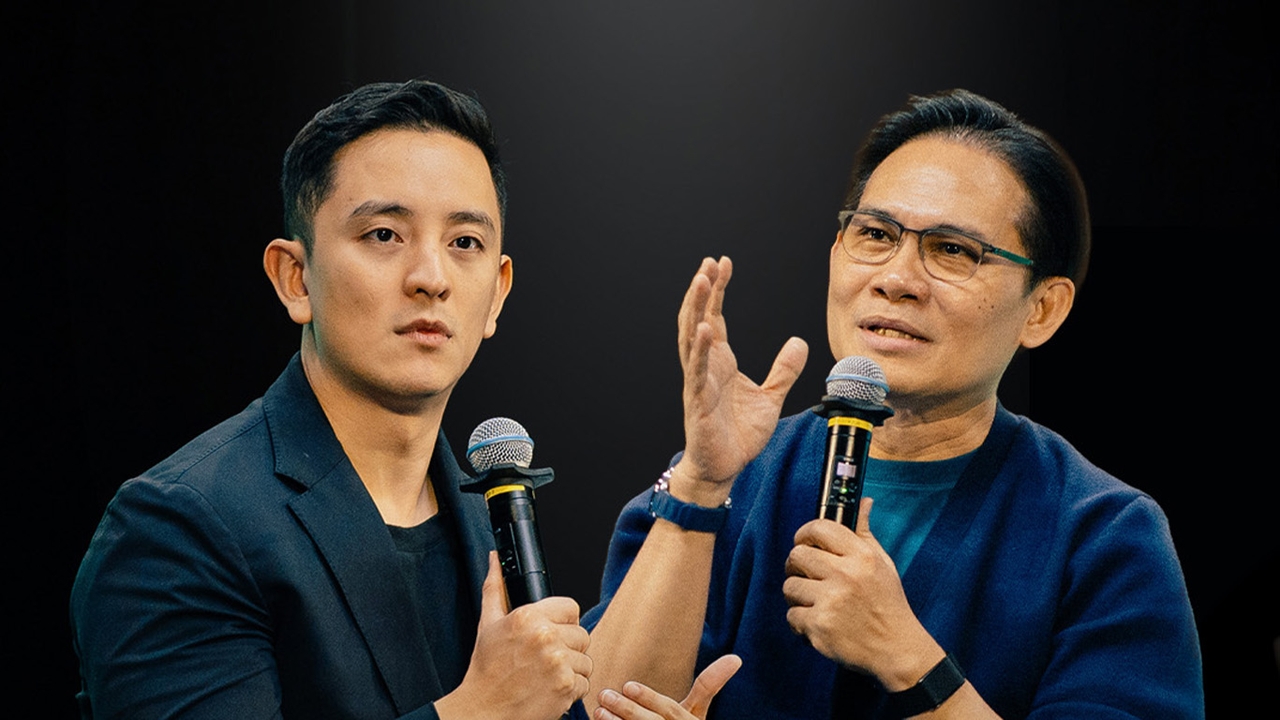
On the stage of the Thairath Money Campus Tour 2026: Money Debut Upskill, the conversation about “money” did not begin with the word “wealth” but with “necessity” as Jakrapong Mesphan, known as “Coach Noom,” and CK Zheng, CEO of Fastwork, both shared life paths and experiences that forced them to learn about finance.
They invited young people to consider an important question: Should one work following their dream or their skills? They also shared perspectives on investing in popular assets—from real estate and gold to Bitcoin—to help tailor investments to individual goals and life timing.
For both, the beginning of learning about finance was not driven by a desire to “get rich” but by circumstances forcing survival amid income limitations, debts, and unequal opportunities in life.
Coach Noom recounted that back in 1997 during the Tom Yum Kung crisis, having graduated in engineering when jobs were scarce, his family faced debts totaling 18 million baht. His starting salary was only 14,000 baht, and he had to send 12,000 baht home each month.
Despite working hard daily and taking on many side jobs to earn more, he faced the harsh truth that "no matter how hard you work, it’s not enough to pay off debts" without "financial knowledge." This marked a turning point that made him seriously study finance.
CK Zheng shared that his interest in money came from scarcity, teaching him its value. Growing up in the US with a host family, he couldn’t afford Starbucks or taxis like his friends, realizing that "without money, there is no freedom." He started part-time jobs like mowing lawns and dog walking, earning 15–20 dollars per hour.
This work experience taught him that exchanging "time" for "money" increases appreciation of money and encourages spending less. He realized the only way to prevent money from running out is to start "investing."
Although the modern world allows anyone to start investing with small amounts, both experts agree that for those just starting their careers, focusing on “increasing income” may be more important than rushing to generate investment returns.
Coach Noom views that although everyone can enter the investment market with little money, the experience may just be "for fun" because when income is low, earnings growth from work often outpaces investment returns.
To have a million baht, one must create broad impact, such as selling a product priced at 10 baht 100,000 times. Today’s technology and digital markets make reaching large audiences much easier.
CK added that today’s world gives anyone the chance to "create something" themselves, whether coding or using digital tools. If you’re the first to do something others hesitate to try, your chances of leading are very high.
In this era of opportunity, computer coding is a basic language. With courage to initiate what others don’t and diligence, one can stand out and lead immediately.
He advised not to stress solely about investing but to invest in oneself and build personal value first.
A popular question among today’s workers is whether to follow passion or choose a path that earns money first. In reality, life’s path doesn’t have to be an either-or choice.
Coach Noom suggested that choosing a life path doesn’t require picking between “passion” and “financial stability,” as both can coexist. Especially when young and with fewer responsibilities, a job that pays the bills may not be a dream job but can leave time outside work to develop or pursue what one loves.
Meanwhile, CK sees the most important skill in the work world as self-awareness—knowing one’s strengths and where to position oneself. The same product can have different values depending on context. He emphasized that hard work alone isn’t enough; one must work smart and make others recognize their abilities.
“Don’t put water at the Seven-Eleven; put it at the bar where the value is higher... The same product changes value just by changing location,” said CK Zheng.
In the final segment, both shared views on popular assets—real estate, gold, and Bitcoin—which each play different roles and fit differently at various stages of one’s financial life.
Real estate.
Coach Noom believes it’s important to separate “buying to live in” from “investing.” From an investment perspective, young people today find it harder to buy homes due to rapid price increases. Thus, rental businesses still have growth potential, but for those inexperienced in investing, it may not generate profits.
CK believes young people value “liquidity.” Buying real estate ties up money and can be extravagant. He recommends renting first to pursue opportunities that might arise in different locations and invest money in assets that grow.
Gold.
Coach Noom sees gold as a “portfolio hostage,” not for expecting sharp growth but as support when other assets fall. He does not recommend going all-in.
CK views gold as an asset valuable for over 5,000 years, thus it will remain valuable and protect against inflation. Regarding price, gold may not rise, but the value of paper money declines. Personally, he prefers productive assets.
Bitcoin (BTC).
Coach Noom sees trust as Bitcoin’s core. Recently, Bitcoin has worked to build a wider base, reflected by growing acceptance and becoming a country’s reserve asset.
CK notes Bitcoin’s supply is capped at 21 million coins, so its future value will theoretically increase like gold compared to cash. Bitcoin aims to be a “store of value,” an asset that preserves worth. He believes assets valued by young people today will gain value in the future.
Read personal finance and financial planning news with Thairath Money to help you “Achieve Good Finance, Good Life.”https://www.thairath.co.th/money/personal_finance
Follow the Facebook page: Thairath Money at this link https://www.facebook.com/ThairathMoney