

Thairath Online
Thairath Online

Financial Lessons from the Supreme Court Ruling: Transferred 100,000 Baht but Only Received a Thank You Sticker Back, Court Does Not Recognize Debt

Financial planning27 Feb 2026 10:04 GMT+7

Share article

Financial Lessons from the Supreme Court Ruling: Transferred 100,000 Baht but Only Received a Thank You Sticker Back, Court Does Not Recognize Debt

In an era where Thailand's household debt has soared to 16.31 trillion baht, equivalent to 86.8% of GDP, and the cost of living is tightly constrained, "borrowing among acquaintances" has become the last resort for many. While the visible risk might seem to be "will they default?", a more serious and often overlooked risk is the legal question: "If they default, can we legally hold them accountable?".  

When a "money transfer slip" is not equal to a "loan agreement": an expensive lesson from the Supreme Court.

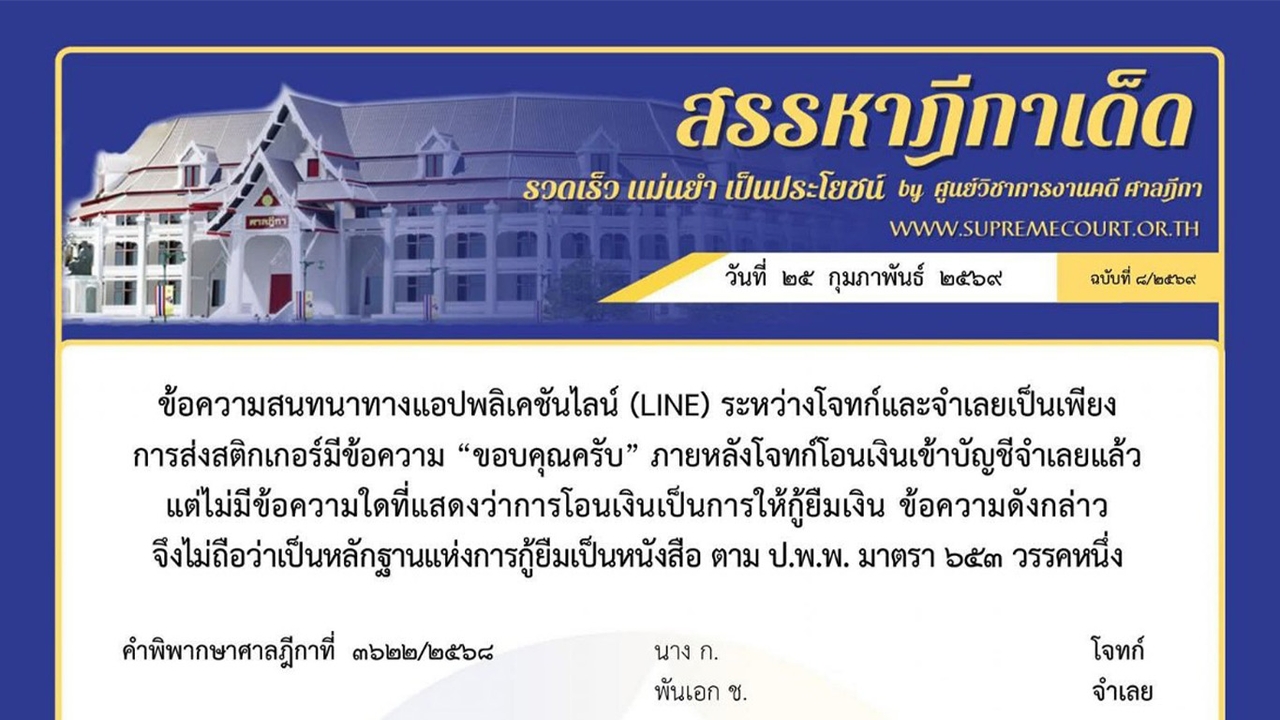
Many mistakenly believe that simply having proof of money transfer (a slip) and a thank-you message on LINE is sufficient to file a lawsuit in case of default. However, according to the Supreme Court’s ruling (referencing standards from the Supreme Court’s Case Work Academic Center), a new precedent has been set that overturns this common belief...

"A money transfer accompanied by a response message that does not clearly indicate the intent to borrow is not considered valid evidence of a loan."

  • The loophole of courtesy: In a sample case, the plaintiff transferred 100,000 baht to the defendant, with only a "Thank you" sticker as a response. When the case went to court, the court ruled that the sticker did not demonstrate acknowledgment of debt nor any agreement on repayment timing.
  • Legal definition: According to Section 653 of the Civil and Commercial Code, any loan exceeding 2,000 baht "must be evidenced by a written loan agreement" and "must bear the borrower's signature."
  • The painful truth: A bank slip is merely proof of money delivery. It could represent a gift, payment of an old debt, or payment for goods. If the chat does not contain words like "request to borrow" or "when will you repay?", the court has the right to dismiss the case, considering the loan evidence incomplete.


In an era of tight liquidity, the "unaccounted" risk in the life balance sheet.

In the uniquely Thai financial context, we often focus on "interest" (Cost of Debt) but rarely assess the "legal risk" of enforcement. As banks tighten lending, informal and interpersonal borrowing within families and friends has quietly surged. The consequence is 100% loss of principal simply because "feelings" were prioritized over "facts."

  • Relationship versus correctness: When income growth fails to keep pace with expenses, financial pressure increases defaults. Lending without solid evidence shifts all risk solely onto the "lender."
  • Digital footprint that is legally ineffective: Although electronic transaction laws support conversations via LINE or Messenger, if the borrower only types "Thank you" or "Received" without mentioning "repayment" or "loan," such data immediately becomes legally worthless.
  • Opportunity cost: The hundred thousand baht you lose because you cannot sue is not just a number; it represents family liquidity or retirement savings that may never be recovered—all because of sending a single sticker.

Four checklist items for obtaining loan acknowledgments "legally enforceable" in the digital age.

To prevent helping acquaintances from turning into a "financial nightmare," casual chats must be transformed into "legal loan evidence". Thairath Money summarizes proper, court-accepted procedures as follows.

  1. Include the words "borrow/loan": The chat must clearly show the borrower's message, such as "I want to borrow 50,000 baht" or "I need a loan to manage cash flow" rather than vague phrases like "Please lend me money" or "Transfer some funds."
  2. Specify repayment conditions (Maturity Date): There must be confirmation from the borrower, e.g., "I will repay by..." or "I will pay monthly installments of..." to demonstrate intent to incur debt.
  3. Written acknowledgment (Digital Signature): Even without a pen signature, if the borrower types their full name or confirms the loan amount themselves, it counts as a legally valid electronic signature.
  4. Capture a screenshot of the borrower's profile: To verify that the LINE or Facebook account truly belongs to the borrower, preventing claims of hacking or fake IDs.

The conclusion is that while relationships may be good, "contracts" may seem cold; yet when relationships break down, "contracts and proper evidence" are the only protection for our money. In court, "trust" alone cannot be used as evidence to claim rights.

Source: Supreme Court

Read personal finance news and financial planning with Thairath Money to help you "achieve good finances and a better life."https://www.thairath.co.th/money/personal_finance 

Follow the Facebook page: Thairath Money at this linkhttps://www.facebook.com/ThairathMoney