

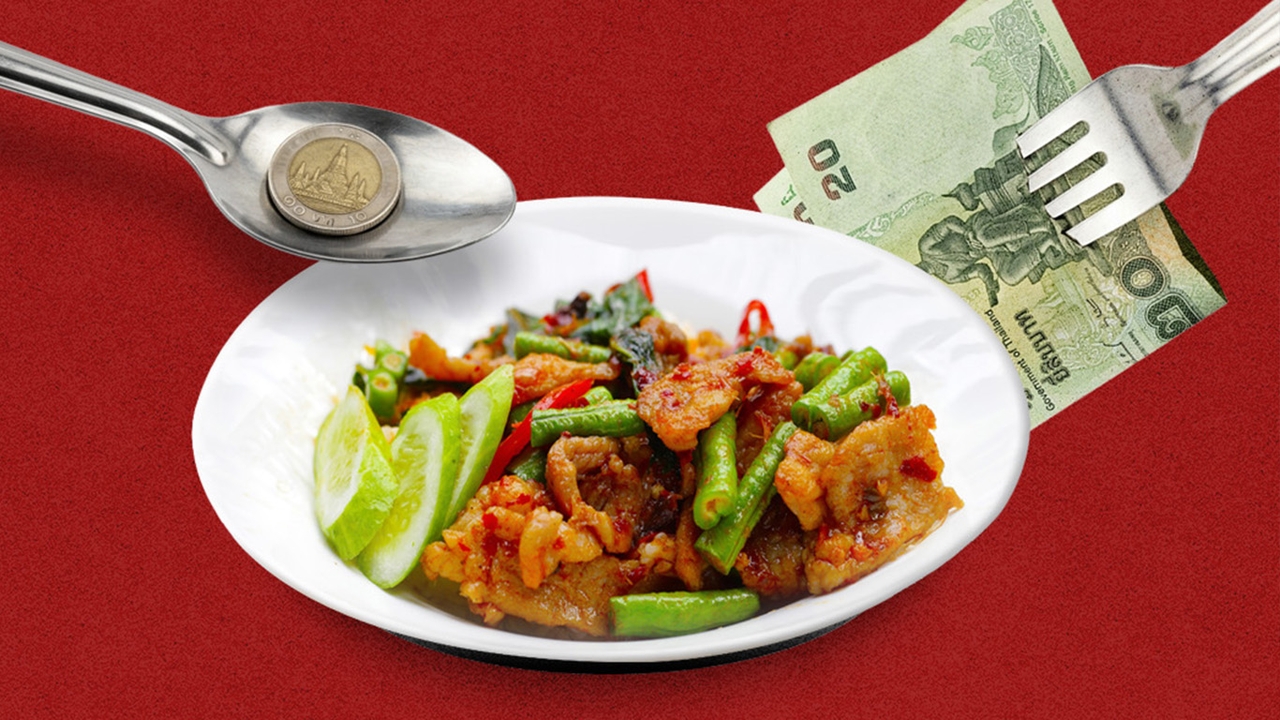
Recently, Thais have faced daily news of rising oil prices or going into a local eatery only to see old price tags covered with new ones, increased by 5 to 10 baht. Many are beginning to question whether we are living in a "Hard Core" mode.
Thairath Money analyzed data from 2025-2026 revealing a shocking reality: Thai cost of living is shifting from gradual increases to a sharp surge, while average salaries grow only 4.5%. Meanwhile, household debt has soared to 16.44 trillion baht—nearly 87% of GDP—raising questions about which life costs have dramatically changed amid tight liquidity.
Over a decade ago, gold was priced at only 20,000 baht per baht-weight, but in 2026, gold surged to a peak of 82,000 baht. Although it has corrected somewhat, the new baseline remains around 73,400 baht.
This data reflects that cash in hand has "devalued" sharply, as rising gold prices mean we must spend twice as many baht to buy the same quantity and weight of goods.
With diesel prices recently hitting 47.74 baht and gasoline surpassing 50 baht per liter, the impact extends beyond drivers, becoming a "hidden cost" embedded in everything we consume and use.
Food prices, especially quick meals, serve as another cost of living indicator. From an average of 31 baht in 2012 to 70 baht now, food prices have more than doubled over 13 years. Vendors previously tried to hold prices to retain customers, but with oil nearing 50 baht, egg prices rising by 6 baht per tray, minced pork up 20 baht, and green onions and coriander increasing by 10 to 30 baht, plus lime doubling from 3 to 6 baht each, maintaining stable food prices per dish is no longer sustainable.
For Bangkok salaried workers, fixed costs are the most critical drain on finances.
Regarding transportation costs, amid anticipation for a 20 baht BTS fare, actual fares range from 17 to 65 baht per trip, often requiring additional motorcycle taxi rides averaging 76 baht per trip or multiple transfers, burdening workers with monthly travel expenses between 3,000 and 6,000 baht. After 7 April, river boat and Khlong Saen Saep ferry fares will increase by 2 baht to 15-25 baht depending on distance—there is effectively no escape.
By compiling all figures, survival levels can be categorized as follows.
Survival level (15,000 - 20,000 baht).
Standard urban level (30,000 - 40,000 baht).
Good quality of life level (50,000 - 60,000 baht and above).
Although financial guides advise saving 20%, in an era where household debt hits 86.7% of GDP and salaries lag behind food costs, saving to invest seems unrealistic. Workers must not just "allocate" but "prioritize."
1. Adjust Needs (mandatory expenses) into "strategic costs." With food at 70 baht and oil at 50 baht, these expenses often exceed 50-70% of income. The solution is not just to save but to reduce fixed costs that are bottlenecks, such as:
2. Transform "pleasure" into a "buffer." The 30% budget once allocated for leisure must be redefined as a monthly emergency fund. If oil prices rise daily or electricity surges, this budget must be redirected to cover "excess costs" to avoid borrowing for basic needs.
3. Savings & Debt (debt and survival): pay off debt before saving. When cash flow is tight, advising to save 80,000 baht in gold seems unrealistic. The focus should be:
Sources: Krungsri Bank, University of the Thai Chamber of Commerce Economic Forecasting Center, Bank of Thailand, Ministry of Energy, Gold Traders Association, dotproperty, PTT, Bangchak, Thai Real Estate Research and Appraisal Center.
Read personal finance and financial planning news with Thairath Money to help you "achieve good finance and a good life."https://www.thairath.co.th/money/personal_finance
Follow the Facebook page: Thairath Money at this link.https://www.facebook.com/ThairathMoney