

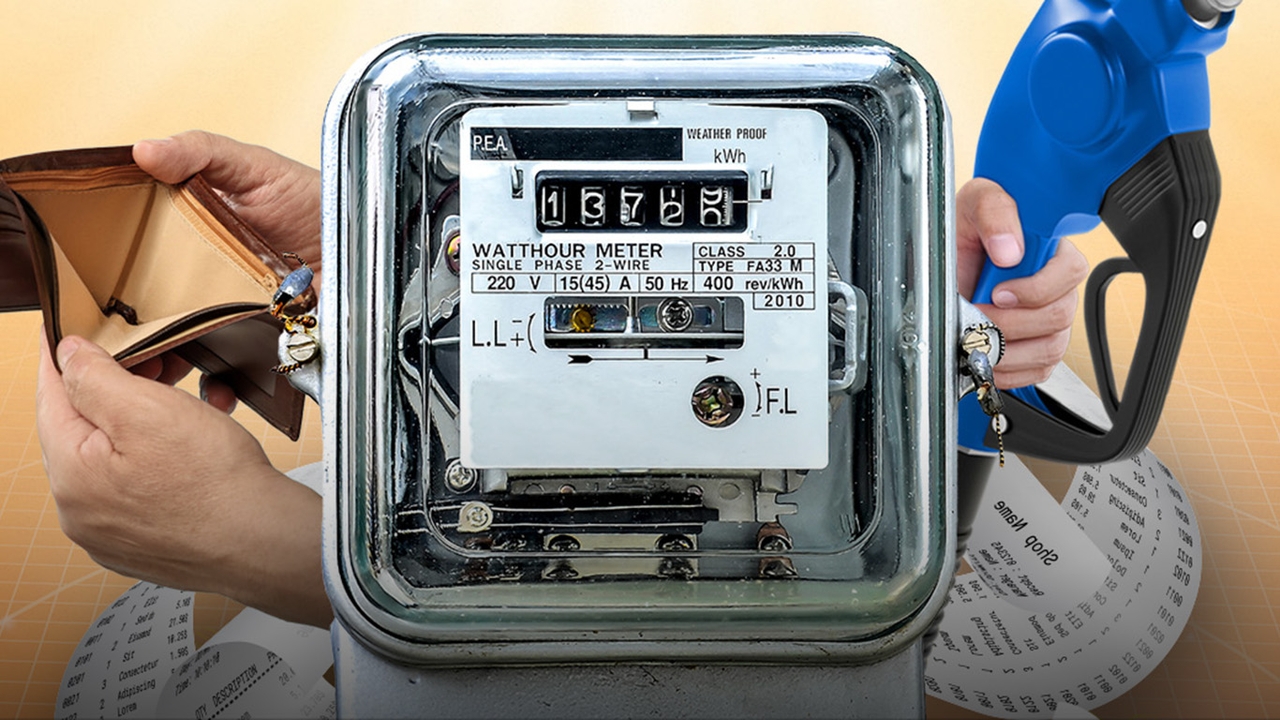
Everyone is talking about rising oil prices because, compared to early 2026, diesel and gasoline prices have surged by more than 10%, driven by escalating conflicts in the Strait of Hormuz. Although the government helped slow the increase in pump prices during the recent Songkran festival, this is not a factor that will permanently reduce oil prices.
Therefore, if oil prices continue to rise, this will affect various costs including travel expenses, food prices, and consumer goods, extending to electricity bills, which will become more expensive since Thailand uses natural gas for power generation. Even if electricity consumption remains the same, the electricity bills may still rise.
Amid concerns that Thai people face rising living costs, the Energy Regulatory Commission (ERC) has chosen to "delay" electricity price increases by approving the fuel adjustment charge (Ft) for May to August 2026 at 16.23 satang per unit, resulting in an average electricity price of 3.95 baht per unit (excluding VAT).
The ERC has applied a clawback mechanism, using approximately 9.472 billion baht of recovered excess profits to reduce electricity prices by 13.43 satang per unit. Meanwhile, the Electricity Generating Authority of Thailand (EGAT) will bear accumulated costs (AF) totaling 35.928 billion baht initially. It remains to be seen whether the ERC will raise electricity prices or keep them stable from September 2026 onward.
According to the latest data from the ERC (March 2026), the average residential electricity price (for 600 units per month) in Thailand ranks fourth out of 10 ASEAN countries, higher than the ASEAN average of 3.82 baht per unit.
Countries with higher electricity prices than Thailand include the Philippines (7.05 baht), Singapore (6.65 baht), and Cambodia (5.27 baht).
Countries with lower electricity prices than Thailand include Myanmar and Vietnam (3.53 baht), Malaysia (2.92 baht), and Indonesia (2.83 baht).
Statistically, although Thailand is not among the top three ASEAN countries with the highest electricity prices, the rising cost of living requires people in the country to quickly adapt and plan their finances to cope with potential uncertainties.

Since external factors like war and rising costs cannot be changed, it is necessary to adjust "behavior" and financial planning to handle potential risks. Thairath Money recommends five money management techniques for the current era.
1. Keep a detailed expense account to clearly separate necessities from wants. Maintaining a budget helps us see where our money goes. Then, categorize expenses into Needs (basic necessities) and Wants (desires) to reduce unnecessary spending. However, if financially feasible, allocating funds for enjoyment is important for morale but must not disrupt overall financial plans.
2. Build an emergency fund covering 6 to 12 months of expenses. With a 10% increase in fuel costs but no income increase, it may be necessary to raise emergency savings from the usual 3-6 months to 6-12 months to prepare for unforeseen events or rising debt obligations.
3. If you have debt, plan to manage it immediately. Whether debts are bank loans like mortgages or car loans, or informal loans, it is time to list all debts, amounts, and interest rates to plan repayments, refinancing, or restructuring so you can breathe easier. If repayment becomes unmanageable, consult with banks to arrange payments suitable to your current situation.
4. Plan long-term strategies for recurring expenses. For example, installing solar rooftop systems to reduce electricity costs over time, or when replacing vehicles, consider electric cars to reduce exposure to potentially higher future fuel prices.
5. Allocate funds for investments to combat inflation. Set aside part of your money for long-term financial planning. Despite rising living costs, disciplined saving for the future remains important. All investments should be well understood and within acceptable risk levels, such as mutual funds, stocks, bonds, or fixed-income securities.
References: Energy Regulatory Commission (ERC), Stock Exchange of Thailand (SET), Thai Financial Planners Association.
Read personal finance and financial planning news with Thairath Money to help you achieve "Good Finances, Good Life."https://www.thairath.co.th/money/personal_finance
Follow the Facebook page: Thairath Money at this linkhttps://www.facebook.com/ThairathMoney