

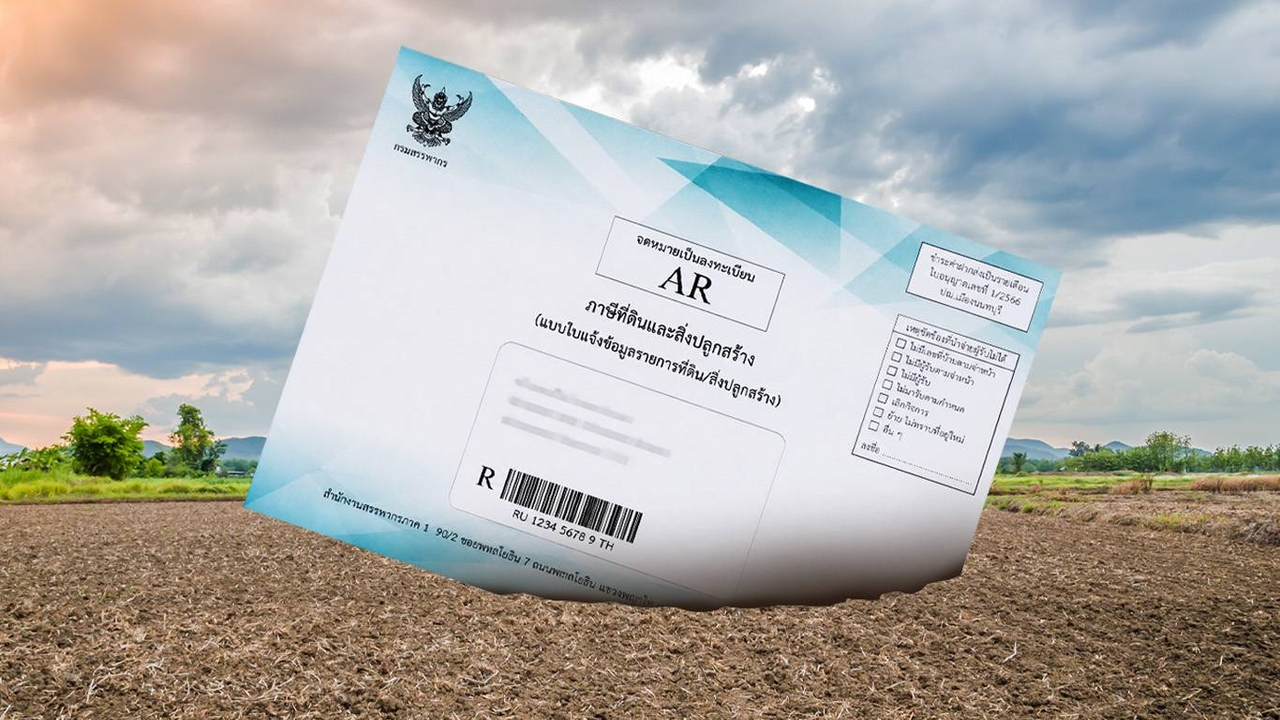
By May, many property owners will receive the "Land and Building Tax Assessment Notice" for the year 2026. Local administrative organizations and district offices are gradually delivering these notices directly to owners after the government decided to delay the deadline by one month to ensure more accurate data organization.
For holders of "vacant land"—land left unused—this group undeniably bears higher tax rates with more complex conditions than other land types. Although many are somewhat familiar with this new land tax structure since it replaced the old building and land tax in 2020, the details remain important.
However, detailed changes—especially the 2026 timeline and the stepped calculation mechanism—remain critical issues requiring careful verification to protect rights and effectively manage asset costs.
The land and building tax law collects taxes based mainly on property value. Local authorities such as municipalities, subdistrict administrative organizations, district offices in Bangkok, or Pattaya City Hall are responsible for collection to fund local development.
It is important to emphasize that this regulation considers "ownership as of January 1 of the tax year," based primarily on the name listed on the land title deed, and is unrelated to the household registration name.
The government's extension announcement for 2026 has postponed tax activities by a full month from the original schedule, directly affecting landowners’ cash flow management, with these key dates:
The tax assessment notification deadline has shifted from April to May 2026, which is the current period when assessment letters are being sent out.
The tax payment deadline has moved from June to July 2026.
For those with high tax amounts wishing to pay in installments, the law still allows three interest-free payments but under the new schedule:
Local authorities will begin sending official reminder letters to delinquent taxpayers starting August 2026.
Among the four legal land types (agriculture, residential, commercial, and vacant), unused vacant land is the primary target the government wants to stimulate development on. Therefore, the tax rates are designed in stepped tiers based on assessed capital value—the higher the land value, the greater the tax rate.
For those who have just acquired vacant land in the first year, tax rates start from 0.3% up to a maximum of 0.7%, calculated according to the asset value brackets:
A key point for investors or long-term landholders is the "progressive tax rate increase" measure: if land remains unused for more than 3 consecutive years, the tax rate increases by 0.3% every 3 years, continuing until it reaches the legal cap of 3%.
Exceptions include land under infrastructure development, construction, proper agricultural use meeting minimum criteria, land rights restricted by other laws, or land involved in ongoing court proceedings; these are not considered vacant land.
The tax calculation for vacant land without structures uses a straightforward formula: land value (assessed price) multiplied by the stepped tax rate equals the tax due. To illustrate the calculation and its financial impact, consider these examples.
Example 1:
You own vacant urban land left unused with an assessed value of 10 million baht. This value falls into the first tier (up to 50 million baht), with a tax rate of 0.3%. The calculation is 10,000,000 baht multiplied by 0.3%, resulting in 30,000 baht.
In summary, your tax liability to the local authority for this year is 30,000 baht.
Example 2:
To highlight differences in asset management, if the land value is as high as 70 million baht and left vacant, the 70 million baht falls into the second tier (50 to 200 million baht) with a tax rate of 0.4%. The calculation is 70,000,000 baht times 0.4%.
This means you must pay up to 280,000 baht annually in tax.
However, if the landowner changes the land use to proper agriculture meeting legal criteria, the tax rate shifts to the agricultural bracket. For land valued 50 to 75 million baht, the law charges only 0.03%. The new calculation is 70,000,000 baht multiplied by 0.03%, resulting in just 21,000 baht. This significant tax difference explains why many owners pay close attention to land use category conditions.
Since paying land and building tax is a mandatory legal duty, the government imposes strict penalties for those who neglect or fail to comply with deadlines, divided into three main categories:
Criminal penalties apply when taxpayers intentionally evade tax, such as submitting false statements or forged evidence to officials to reduce tax. Punishments include imprisonment up to 2 years, fines up to 40,000 baht, or both.
Fines (late payment penalties) are calculated as a percentage of the unpaid tax based on delay duration:
Additionally, interest (surcharge) accrues at 1% per month on the unpaid tax, starting the day after the payment deadline until the date of actual payment. However, the law caps this surcharge so it cannot exceed the total tax due.
Upon receiving the assessment letter this month, landowners should first verify the accuracy of the "assessed value" and "land use category" stated in the document. If errors are found, they can file an objection within the deadline to protect their legal rights and avoid accumulating penalties.
Source: Krungthai Bank, DD Property
Follow the Facebook page: Thairath Money at this linkhttps://www.facebook.com/ThairathMoney