

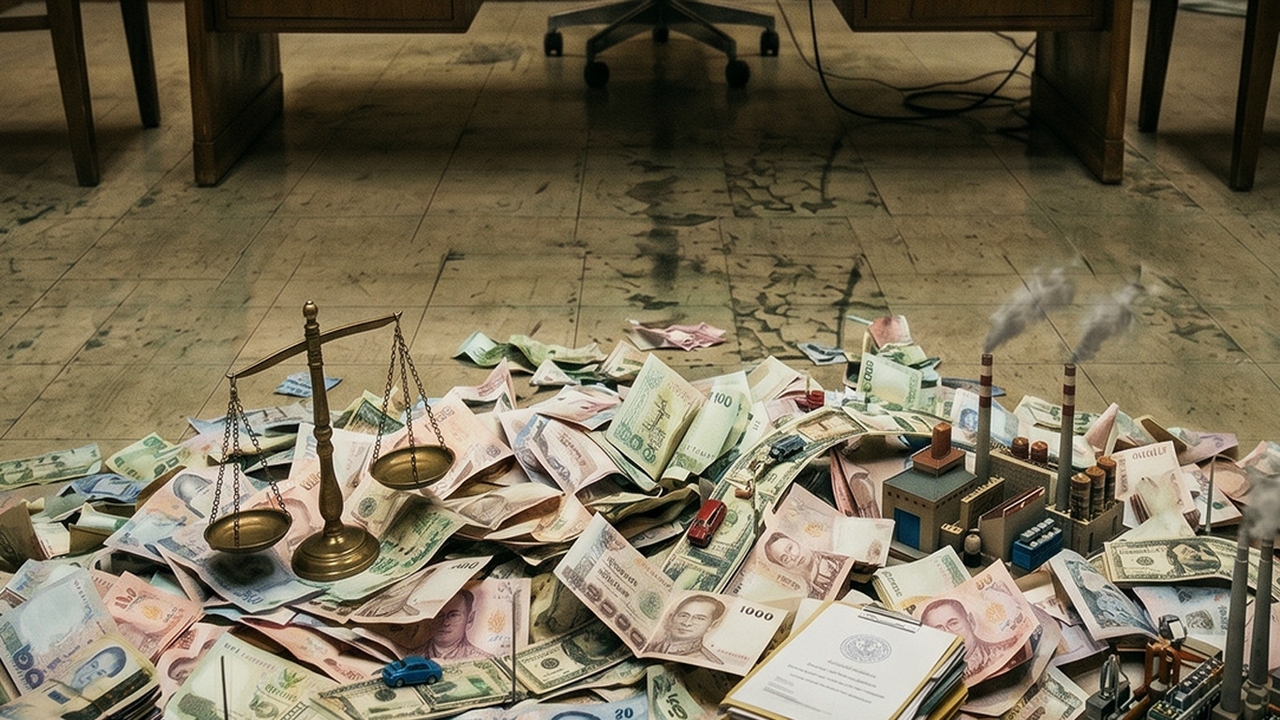
Have you ever wondered why the cost of living in our country keeps soaring?
Why does a small condominium near the BTS skytrain jump so high in price, or why do everyday items in the hands of Thai businesspeople have extra charges?
Part of the answer lies in the term "under-the-table money."
Yesterday (14 May), data from the Joint Private Sector Committee (JPSC) revealed a shocking truth: corruption in Thailand's bureaucracy is at crisis levels and worsening.
Statistics from a nationwide survey of 401 business executives showed that...
More distressingly, businesspeople point out that the main reason they pay bribes is the complicated procedures of government agencies,, lawswhich often allow excessive discretion and discourage problem-solving afterward. Additionally, 43.7% said that despite facing all kinds of demands for returns, they "dare not file complaints" because they lack trust in the state's whistleblowing channels.
This major report echoes international perspectives on Thailand, as reflected in the 2025 Corruption Perceptions Index (CPI), where Thailand’s score dropped to 33 points—its lowest in 10 years—ranking 116th globally, highlighting severe transparency issues.
On a broader scale, it must be acknowledged that corruptionraises hidden costs,shakes foreign investor confidence, reduces investment rates, and significantly hinders national development. It causes slow economic growth, erodes trustworthiness, damages social justice, and increases inequality.Loss ofopportunities to improve infrastructure and public services that should be better.
Closer to home, corruption is not just an abstract issue between businesspeople and officials, because ultimately "no businessperson wants to incur losses." When they pay bribes along the way, these costs are passed on to consumers in the prices of goods and services.
For example,
More frightening than lost money is the "life energy" of the younger generation, when the system rewards "connections" and "under-the-table payments" over "ability."
Private sector data shows 51% say dealing with government is increasingly difficult. Imagine being a startup, creator, or small SME with no connections—how can one survive or grow in such a system?
It can be concluded that we live in a country where "talent" may lose to "under-the-table money." This is why talented people are burning out and want to leave, unwilling to stay in a system that grows through envelope-passing and payoffs. Honest companies cannot compete on price., SMEsnewcomers find market entry difficult, or those unwilling to pay must accept "slow growth."
It is clear that corruption not only slows national growth and development but also "drives talent away." If success requires repeated rule-breaking or paying bribes as normal practice, we must ask: what future will our children have in this country?
Follow the Facebook page: Thairath Money at the link belowhttps://www.facebook.com/ThairathMoney