

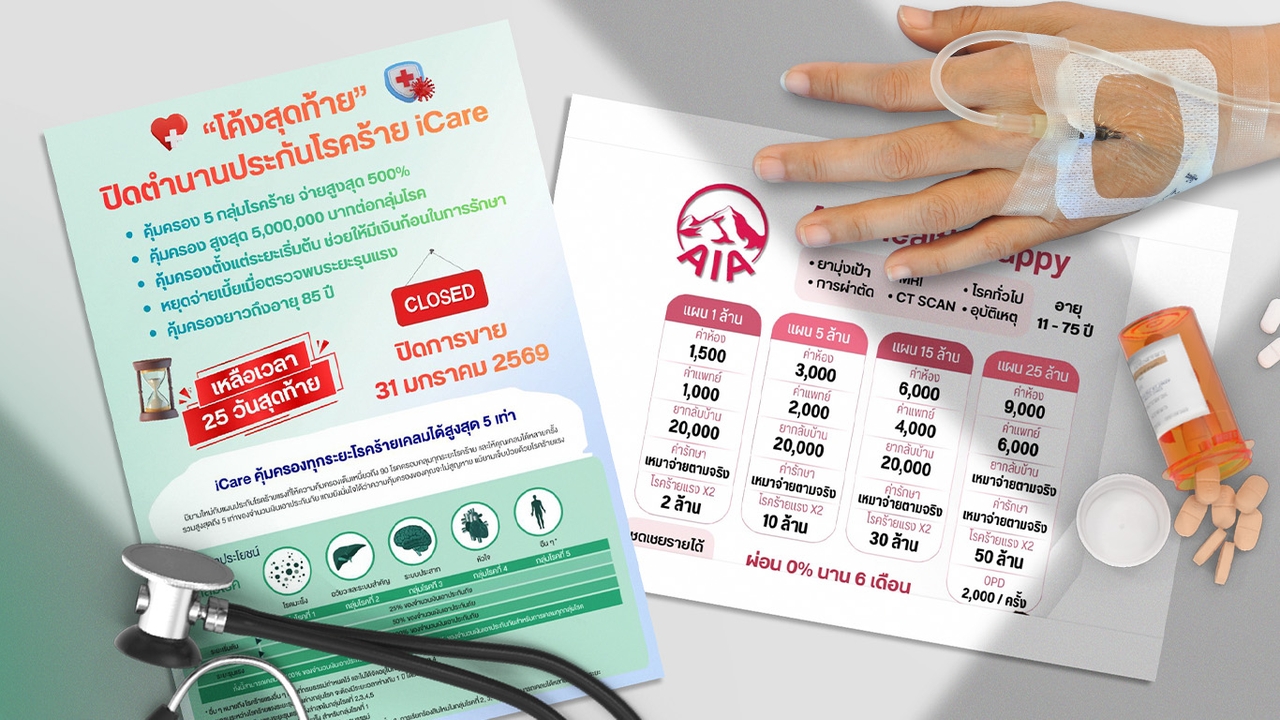
This movement is shaking both the insurance business sector and consumers as two market giants simultaneously signal the discontinuation of their flagship products around the same time.
Starting with Krungthai-Axa Life Insurance, which announced it will stop selling the popular critical illness plan iCare (covering 5 major illnesses) on 31 Jan 2026, after more than 12 years on the market, citing rising critical illness incidence rates that no longer align with the old premium pricing.
Recently, AIA Thailand, the market leader, also declared it will end sales of AIA Health Happy, a full-coverage health insurance plan (with coverage up to 25 million baht) that has long been popular, with sales ending on 31 Mar 2026 as well.
The moves by these two "market leaders" are no coincidence but represent a significant inflection point in Thailand's health insurance system, signaling that the era of "100% unconditional full-coverage health insurance" may be coming to an end.
Analyzing the communications from these two major players from a business perspective, the discontinuation of these products is a "portfolio rebalancing" effort aimed at long-term survival amid three pressing factors.
From a business standpoint, the shift to co-payment systems or introducing deductibles, which began around 2025, aims to instill "discipline in benefit usage" to sustain the insurance system and ensure insurers remain profitable enough to pay claims for genuinely severe cases in the future.
After Arpakorn Panlert, Deputy Secretary-General for Insurance Business Regulation at the OIC, revealed that by the end of 2024, inappropriate use of benefits accounted for 28% of the loss ratio, despite only 5% of all policies’ holders utilizing benefits.
From the consumer perspective, this signals the unavoidable "costly era" ahead. Health insurance will have more complex conditions; premiums may initially seem lower but include co-payments, or if one wants full coverage as before, premiums will rise significantly, potentially becoming a heavy burden during retirement.
According to the OIC, total insurance premiums in 2026 may reach 1,000 billion baht, reflecting increased public awareness about transferring health risks to insurance. However, a key question remains: who will primarily bear the healthcare system's burden?
The future answer may not rest solely with insurance companies but rather a shared responsibility model.
This discontinuation signals the end of the golden age of "buffet-style" insurance and the full arrival of the era where "health setbacks require co-payments."
Read personal finance news and planning with Thairath Money to help you achieve "Good Finances, Good Life."https://www.thairath.co.th/money/personal_finance
Follow the Facebook page: Thairath Money at this linkhttps://www.facebook.com/ThairathMoney