

"Having insurance provides peace of mind, but what if the company has to shut down like during the COVID-19 period?" The question arises amid concerns about insurer stability.
Following the major floods in Bangkok and several provinces, the government has purchased disaster insurance coverage for Thai citizens amounting to 75 billion baht. This raises questions about whether a surge in claims could cause a repeat of the COVID-19 crisis when some insurers went bankrupt. Currently, how resilient is Thailand's insurance industry to such risks?
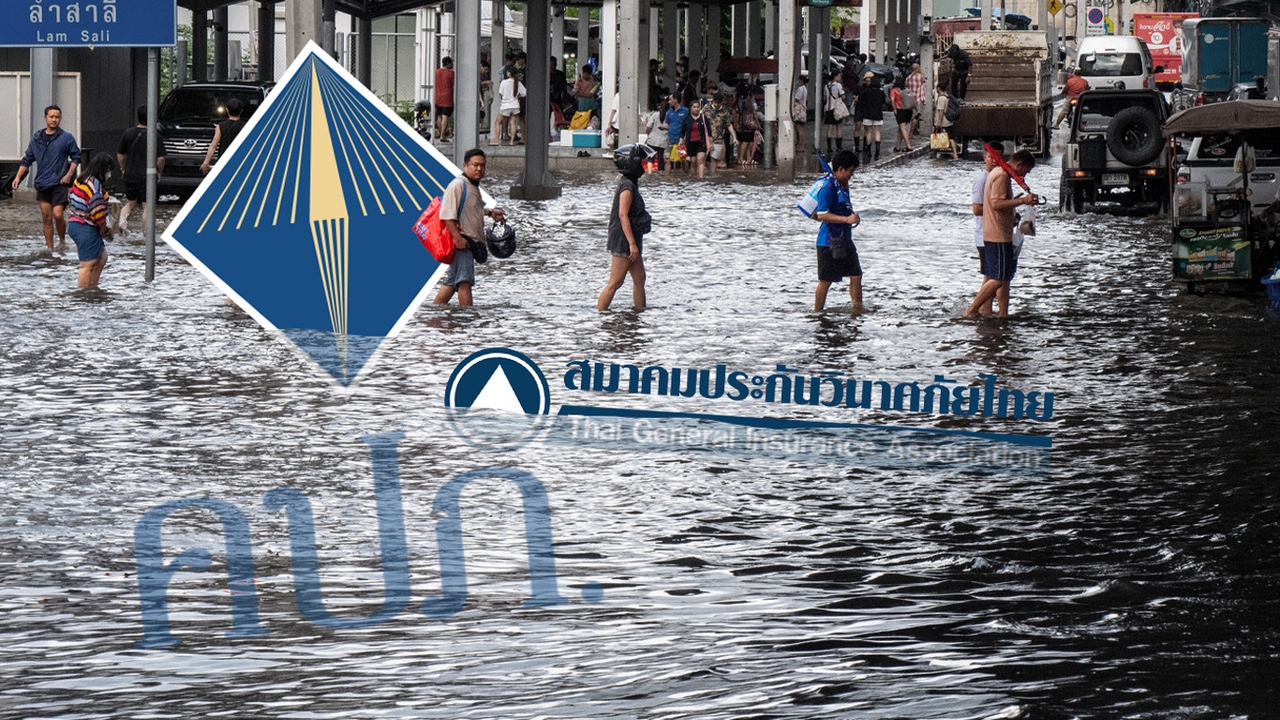
Since the night of 25 Sep, flooding occurred in multiple locations in Bangkok and other provinces, prompting authorities to declare disaster zones. Initial estimates from Kasikorn Research Center put the net economic impact at 7 to 17 billion baht, or about 0.03% to 0.11% of GDP. Meanwhile, the Economic and Business Forecasting Center at the University of the Thai Chamber of Commerce estimates damages could reach as high as 12 billion baht.
Compared to the massive floods of 2011, many consider this 2026 flooding less damaging. However, flood risk remains elevated with news of new rainfall expected between 5-7 Oct, causing concern among residents about their ability to cope, especially as prior government aid was initially only 9,000 baht per household.
In response to rising natural disaster risks and uncertainties, the government has implemented the National Disaster Insurance system by purchasing insurance from Thai companies to manage these risks. It allocated a budget of 15.5 billion baht to secure coverage totaling 75 billion baht, protecting permanent residences and death (or total permanent disability) caused by three main disasters: floods, storms, and earthquakes. Coverage runs from 1 Oct 2026 to 1 Oct 2027.
Thus, although the floods starting 25 Sep 2026 are not yet claimable, if new floods occur and disaster zones are declared, policyholders can claim up to 100,000 baht per household per incident. Initial payments of 10,000 baht per household per incident may be made if conditions are met.
With coverage reaching 75 billion baht, excluding claims for other damages such as vehicles submerged or water surrounding homes, insurers must also cover those who purchased separate policies. This raises concerns about how this damage might impact Thailand’s insurance industry.
The major floods caused widespread damage. Comparing with the 2011 floods or the 2025 Hatyai floods, Dr. Somporn Suebtawilkul, CEO of Dhipaya Group Holdings and President of the Thai General Insurance Association, explained that the 2011 floods caused damage at various levels but the insurance industry fulfilled its obligations under policies held by customers. The Hatyai floods caused about 20 billion baht in damages. Although the 2026 floods may cause twice that damage, the association assures that Thailand’s insurance system can handle this, with an average Capital Adequacy Ratio (CAR) of 471.62% in Q2 2026 among member companies—well above the 140% minimum required by the OIC.
Regarding the National Disaster Insurance, risk is managed by distributing it among 11 companies, with a 100% reinsurance structure. Coverage of 75 billion baht is reinsured in two parts.
First, the initial 5 billion baht is retained in Thailand. Participating companies can use reinsurers arranged by the Thai General Insurance Association, with limits from 1 to 4 billion baht (the first 1 billion baht may be allocated within each company).
Second, the portion from 5.001 billion to 75 billion baht is reinsured overseas, with multiple countries collectively providing coverage exceeding 100% of the insured amount.
This insurance scheme arose after the government allocated a budget of 15 billion baht and tasked the association to study and calculate appropriate coverage, resulting in the disaster insurance policy effective from 1 Oct 2026 (starting at 00:00).
Additionally, to combat potential insurance fraud, claims can be made online, and technology including AI will be used to screen for fraudulent claims.
Arpakorn Panlert, Deputy Secretary-General of the Office of Insurance Commission (OIC), told Thairath Money that discussions are ongoing in various sectors. For example, the Ministry of Tourism is considering group accident and emergency health insurance for tourists.
Meanwhile, for farmers, a rice paddy insurance project is awaiting final government approval. This program, in partnership with the Bank for Agriculture and Agricultural Cooperatives (BAAC), covers drought, floods, storms, and more, but budget allocation depends on government policy. This insurance has existed for several years but has not been continuous.
Finally, the government’s purchase of 75 billion baht disaster insurance is new to Thailand, so it remains to be seen how effectively this mechanism will provide quicker and more transparent relief to people when disasters occur.
Read personal finance and financial planning news with Thairath Money to help you "Better Finances, Better Life".https://www.thairath.co.th/money/personal_finance
Follow the Facebook page: Thairath Money at this linkhttps://www.facebook.com/ThairathMoney