

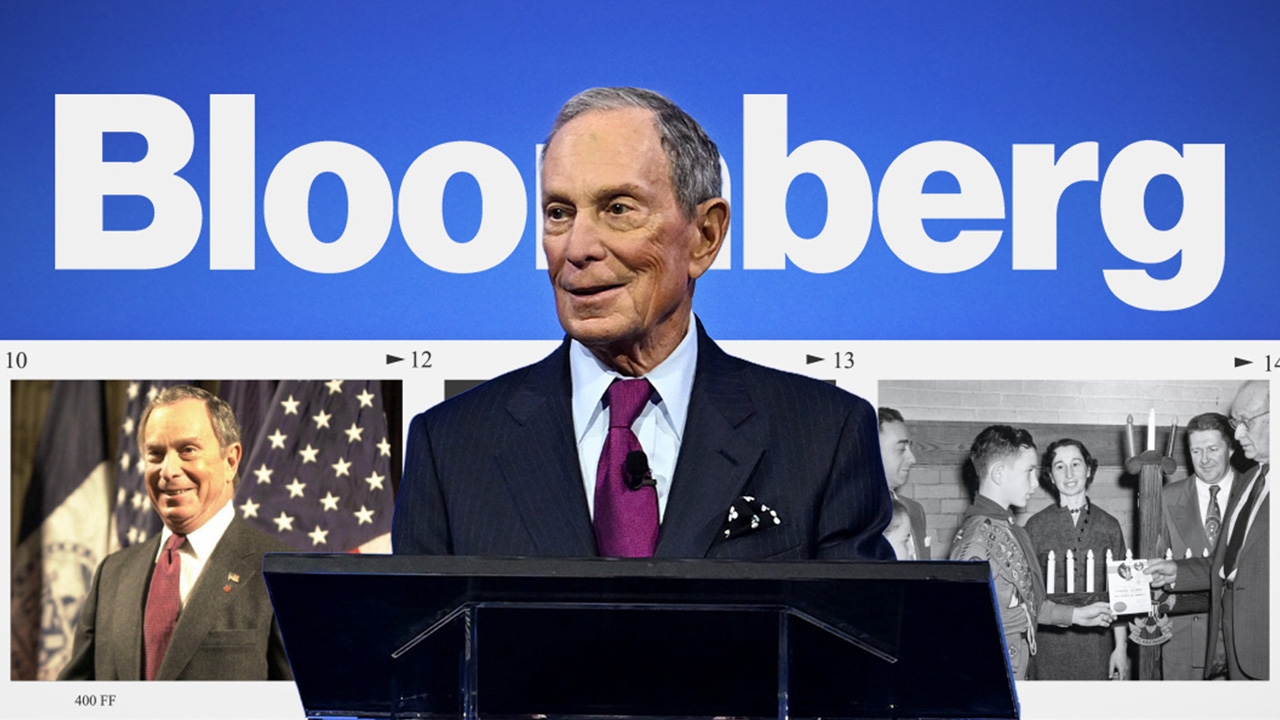
Many who follow financial news or international media will be familiar with a globally influential news agency, especially in finance, called "Bloomberg." Initially, the Bloomberg name was well known as a major financial data system indispensable to Wall Street, before expanding into a globally recognized media outlet.
"Michael Bloomberg" is the individual behind the success of the Bloomberg empire, a billionaireranked17th worldwide, with total assets exceeding 109.4 billion U.S. dollars (as of 30 Nov 2025 GMT+7). Beyond his wealth, he has been more than a businessman—he has also been a leader and a generous philanthropist who saw opportunity during crises, recognized data as an asset, and became a pivotal figure on Wall Street.
This article by Thairath Money in theHow to Make Moneycolumn delves into all aspects of Michael Bloomberg’s life, the financial industry genius who transformed investor work on Wall Street through data, and expanded that success into an indispensable media and technology empire for every financial institution.
The early image of Michael Bloomberg was not of someone raised wealthy in Manhattan, New York City, but rather growing up in Medford, Massachusetts, a modest town shaped by the determination of an immigrant family.
Born in 1942, near the end of World War II when the U.S. played a leading role, the country was mobilizing all citizens to support the war effort. His father, William Henry Bloomberg, and mother, Charlotte Rubens Bloomberg, descendants of Russian immigrants, epitomized the upward social mobility of the American Jewish middle class in mid-20th century America.
William Bloomberg worked as an accountant for a dairy company, earning enough to support the family. Michael Bloomberg’s beginnings were not extravagant or privileged. He lived in a small working-class suburban home, in a family that was stable but not wealthy.
A notable milestone came at age 12 when Michael Bloomberg joined the Boy Scouts of America, as he noted on his website.Mike Bloombergexplained that he earned the Eagle Scout rank—the highest possible, achieved by very few—and was proud of this achievement because it taught him discipline, ambition to earn badges, and leadership, shaping his strong disdain for disorder later in life.

After graduating from Medford High School in 1960, he attended Johns Hopkins University in Baltimore, studying electrical engineering. He worked his way through school as a parking lot attendant and took out loans to finance his education.
After earning his engineering degree, he pursued further study at Harvard Business School, obtaining an MBA in 1966. This education gave him insight into finance and management, forming the foundation for his future entrepreneurship.
This period marked a transition era as post-war generations began applying statistical analysis to management. Bloomberg stood at the crossroads, understanding practical work, engineering technology, and financial theory well.
His first job after graduation was at Salomon Brothers, a prominent investment bank at the time. Michael Bloomberg’s initial role on Wall Street involved manually counting stocks and bonds worth millions of dollars.
In the mid-1960s, Wall Street still relied heavily on paper, meaning every trade required physically transporting certificates through pneumatic tube systems. This inefficiency revealed to him the market’s sluggishness and lack of effectiveness.
His career at Salomon Brothers had ups and downs. He rose to become a key General Partner on the trading floor before being reassigned to behind-the-scenes work in the company’s Information Systems division.
However, this setback coincided with the digital revolution. He began applying his engineering background to finance, recognizing traders were disadvantaged by lacking real-time data, often relying on previous day’s closing prices or fragmented info via phone. He realized the future of finance depended not on trader instinct but on speed and accuracy of on-screen data.
In 1981, a low point arrived when Salomon Brothers was acquired, and he was laid off. As a General Partner, his shares were cashed out, providing him a severance of about 10 million U.S. dollars.
This sum became seed capital for founding his own company and introduced us all to Bloomberg L.P. later on.
"The financial world is drowning in raw data,"
Michael Bloomberg did not retire with his $10 million and leave finance as many suggested. Instead, he used that capital to launch "Innovative Market Solutions," with the clear vision "to place a computer on every Wall Street desk."
Looking back at the financial industry he had just left, he saw its glaring inefficiencies and realized firms on Wall Street would pay well for systems that could aggregate data, perform complex analysis such as bond yield graphs, and deliver real-time information.
The first product released was the "Bloomberg Terminal," a world-changing innovation. Before this, a trader might have to watch separate Telerate screens for bond prices, Quotron screens for stock prices, manually calculate yields, and keep stacks of newspapers for news updates. This tool integrated all these functions seamlessly into a single ecosystem.
The brilliance of theBloomberg Terminalwas not just in data aggregation but in analysis, allowing traders to instantly compare U.S. government bonds with corporate bonds and generate historical trend graphs with just a few keystrokes.
New and advanced products often face skepticism about reliability. Major financial institutions hesitated to entrust critical data to this system until a turning point in 1982, when Merrill Lynch, a leading U.S. investment firm, ordered the system and invested $30 million for a 30% stake in the company.

With growing trust, the company flourished, renaming itself "Bloomberg L.P." in 1986 and pioneering a business model based on leasing Bloomberg Terminals rather than selling them outright. This early subscription model remains in use today, with membership costing about $31,980 per terminal annually.With around 350,000 global subscribers,Bloomberg Terminal's business generates over $10 billion annually.
Currently, Bloomberg L.P. remains a private company, so it does not publicly disclose financial statements, but it is estimated that in 2023 the companyhad revenues of$12.5 billion.
After the Bloomberg Terminal became hugely profitable and having spent nearly his entire life in finance, Michael Bloomberg expanded into media, launching " Bloomberg Business News" (now known as Bloomberg News ) in 1990 to supply news directly to the Terminal, eliminating dependence on Dow Jones News.
He later expanded media operations into television, radio, and magazines. Although less profitable, this media division played a critical strategic role: enhancing brand credibility and ensuring Bloomberg Terminal remained the fastest news source, helping retain subscribers.
In 2001, he chose to enter politics, running for mayor of New York City during a time of crisis. Following the 9/11 terrorist attacks on the World Trade Center, which devastated the city, the public sought a professional crisis manager rather than a typical politician. This led to billionaire Michael Bloomberg winning the election.

As mayor, he transformed city management by applying the data-driven, technological approach he used in business. New York recovered from 9/11 and the 2008 financial crisis more quickly and robustly than other cities, with record employment and tourism. He was elected to three consecutive terms, serving 12 years.
After leaving office in 2013, he returned to business and intensified his philanthropic efforts,founding"Bloomberg Philanthropies," to channel profits into public health, environment, education, government innovation, and arts and culture. .
Sources:Forbes,,Mike Bloomberg,,EBSCO,Investopedia [1][2][3][4],Morningside Center,,HBR
Follow the Facebook page: Thairath Money at this link -https://www.facebook.com/ThairathMoney