

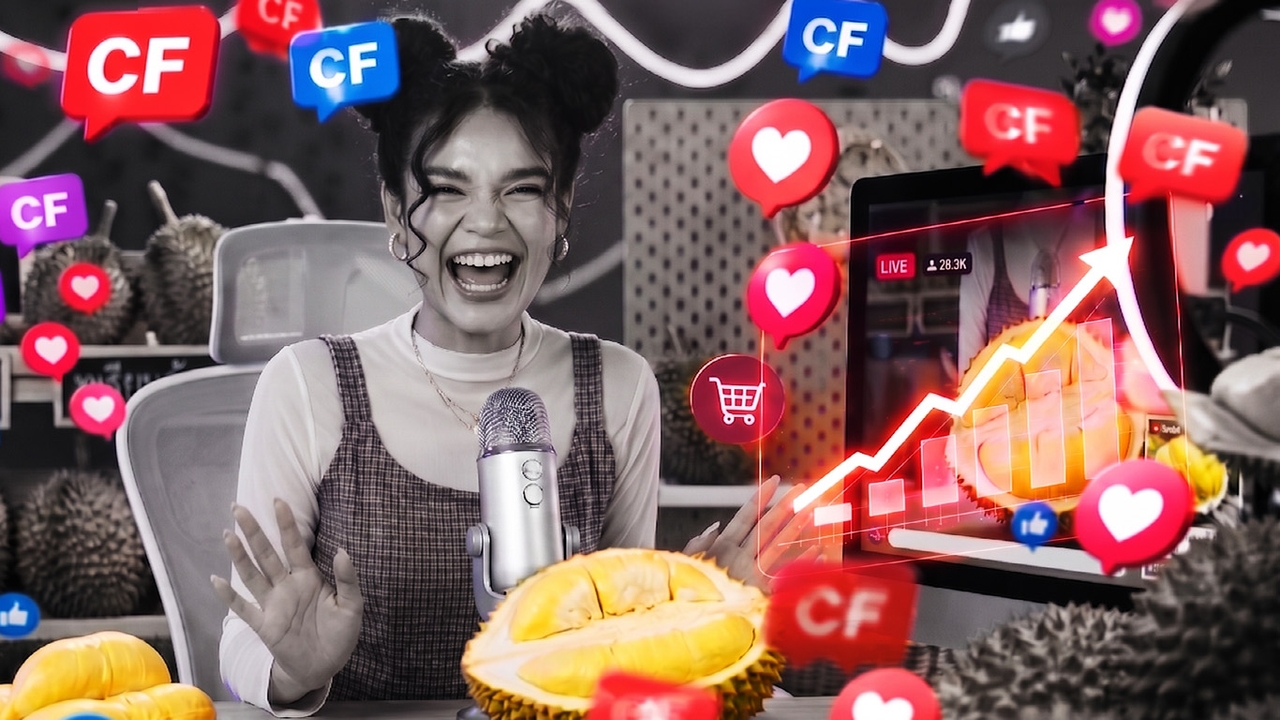
Have you ever wondered why when we shop at malls, we hesitate and compare prices at dozens of stores yet don’t buy, but once we enter a live stream or see a Flash Sale countdown, all logic collapses? Before we realize it, money has already been transferred from our account, even though we didn’t really want that item that much.
The clearest reflection of this nowadays is the phenomenon called “durian fever live streams.” No matter where you scroll, you’ll see famous influencers creating legends of "basket-breaking" sales, raking in millions to hundreds of millions of baht within minutes. When durian season is hot, online sellers dress like farmers and slice durians live in real time. Viewership soars, and people flood the F button until the system nearly crashes.
Behind this success, there are almost always “economic mechanisms” and “psychological wars” at play.
“Only 3 durians left, sir!”
“This bag model has only 3 left, once they’re gone, they’re gone. This price is only for this live stream!”
These classic phrases affect our self-control through behavioral economics. One theory called Loss Aversion by Nobel-winning economist Daniel Kahneman explains that humans feel the pain of "loss" twice as strongly as the pleasure of "possession."
Analysis from Bnomics by Bangkok Bank points out that when a seller shouts “Only 3 left,” our brain stops questioning the necessity of the item and immediately calculates, “If I don’t buy now, I’ll lose this opportunity forever!” This fear of loss activates the amygdala (the brain region controlling fear and anxiety), which suppresses the prefrontal cortex responsible for logical analysis, temporarily paralyzing rational thought. In simple terms, “emotions spike, reasoning collapses,” so we press CF first and let our brain find excuses afterward.
It’s like when sellers say, “This price is only for the next 2 minutes,” and a countdown timer runs on screen, making our hearts race.
Psychologically, this is called the Zeigarnik Effect. Humans dislike unfinished tasks; our brains focus on “incomplete missions.” When sellers impose time pressure, the brain sees buying as a mission to complete. Mental tension rises sharply, and the only way to release this discomfort is to type CF and transfer the money to finish it. Only then will the brain relax and feel satisfied.
Another trigger is FOMO (Fear of Missing Out). Among millennials (Gen Y), as many as 69% experience this, and research shows FOMO drives sudden purchases up to 66.4%.
Watching live streams, we see messages flooding the chat like “CF please,” “01 ready to pay,” “02 confirmed,” rapidly like a stream. This is called Herd Behavior. According to Robert Shiller’s concept, we tend to decide based on others around us; our brains shortcut to thinking, “If so many people are buying, it must be good.”
But behind this bustle, sometimes there is Artificial Crowding — promotional psychology and atmosphere-building strategies that sellers use for double impact.
Moreover, live streaming has eliminated Ronald Coase’s Transaction Costs. Previously, buying meant going to the mall, searching, and comparing prices. In live streams, everything happens on one screen — you see the product, the seller tries it out live, and you can ask questions immediately (reducing information asymmetry). This makes us feel safe, confident, and decide faster.
Add to that the Anchoring Effect sellers often use, like “This item sells for 1,590 baht in stores, but today in this live stream, it’s only 390 baht!” Our brains latch onto 1,590 as the reference point and feel that 390 is incredibly cheap, even though the actual cost might be only 150 baht.
Ultimately, we’re not just buying products; we’re buying Entertainment Utility — the seller’s humor, the thrill of the rush to buy in time. It’s a form of recreation for today’s generation.
However, international research by Isabella Piña of Regent University studying “The Digital Temptation” shows that after pressing CF and the live ends, brain chemicals drop back to reality. This leads to Post-Purchase Cognitive Dissonance — mental conflict after buying.
In lay terms, this is the feeling of “waking up regretting the money spent,” staring at unripened durians or clothes still with tags, asking repeatedly, “Why did I buy so much?” Meanwhile, compulsive, mindless CF pressing accelerates household debt crises, especially among young people. Data shows social media addicts who watch product reviews impulsively lose money to sudden purchases four times more than others, resulting in unnecessary credit card or buy-now-pay-later debt.
The CF button or the purchase button on live streams is not a coincidence but a deliberately designed space using fear, scarcity, and social pressure psychology that causes us to transfer money in a split second.
Follow the Facebook page: Thairath Money at this link.https:// www.facebook.com/ThairathMoney