

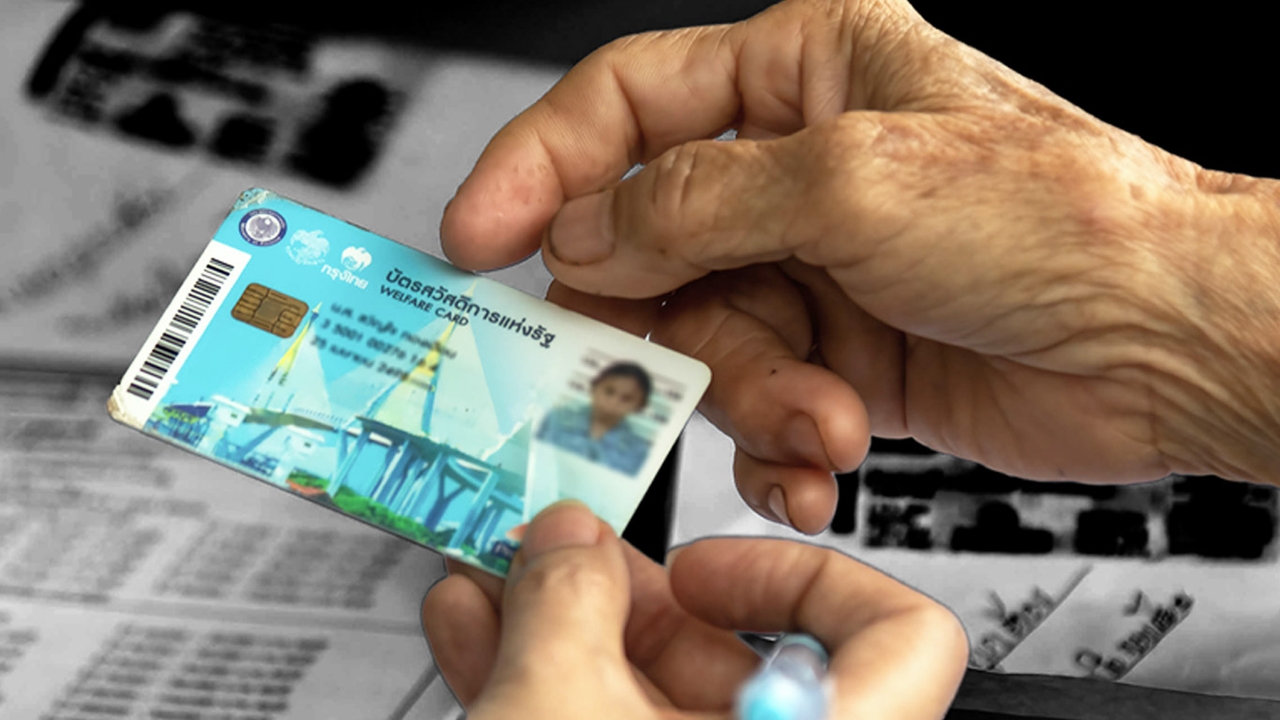
"If parents have zero income but their children claim a 30,000 baht annual tax deduction for supporting them legally, do you think the parents should lose their poverty card eligibility?" The question has become central in the upcoming registration for the 2026 State Welfare Card, or 'poverty card,' open from 4 to 21 June 2026, sparking widespread debate across Thai society.
Immediately after the Ministry of Finance announced a new exclusion criterion stipulating that "anyone whose name is used to claim tax deductions as a parent, spouse, or child will be immediately disqualified," the issue ignited social controversy.

From the government's perspective, this measure aims to plug loopholes to ensure tax funds reach "truly needy individuals without support" and to prepare the database for future implementation of a Negative Income Tax system.
However, from the public’s viewpoint, particularly among the lower-middle class who work honestly and pay taxes properly, this criterion raises serious questions: Is the state misdefining "poverty"? More importantly, this might not just concern the poverty card but could signal the future direction of Thailand’s welfare allocation over the next 10 to 20 years.
Looking beyond individuals to the whole family?
Yet, one critical condition involves using tax data where children claim a 30,000 baht standard deduction per parent annually as a disqualifier—effectively reverting to assessing the family’s economic situation collectively, despite the stated individual focus.

It seems to imply that if parents’ names are used for tax deductions, it means they have an "economic caretaker," thus immediately excluding them from the "genuinely poor" group.
When "filial piety and tax system participation" become burdens punishable by loss of welfare rights.
Online, sarcastic and poignant criticisms emerged, such as...
"This policy teaches us that filial piety is worth about 30,000 baht a year."
"When children send money to support their parents and claim tax deductions, it is a responsibility, not a marker of true or false poverty."
This reflects the undeniable reality that many Thais are neither wealthy nor destitute, but are salaried workers earning 20,000 to 30,000 baht monthly, balancing urban living costs while supporting children and aging parents.
The annual 30,000 baht tax deduction (which translates into a modest actual tax savings given the progressive tax rates) is a basic right that helps keep families afloat, not an indication they comfortably support their parents.
Consequently, many families face a dilemma, calculating a trade-off between letting children claim parents’ names for tax deductions or retaining the parents’ poverty card benefits, which average 4,000 to 6,000 baht annually (such as shopping and transportation allowances). They must assess which option is more advantageous.
An era where the "state knows more" yet citizens bear the burden of "proving poverty."
However, the question remains: despite advanced technology, Smart Card ID systems, and detailed income and asset data, why does the 2026 welfare screening still impose burdens on over 13 million current cardholders, forcing them to repeatedly travel, submit documents, and re-verify their identities?
Reducing false poverty claims but risking exclusion of the genuinely poor?
Inclusion Error: Non-poor individuals mistakenly receiving benefits (false positives).
The stringent 2026 exclusion criteria, including the parental tax deduction disqualification, clearly prioritize reducing Inclusion Errors (false beneficiaries). Yet, the critical question is whether raising the eligibility bar this high will increase Exclusion Errors (genuine poor left out), especially elderly rural parents whose urban children claim tax deductions without actually providing financial support.
This raises a significant question: amid Thailand’s historic low birth rates, a shrinking younger generation, rising living costs, and a growing elderly population without pensions or steady income reliant on their children, is the state’s assumption—that if children claim tax deductions, parents no longer need welfare—sustainable over the next 10 to 20 years?
On one side is the survival of the family institution (middle class) that views the state’s rules as too harsh, shifting burdens back onto citizens amid soaring living costs.
On the other side is the country’s fiscal survival (government), which believes strict budget management targeting only the critically needy is necessary to prevent collapse of the national welfare system. This presents an open-ended dilemma for Thai society: choosing the path that minimizes harm as the population ages.
Source: Ministry of Finance, TDRI
Follow economic and government policy news with ThairathMoney at
https://www.thairath.co.th/money/economics/thai_economics
Follow the Facebook page: Thairath Money at the link belowhttps://www.facebook.com/ThairathMoney