

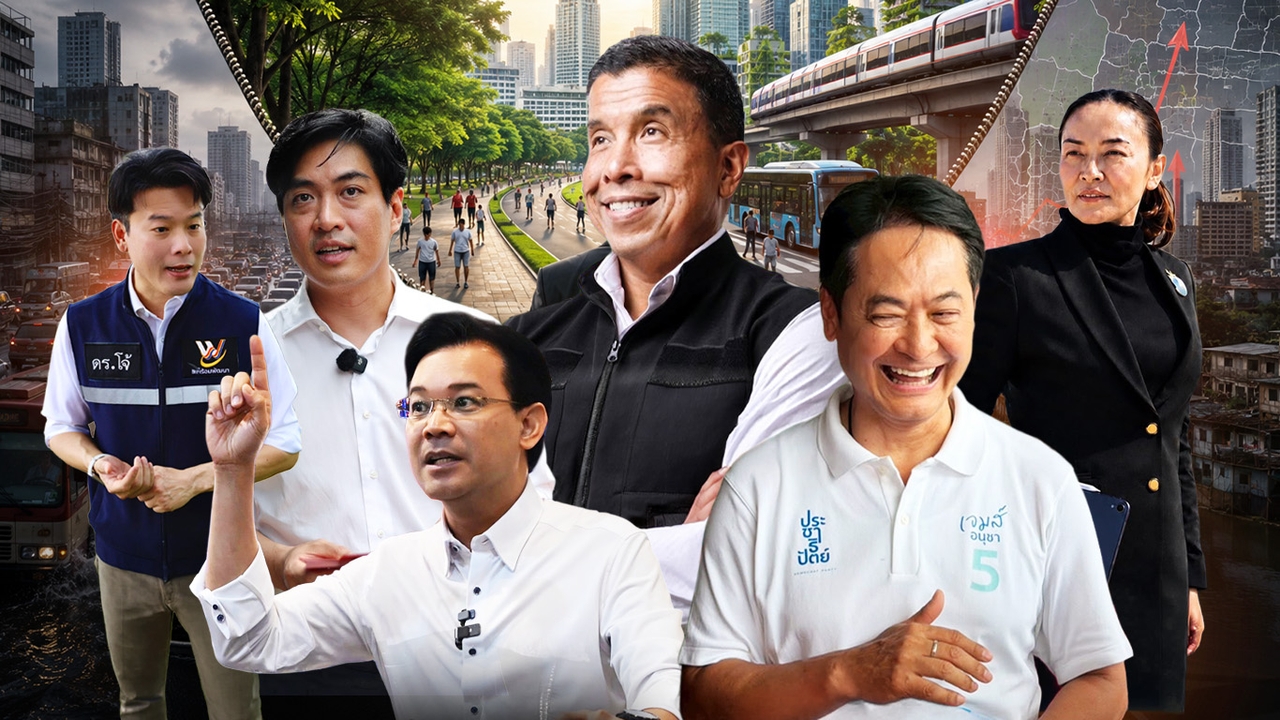
Did you know? The Bangkok governor election might affect your wallet more than hoping for your company’s annual salary raise!
While legally the Bangkok governor cannot set minimum wages or order banks to lower interest rates, the governor holds full authority over controlling "city costs," which act like hidden taxes that Bangkok residents unknowingly pay every day.
Thairath Money analyzed data from the National Economic and Social Development Council, showing Bangkok as the city with the second highest per capita income in Thailand—697,529 baht annually (latest 2024 figure), second only to Rayong province. Yet most Bangkok residents feel each month is a constant struggle to make ends meet.
Statistics also reveal that over 50% of Bangkok’s population earn less than 30,000 baht per month, with the median salary at 28,600 baht. However, these urban workers pay nearly 5,000 baht monthly on travel—about 17% of their total income.
Households in Bangkok carry debts amounting to 181% of their annual income, severely limiting their ability to save or invest for future security compared to populations in other major global cities. This high figure stems from "hidden taxes" imposed by daily infrastructure problems residents face.
Let’s simulate a real-life scenario for an office worker earning the standard 30,000 baht/month in Bangkok, examining what the city deducts from your income.
Clearly, some costs are not direct income losses but "city costs" resulting from fundamental urban problems we must bear.
According to the latest Thairath Poll, the urgent problems residents want addressed most directly relate to their financial burdens.
1. Traffic congestion and travel (top poll issue): Bangkok residents lose an average of 35 minutes per trip stuck in traffic. Losing one hour daily equals 365 hours or over 15 days annually wasted. This lost time is an economic opportunity cost that could be spent resting, side jobs, or creative work. This problem causes overall economic damage of 165.4 billion baht per year.
2. Travel expenses and feeder buses: Currently, commuting from alley homes to BTS stations requires multiple transfers like motorcycle taxis, minibuses, and buses. The free electric bus project "BMA Feeder" on seven main routes helps directly cut this fixed cost.
3. PM2.5 dust and pollution: Often overlooked because costs are indirect, but the Puey Ungphakorn Institute reports Bangkok suffers the highest economic damage from toxic dust in Thailand—436.33 billion baht annually—including medical costs, sick leave, and reduced health.
4. Flooding and drainage: Government compensation of 5,000–9,000 baht per household after floods never matches actual property damage, especially to cars and homes. Proactive drainage management like canal dredging and waterway clearing acts as insurance protecting residents’ assets.
All this helps illustrate why the Bangkok governor election on Sunday, 28 June 2026, matters. With about 4.5 million eligible voters (more than 2022), 18 candidates are running for governor alongside 258 council candidates across districts.
Early NIDA Poll results show independent candidate Chadchart Sittipunt (#9) leading with 67.30%, followed by Chaiwat Stavanvijit of the Prachachon Party (#10) at 8.20%, and Anucha Burapachaisri of the Democrat Party (#5) at 3.10%, plus other notable candidates like Komsan Panvichatikul (#13), Mallika Bunmitrakul Mahasuk (#14), and M.L. Korakasiwat Kasemsri (#1).
But the key consideration is not just the individuals, but the policy ideas that could transform the city’s cost structures, such as:
Finally, Bangkok’s annual budget of about 80 to 90 billion baht can effectively become money returned to manage the "life budget" of every city resident if a governor can implement tangible policies—for example, saving you 1,000 baht per month in travel costs, 500 baht in health-related expenses, or returning 30 minutes daily lost on roads.
Such a governor could boost your disposable income more than a 5% salary raise from your company!
On 28 June, don’t think of voting merely as a legal duty or political preference. You’re choosing someone to manage your "wallet" and "life costs" for the next four years!
Sources: National Economic and Social Development Council, Kasikorn Research Center, Bangkok City Planning Office, Rocket Media Lab, General Insurance Association, Chulalongkorn University Faculty of Engineering, Puey Ungphakorn Institute.
Follow economic and government policy news with ThairathMoney athttps://www.thairath.co.th/money/economics/thai_economics
Follow the Facebook page Thairath Money herehttps://www.facebook.com/ThairathMoney