

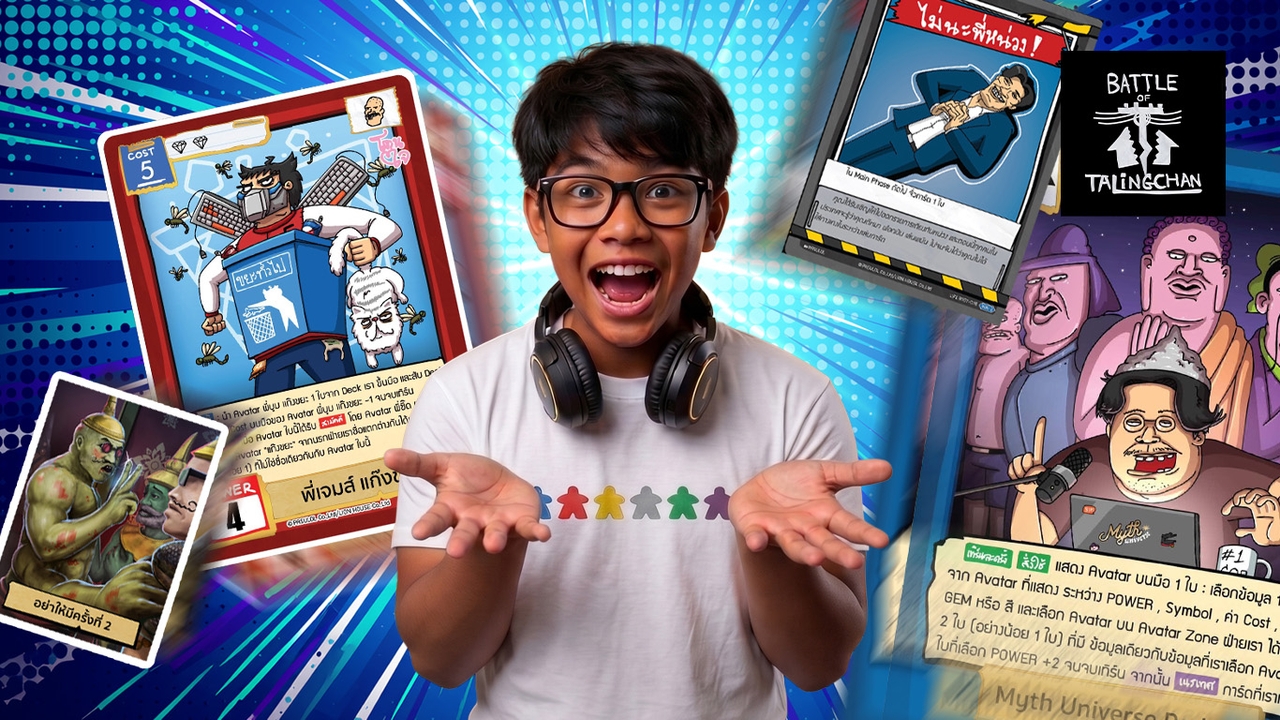
"At first, I thought my child was just buying cards to play, but after listening to him explain about rare cards, trading, and prices changing daily, I began to wonder... is this just a toy, or a new form of asset for the younger generation?"
If you have children or grandchildren in primary to secondary school, chances are you've seen packs of cards scattered on the table or heard the name "Battle of Talingchan" without really knowing what it is.
It began as a dark joke on YouTube, evolved into an animation with millions of followers, and then became a card game with an actual marketplace where prices fluctuate daily. Many children are starting to "understand market mechanisms" through card trading even before they know what stocks are.

Imagine a child who buys a card for just a few tens of baht from a random pack, but when it’s a rare card, its price can soar to thousands or tens of thousands of baht. This is exactly what happened with early Battle of Talingchan cards: UR cards or special illustrations cost on average just tens of baht to produce, but in the resale market, they trade from tens of thousands up to fifty thousand baht due to rarity, no reprints, and demand exceeding supply.
For example, codes SD01 to SD05 including characters like "Tough Kirilas," "Hero of the Alley," "Hell is Just Chili Paste," "Fighting Rooster Soldier," and "Born from Water" were the first sets that quickly sold out from main stores and have high collector demand.
In simple terms, this mechanism is the same that causes some sneaker models or art toys to spike in price, leaving outsiders wondering, "Why is this so expensive for just that?"
An example of collaboration cards released recently.

The collaboration between Battle of Talingchan and the "Myth Universe" podcast produced cards parodying the hosts sitting among legendary characters in a cheeky style typical of the brand. Interestingly, the gameplay mechanics of this card go beyond the artwork; it has complex power usage conditions requiring players to read various values on their avatar cards—such as power, symbols, usage cost, and the number of gems—and compare them to cards on the field to gain advantages. Simply put, children playing this card must read conditions, analyze numbers, and decide how best to allocate resources, much like interpreting a condensed financial statement.

The second example comes from another route: a collaboration with the Pixiv artist platform in a fan art contest where new artists reinterpret characters from this universe in their own style. A fierce green giant inspired by Thai literature is featured with the artist’s name and work ID on the card.
This is the point where this market differs from typical collectibles because its value is not derived solely from the game itself but also from the "creator community" that continues to grow. The more artists involved, the more limited edition cards are produced for collectors, which is the same formula that has driven prices up for many collectible brands worldwide.
These two cards illustrate well why the value of a single card can vary by tens or hundreds of times. It depends not on the paper or ink but on gameplay mechanics, production limits, and the stories behind the community connection.

More interesting than the price figures is how these children understand their cards. One Gen Alpha child shared that his favorite cards are easy to play and affordable, usually around 300 baht, while rare cards go for about 700 baht. Importantly, the cards include Thai-style humor and stories from familiar literature, making them more accessible than foreign card games.
This is why many parents start to question unknowingly when they see their children practicing supply and demand, negotiating prices, assessing risks about which cards to keep or sell—skills identical to what adults learn when starting to invest in the stock market.
However, unlike their parents’ generation, Gen Alpha does not emotionally attach to cards through "nostalgia" like those who grew up with Pokémon and buy cards later to relive childhood. They treat it as portfolio management and risk diversification from a young age.

Research shows that in early 2026, the Battle of Talingchan player base (60,000 followers) grew by about 5,000% after the release of animation content explaining gameplay rules. The product expanded distribution to toy stores like Toylaxy, B2S, online orders via 7-Eleven, and recently featured in a national competition at the Thailand Character & Content EXPO 2026 at Paragon, supported by the Department of Intellectual Property.
On a larger industry scale, the Thai gaming market is worth over 36.5 billion baht, but more than 98% of that is from imported businesses and foreign-licensed content. The emergence of a Thai IP like Battle of Talingchan with this player base in just two years is thus seen as a rare exception in this market structure.
However, before rushing to buy for speculation, it’s important to understand this is not an investment with guaranteed returns. Card prices depend on popularity, player base, and market conditions at the time, lacking the fundamental value backing that company stocks have.

Also, beware that a current hot trend may fade tomorrow. If popularity declines or new card sets replace rare ones, prices that once soared can drop just as quickly.
A thought-provoking question is whether the younger generation is building wealth through what they truly love more than what previous generations called "investment." If so, how much will the future definition of assets change?
Ultimately, not every collectible generates returns, and one should not buy solely hoping to speculate on trends because their value depends on community, popularity, and market conditions, all of which can change at any time, like all alternative assets in the past.
Source: Kasikorn Research Center, Battle of Talingchan, settrade, club.b2s.co.th
Follow economic and government policy news with ThairathMoney athttps://www.thairath.co.th/money/economics/thai_economics
Follow the Facebook page: Thairath Money at this linkhttps://www.facebook.com/ThairathMoney