

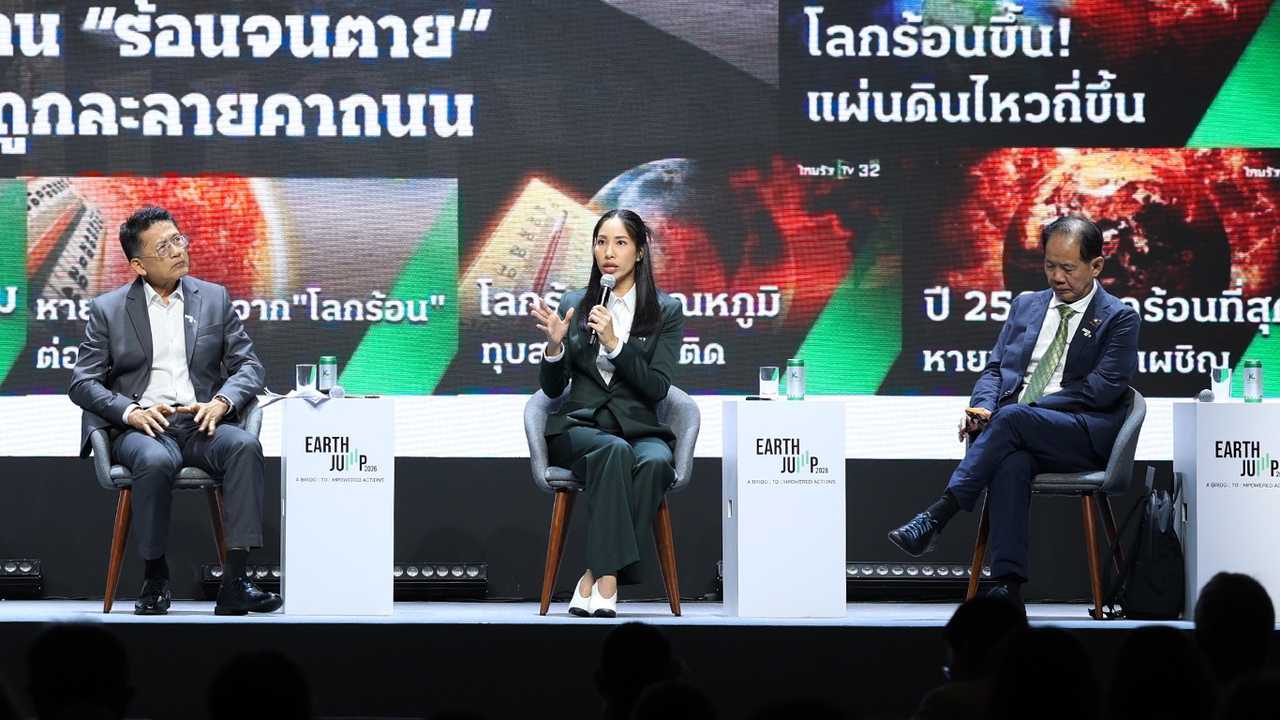
EARTH JUMP 2026 is the title of the event. In its fourth year, the annual major sustainability forum organized by Kasikornbank in collaboration with global partners operates under the theme "A Bridge To Empowered Actions," encouraging businesses to take real steps, providing guidance to help them survive, adapt, and thrive in the new world.

Rungreung Sukkeodkitpiboon, President of Kasikornbank, said that EARTH JUMP 2026 "Empower Action," hosted by Kasikornbank under the theme "A Bridge To Empowered Actions," has sparked inspiration and prepared small and medium-sized enterprises (SMEs) to transform their businesses and overcome various challenges toward a green society.
This adaptation not only helps businesses, as key drivers, to grow steadily and sustainably over the long term but also acts as a proactive force leading Thailand’s economy to grow strongly and sustainably together.
Kasikornbank has outlined support for SMEs covering four main areas, starting with the most important: providing knowledge to build correct understanding, followed by tailored solutions enabling entrepreneurs to apply improvements or changes in their operations aligned with sustainable development.
Additionally, consulting services help facilitate business transitions toward environmentally friendly models, and crucially, financial support and access to funding act as key drivers to make SME business transformation toward a green society both effective and feasible.
"The essential starting point for transitioning toward sustainability is for entrepreneurs to open their minds and recognize this as an urgent necessity. Although Thailand aims to achieve Net Zero by 2050, the journey toward this significant goal must begin today, seeking business partners and experts who can provide accurate advice, helping businesses smoothly cope with changes," Rungreung said.
Currently, all sectors are seriously pushing this agenda, providing a great opportunity for SMEs to learn and prepare. Kasikornbank is ready to serve as an advisor and partner supporting entrepreneurs at every step of the transition, jointly driving all businesses toward becoming truly sustainable and efficient green enterprises.
. Kattiya Indaravichai, Chief Executive Officer of Kasikornbank, added that in a world where businesses continually face pressure, sustainability becomes the way for businesses to survive, adapt, and grow in the new world, especially as global rules change. Being green is no longer a bonus but a license to operate.
Furthermore, "long-term sustainability" requires patience, investment, and time, but the outcome is a structure that grows stronger over time. To lead Thai businesses toward sustainability, four characteristics are essential.
First, change the mindset from surviving short-term to pursuing sustainable growth.
Second, turn obstacles into opportunities.
Third, progress must be collective. Previously, large businesses led the way, but now it must extend through the supply chain to SMEs, which are key to the transition.
Fourth, shift from vision and commitment to serious action because the transition is not about speed but moving together and ready to sustainably reach Net Zero.

EARTH JUMP 2026 packed two full days with two stages featuring 60 leading speakers, including in panel discussions. One such panel was "Powering Sustainability: The Role of Media as a Change Catalyst," highlighting the media's pivotal power in driving sustainability. It began by reflecting on the media’s usual role, often behind the scenes telling others' stories.

Jitsupa Watcharaphol, Co-Chief Executive Officer of Thairath TV and Thairath Online, shared her dual perspective as both a media executive and journalist at Thairath, pointing out that media has a unique power to change the world compared to other professions, due to its louder voice, influence, and professional ethics, allowing it to highlight overlooked issues and create momentum up to policy levels to prompt real action.
Thairath’s approach to driving sustainability is divided into two main dimensions. The first is education, through 111 Thairath Wittaya schools nationwide, established long before the sustainability trend, aiming to reduce inequality and provide equal access to quality education for disadvantaged children in remote areas. Partnerships, such as with SCGC, support initiatives like active learning projects teaching waste management. The second dimension is the environment and media work, which plays a primary role in raising awareness.
From sustainability reports to investigative journalism aimed at protecting the environment, Jitsupa explained the media’s responsibility through producing Sustainability Reports in 2024 and 2025, gathering ideas and activities from government, private sector, policy, and education in one place to demonstrate that sustainability cannot be achieved by individuals or single agencies alone but requires collective progress.
Beyond reports, Thairath consistently creates environmental content and news stories, focusing on long-term impacts often overlooked. A clear example is its coverage opposing the construction of the Salak Phra tunnel in Kanchanaburi province, highlighting environmental damage from mountain blasting; the project remains unstarted to date.
In a recent case, when dugongs were hunted and beheaded, Thairath’s media group did not just report daily news but sent investigative teams into the field to expose the critical crisis of Thailand’s dwindling dugong population, using investigative storytelling to attract attention and show it as an immediate threat. They also headline difficult topics like climate change with clear imagery, such as stories about homeless people dying on the streets due to extreme heat, helping the public grasp the situation more easily.

On this front, Kitti Singhapad, anchor of the "3 Dimensions" news program, supported the view that environmental journalists remain few and their work is like "finding allies" to build a coalition.
He cited his experience covering the global climate summit (COP), a political negotiation space limited to leaders and ministers,
which focused on three main pillars: greenhouse gas reduction, impact adaptation, and funding plus technology to assist countries. Without journalists seeking sources and civil society groups protesting outside, the voices demanding fossil fuel reduction and corporate accountability would never reach the outside world.
He noted that environmental journalism or green journalism fundamentally conflicts with current media algorithms because such news lacks clear drama or polarized conflicts, its impacts are long-term rather than immediate, and it contains complex scientific terminology like Net Zero, Carbon Credit, and CBAM, which the public cannot grasp without media explanation. Moreover, scientific views range widely from activists like Greta Thunberg to former U.S. President Donald Trump.
In environmental news work, Kitti referred to Rachel Carson’s book "Silent Spring," which exposed the dangers of DDT and sparked the environmental movement that led to the creation of the U.S. Environmental Protection Agency (EPA) and documentaries like BBC's "Blue Planet." Nonetheless, such topics receive minimal media coverage because they are overshadowed by other types of news due to algorithms.

This aligns with Wanchai Tantivitayapitak, Director of the Public Broadcasting Organization of Thailand (ThaiPBS), who stated that journalists must act as "trusted messengers" enabling consumers to think and decide independently, rather than being promoters or opinion shapers. Media must jolt society awake by raising issues like government welfare distribution or educating about AI. Yet today, truth is often trimmed and selectively presented for certain interests.
Wanchai presented critical information rarely discussed in Thai society, citing a report from Climate Central stating that by 2050, about 30 years from now, coastal cities worldwide and over 150 million people, including Bangkok and central Thailand provinces, will definitely face flooding and submersion.
He also referenced Antarctic researchers who found that the South Pole ice is collapsing to bedrock and melting faster than expected, leading to rapid sea-level rise. The most frightening future crisis is freshwater wars, as the Himalayas, the source of six major Asian rivers supporting billions, are melting significantly.
Compared to neighbors like Indonesia, which passed a law to relocate its capital from Jakarta, sinking due to flooding, to Borneo Island under the name "Nusantara," set to begin moving in a few years, Thailand still lacks concrete preparedness, whether relocating its capital or building sea dikes. These remain mere concepts shelved away. Even as the Bangkok governor election approaches, few candidates seriously address the city’s flooding threat.
However, Thai society still lacks understanding, for example, the Ranong-Chumphon land bridge project is often viewed only economically, without accounting for the damage to forests, coral reefs, and tourism losses.
Jitsupa added that mainstream media outlets like Channel 3 or Thairath remain business organizations balancing capitalism, organizational survival, and the beauty of the world. Media businesses rely on advertising revenue and view counts, and environmental news does not perform as well as crime or drama news.
Additionally, over the past decade, journalists have faced lawsuits from powerful and financial groups, making their work more difficult. Media must adapt by presenting truthful, beneficial facts while ensuring employee and organizational survival.

To address the difficulty and distance of environmental news, Kitti shared that stories must be brought close to the audience, for example, instead of saying polar ice is melting, which seems irrelevant to Thai people, explain that Bangkok’s temperature will become as hot as a desert. They also emphasize positive news offering "solutions," helping people gradually open their minds and change behaviors.
"The most important shield for media is that what is presented must be truthful and serve the public interest without conflict or personal issues. If media maintain straightforward principles and appropriate distance from sponsors, they can operate safely," Kitti said.
Towards the discussion’s end, participants looked to the future of new media professionals. Wanchai commented that environmental journalists have the toughest work, needing broad knowledge of law, science, and economics. It is encouraging that today’s youth show much more interest in environmental issues than previous generations because they face daily crises like PM 2.5 pollution. Now, many students and youth are launching startups related to environment, waste management, and organic fertilizer, indicating environmental news will play a role as significant as political or sports news in the future.
Meanwhile, Jitsupa noted that creating media focused on environmental issues today is extremely challenging due to many limitations. General audiences tend to pay less attention to environmental news compared to crime, drama, or colorful human-interest stories that generate more views.
This results in fewer advertising funds and sponsors genuinely supporting environmental issues. Moreover, media face risks and difficulties greater than before, forcing many news outlets to adapt for survival and safety.
Therefore, modern media must function as businesses balancing survival in capitalism with reporting truthful, beneficial facts to the public. Success and sustainability in this require genuine understanding and support from all sectors of society.
The fact that financial institutions are organizing environmental events like "Earth Jump" by Kasikornbank reflects that the business sector increasingly recognizes sustainability as "non-negotiable." Similarly, for today’s media, not addressing sustainability is impossible.
The key is how to communicate for real benefit, since politicians think in election cycles and marketers in quarters, but the environment requires thinking in decades. Media cannot drive this alone; they need consumer support.
If society prefers any environmental content, whether in-depth reports or hopeful stories, it should support by liking, sharing, or subscribing to help media earn income, gain morale, and jointly drive the world forward so environmental journalism is not a marginalized profession but a powerful force capable of real change.

Additionally, the event features K-Climate Solutions offering comprehensive services, from business readiness checks with ESG Readiness Check, greenhouse gas emission calculations, expert consultations, to launching a new service, the “Sustainability-Linked Loan for SME,” providing special interest discounts upon achieving targets.
A major highlight of EARTH JUMP 2026 is hosting the global stage through collaboration with the World Bank Group for the 8th Global Policy Forum on Natural Capital 2026, positioning Thailand as a "bridge" between global policies and practical business implementation.
Read more about Sustainability and ESG with Thairath Money to help you "Better Finances, Better Life" athttps://www.thairath.co.th/money/sustainability
Follow the Facebook page: Thairath Money at this linkhttps://www.facebook.com/ThairathMoney