

Thailand is entering a phase where Climate Change is shifting from an environmental issue to a core economic and competitiveness challenge. This follows average economic growth of only 2.2% annually, whereas achieving high-income country status by 2037 requires sustaining growth of about 5% per year.
Amidst the tougher growth challenge, Thailand must also confront floods, droughts, extreme heat, water shortages, and risks from changing global trade rules. The World Bank estimates that without serious adaptation, climate change could reduce Thai GDP by 5-14% by 2050.
This shifts Thailand’s question from “whether to reduce carbon” to “how to invest in transition, and who will bear the cost.”
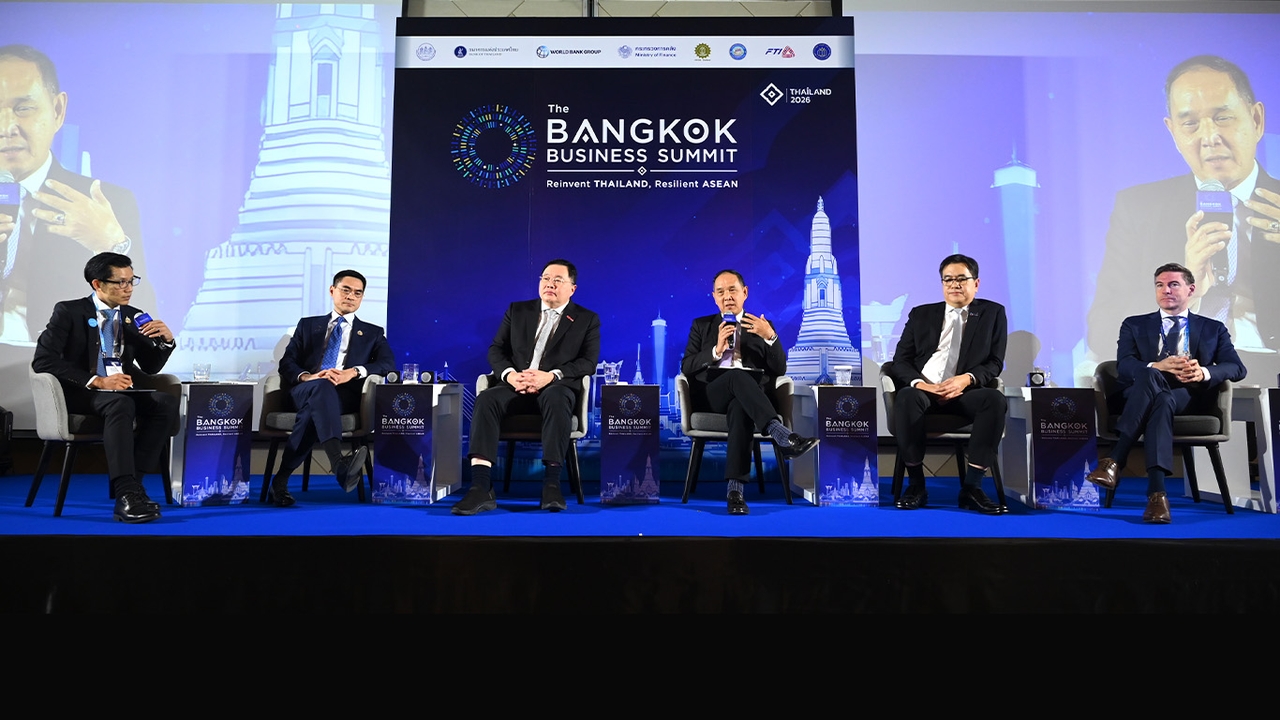
At The Bangkok Business Summit 2026 on the theme BUILDING RESILIENCE: Driving Thailand’s New Growth Engine, policymakers and major business leaders jointly addressed how the private sector must prepare as Thailand moves into implementation over the next 2–3 years.
Dr. Pirun Saiyasitpanich, Director-General of the Department of Climate Change and Environment, clearly outlined that climate change is becoming a direct economic risk for Thailand.
“The cost of doing nothing is very high, potentially resulting in GDP losses exceeding 5-14%."
The essential focus is protecting GDP and maintaining national competitiveness. Thailand is adjusting its Net Zero target to 2050 under NDC 3.0, aiming for carbon neutrality by then—but this goal cannot be achieved without investment.
“If Thailand wants to meet the target, we must invest 2 trillion baht, mobilizing funds from both private sector and government budgets.”
The next challenge is creating mechanisms to channel funds toward the transition, including Carbon Tax, ETS, Carbon Credit, and Climate Fund, alongside using Carbon Finance linked internationally. Meanwhile, the government is pushing legal frameworks and market mechanisms to embed carbon reduction into the economic system rather than isolated corporate projects.
For Thai Airways, the transition is clear as the business must simultaneously manage energy costs, international regulations, and investments in new technology.
Chai Eamsiri, CEO of Thai Airways Public Company Limited, stated that the aviation industry has long faced carbon emission standards and increasing pressure.
“The most critical point is energy — we must use fuels that significantly reduce carbon emissions.”
Thai Airways’ options include new aircraft models that save 20-30% fuel, improving operational efficiency, using Sustainable Aviation Fuel (SAF), and managing Carbon Credits. However, the transition entails high costs: new aircraft require substantial investment, and production capacity cannot meet demand, forcing airlines to continue using older planes.
The issue is not only current costs; unpredictable energy prices and carbon credit prices complicate long-term cost planning.
This is why Thai Airways has devised the THAI Carbon Readiness Journey strategy covering MEASURE, REDUCE, TRANSITION, MANAGE, and ENGAGE. It begins with developing unified Scope 1–3 carbon data systems, then reducing emissions from operations, increasing SAF usage, managing Carbon Liability and CORSIA, and disclosing carbon data to passengers alongside the idea of a Carbon Charge.
Additionally, the company applies Circular Economy principles to reduce waste and resource use, aligning with fleet upgrades, fuel efficiency improvements, and Route Optimization to cut fuel consumption.
While Thai Airways adjusts internally, PTT is advancing by creating a large-scale sandbox model called I-SPARK in Map Ta Phut, Rayong, aimed at experimentally driving industrial transition at commercial scale.
The I-SPARK plan for 2026–2035 outlines investments of $2–5 billion USD, targeting GHG reductions of 3–9 million tons CO₂e, expected to generate economic value of $1–3 billion and create over 13,000 jobs.
This model is structured around three pillars:
PTT’s concept is noteworthy because carbon reduction is framed as both investment and new industry creation simultaneously. The goal extends beyond emission cuts to making the area a model attracting foreign investment and expanding to other regions.
Another challenge comes from Thamasak Sethaudom, CEO of The Siam Cement Public Company Limited (SCG), reflecting the reality for heavy industry that carbon reduction technology alone is not enough if markets, regulations, and supply chains are unprepared.
SCG began low-carbon cement production years ago but faced major issues: customers lacked confidence and market momentum was insufficient. The strategy shifted from changing “products” to building an ecosystem, leading to the Saraburi Sandbox and the 4P approach.
“Our task is to make this happen in reality while maintaining competitiveness.”
SCG’s case illustrates that a single company cannot reduce carbon alone if rules, markets, funding, and partners do not progress together.
Marc Forni, Senior Urban Resilience and Recovery Specialist at the World Bank, clarified the issue further: although green bonds exist and banks are willing to lend, the key question is whether funds are going to the right problems.
“Money is available; banks are ready to lend for major projects like green bonds, but the problem is whether it addresses the core issues.”
The challenge lies in the project ecosystem — from uncertain long-term policies, complex procedures, measurement difficulties, to proving that projects are sufficiently viable to attract funding. This aligns with Thailand’s major challenge, as the World Bank states Thailand needs an additional 7.1 trillion baht in climate investment over the next 25 years. Public funding alone is insufficient; mobilizing private and financial sector capital is essential.
This forum reflects not only the need for Thailand to meet carbon reduction targets but also that the cost of inaction is becoming visible through natural disasters. Thailand faces a critical choice: invest now to transition, or risk paying a much higher price later by doing nothing.
As global partners, investors, and trade rules increasingly prioritize carbon, reduction efforts directly affect production costs, export markets, investment, and Thailand’s competitiveness. This may explain why “Net Zero 2050” is shifting from an environmental goal to an economic imperative requiring business investment starting today.
Read news on sustainability strategy, ESG, green finance, and sustainability technology with ThairathMoney athttps://www.thairath.co.th/money/sustainability
Follow the Facebook page Thairath Money at this link -https://www.facebook.com/ThairathMoney