

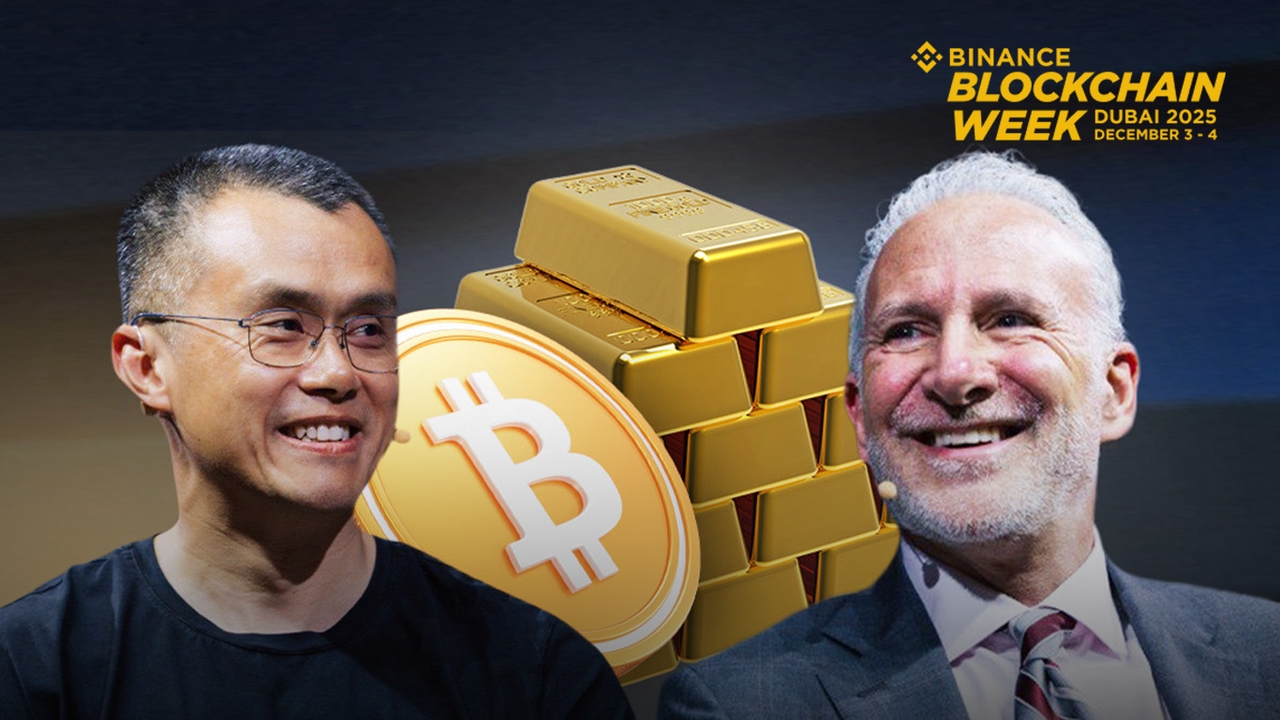
The face-off on the same stage between Changpeng Zhao (CZ), founder of Binance and Giggle Academy, and Peter Schiff, senior economist and founder of Euro Pacific Asset Management and Schiff Gold, was one of the most watched highlights globally at Binance Blockchain Week 2025 held in Dubai, UAE, from 3-4 December. The main topic was the question investors, institutions, and policymakers worldwide seek to answer: Which asset represents the future of sound money, Bitcoin or tokenized gold? Here are the key points Thairath Money summarized from the global debate.

The most watched and viral moment on social media occurred when CZ picked up a red box, revealing it as a special gift from the President of Kyrgyzstan. Inside was a 1-kilogram gold bar valued at about $130,000. On stage, CZ handed the gold bar to Peter Schiff for inspection. Upon looking at it, Schiff hesitated immediately, saying, "The color looks off," comparing it with the gold bracelet he wore. He said he was unfamiliar with the mint's name stamped on the bar and insisted it needed purity verification before he would believe it was genuine.
CZ seized the moment to retort, "This is the problem. Even when gold is right in front of us, we cannot instantly verify if it's real or fake. We must rely on experts or the mint's reputation. But if I transfer Bitcoin to you now, you can verify it immediately on the blockchain without trusting anyone."
The core of this debate centered on a fundamental philosophical question: "What gives an asset its value?" Peter Schiff stood firm on the concept of 'Intrinsic Value'. He believed gold has value because of its unique physical and chemical properties, unlike other metals.
"Gold does not rot, rust, or corrode. Even after thousands of years, it remains an excellent electrical conductor, used in electronics, medicine, space technology, and even inside the mobile phone you hold. This is 'real utility,' not just belief or hope," he explained.
He further compared, "When you hold gold, you possess 'stored utility' from today into the next thousand years. It's like storing energy in a stable physical form."
He also attacked Bitcoin, saying it is "backed by nothing." He stated, "Bitcoin is just numbers on a computer. It is intangible and has no utility beyond transferring value. People might argue, 'But it transfers quickly across borders.' Yes, it does, but that is not intrinsic value; it's merely 'convenience.'"
Additionally, Schiff compared Bitcoin with companies like Google or Facebook, saying, "Though those companies are intangible, they provide real services, have billions of users, generate advertising revenue, have infrastructure, and teams creating value. But Bitcoin? It is merely passed between speculators, producing no income or goods or services. It's purely a 'Greater Fool Theory' game where buyers hope to sell at a higher price."
CZ countered with a modern-world perspective, rejecting the idea that value must come only from tangibles.
He said, "Today, value is no longer defined by physicality. Think about it: the internet is intangible but extremely valuable. Data is intangible but has become the most valuable asset of the 21st century. Social media platforms like X or TikTok are just code and networks but are worth tens of billions. Bitcoin is similar. Its value comes from network effect and utility. As more people use Bitcoin, the network strengthens, and value rises accordingly. This is not empty belief but value derived from actual use by millions worldwide."
Ultimately, value is what people collectively agree to be valuable. Gold is valuable because humanity has agreed so for thousands of years. Bitcoin is valuable because digital-era users see it solving problems gold cannot. Deciding which is better depends on whether you believe in a world where value must be tangible or one where value arises from networks and technology.
A revealing point was that throughout the debate, Peter Schiff did not reject blockchain technology. In fact, he is one of the builders developing his own project called T-Gold or Tokenized Gold.
Peter Schiff explained, "The idea is to store real 99.99% certified gold bars in internationally standard vaults. Then, we issue digital tokens on the blockchain representing ownership of that gold."
Schiff compared the tokens to 'coat check tickets' at a party—these tickets are not the coats themselves but the right to exchange them back. He believes this makes gold better because of divisibility, transportability, and liquidity. He explained that physical gold bars require finding buyers, negotiating, and verifying authenticity, but gold tokens can be traded instantly on digital markets with much higher liquidity. Furthermore, tokens can serve as a medium of exchange. "This is crucial. Physical gold is unsuitable for daily transactions, but digital gold can be spent like digital money while still holding real gold."
CZ agreed but expressed concerns, viewing the project as excellent yet problematic in terms of 'trust.' His argument was that token holders still must 'trust' three things:
CZ compared Bitcoin by saying that when you hold Bitcoin in your own wallet (self-custody), you do not have to trust anyone. There is no central company, no vault, no custodian. That Bitcoin is directly yours. No one can seize it, ban it, or counterfeit it. This is the true meaning of 'trustless'—a system that does not require trust.
However, the conclusion here was that both sides agreed blockchain technology can make gold easier to use but maintain fundamental philosophical differences. Schiff believes trust in reputable institutions is necessary and acceptable, while CZ sees eliminating the need for trust as Bitcoin's most important innovation.

One of the most heated points was whether "Bitcoin can truly be used as money." The crux was how crypto cards like the Binance Card function.
Peter Schiff attacked, saying that using the Binance Card to pay is not truly "paying with Bitcoin" but "selling Bitcoin to convert to fiat to pay merchants," because the recipient receives dollars, not Bitcoin. He viewed this as proof Bitcoin fails as money.
He cited the criteria for "real money" in economics, stating that if Bitcoin is real money, it must fulfill three functions.
CZ argued from a user experience (UX) perspective, saying users just swipe the card, their crypto balance decreases, and they get the product—that completes the process. Comparing to current systems like Visa credit cards, he said users don't think about the backend currency conversions, payment gateways, settlements that take 1-3 days, and merchant fees of 2-3%. Users just swipe and pay. Bitcoin works the same way.
He explained, "Having backend conversion processes doesn’t mean it’s not payment. It’s a solution to the chicken-and-egg problem: stores don’t accept Bitcoin directly because not enough people use it, and people don’t use it because stores don’t accept it. So we build this bridge for mutual benefit."
He cited a case study from Africa, recounting meeting a user in Nigeria who wanted to send money home to his mother in a rural area. Using banks or Western Union incurred fees as high as 10-15%, and his mother had to travel 2-3 days to the nearest branch due to poor transportation. Using crypto, transfers were instant with minimal fees, and his mother could convert to local currency immediately via village agents or spend directly via mobile. This is tangible utility. Similarly, in Venezuela, where the bolivar loses thousands of percent in value annually, people use Bitcoin and stablecoins to protect wealth, receive salaries in Bitcoin, and spend it daily.
Here, both sides fiercely used price data to attack each other but interestingly chose completely different timeframes.
Peter Schiff looked back four years, emphasizing, "In the past 4 years, Bitcoin’s price has dropped 40% against gold," despite Bitcoin ETFs, Super Bowl ads, and MicroStrategy’s purchases, with no new highs.
CZ countered with a 15-year perspective, accusing Schiff of cherry-picking short periods. From inception, Bitcoin has grown from zero to this point, outperforming nearly every asset globally. He also noted that gold has been relatively flat for decades until recently.
Schiff believes younger investors losing money on Bitcoin will learn an expensive lesson and eventually turn to stable assets like gold as they mature. He sees Bitcoin as wealth transfer from latecomers to earlier investors, per the Greater Fool theory.
CZ acknowledged speculators exist in crypto but pointed out stock and gold markets also have speculators. Speculation doesn't render an asset worthless because developers (builders) are creating ecosystems and innovations.
The debate lasted nearly an hour. Despite heated exchanges, it ended on a friendly note, reflecting that while technology advances (Bitcoin), the traditional foundations of value (Gold) still carry weight and reason.
CZ prevailed on modernity and verifiability, while Schiff firmly upheld history and stability.
Ultimately, which side is correct may depend on whether you choose to trust intermediaries or code.