

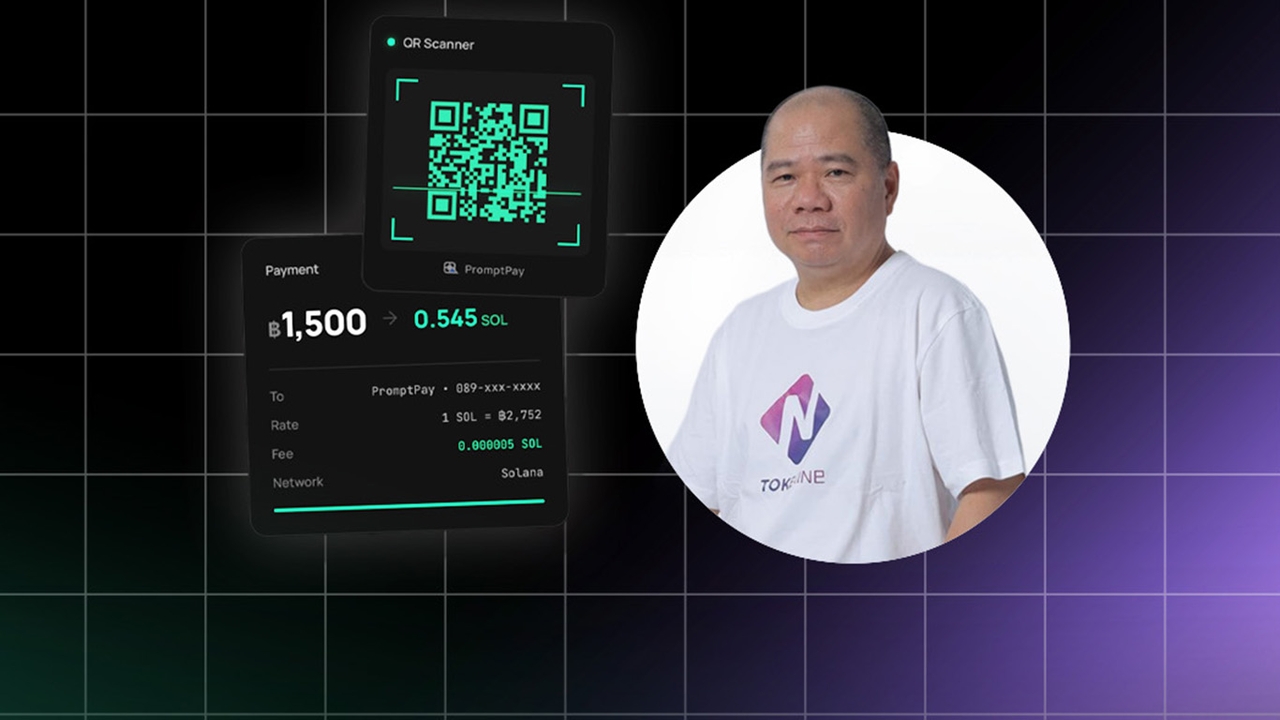
“Pay PromptPay with crypto without using banks or identity verification” is the claim of a service called QRSOL (qrsol.xyz), developed on the Solana network, currently attracting attention in Thailand’s crypto scene.
QRSOL’s website states that the service lets users "scan any PromptPay QR or merchant QR and pay with SOL directly via peer-to-peer transactions, without banks and no KYC."
The main concept involves: 1) users holding SOL cryptocurrency in their wallets; 2) Thai merchants having standard PromptPay QR codes; and 3) QRSOL’s system acting as an intermediary.
The mechanism is that users pay with Solana → the system converts it to baht through a Matcher → merchants receive baht. Simply put, merchants do not get crypto directly; instead, an intermediary exchanges the crypto for baht and transfers it into the Thai system.

Additionally, it states the following:
Dome Charoenyos, CEO of Tokenine, an expert in this field, told Thairath Money that this system resembles foreign exchange P2P models where an intermediary (Matcher) exchanges SOL to profit, transferring baht from their own bank account to the merchant’s PromptPay, and only then is the SOL unlocked to the Matcher.
From a technical perspective, Thai regulators like the Bank of Thailand and the Securities and Exchange Commission (SEC) have clear rules prohibiting licensed crypto exchanges from using crypto as a means of payment. QRSOL’s service falls into this category.
“This model is not new, and similar attempts to link crypto with Thai payment systems have been made before, but legal issues arose because the SEC has explicitly stated it does not want digital assets used directly as payment media.”Dome Charoenyos said.
Asked about the risks if this service is actually used, Dome explained:
Regarding the no-KYC claim, Dome said, “No KYC in this system hardly helps because when baht is transferred to a merchant’s bank account—which requires KYC—regulators can trace back to the account holder.”
“QRSOL won’t last long; it will be shut down quickly because it’s an easy target for investigation. The Bank of Thailand is monitoring this already. Personally, I believe using baht for payment is currently the most convenient.”Dome Charoenyos concluded.
Follow the Facebook page Thairath Money at this link -https://www.facebook.com/ThairathMoney