

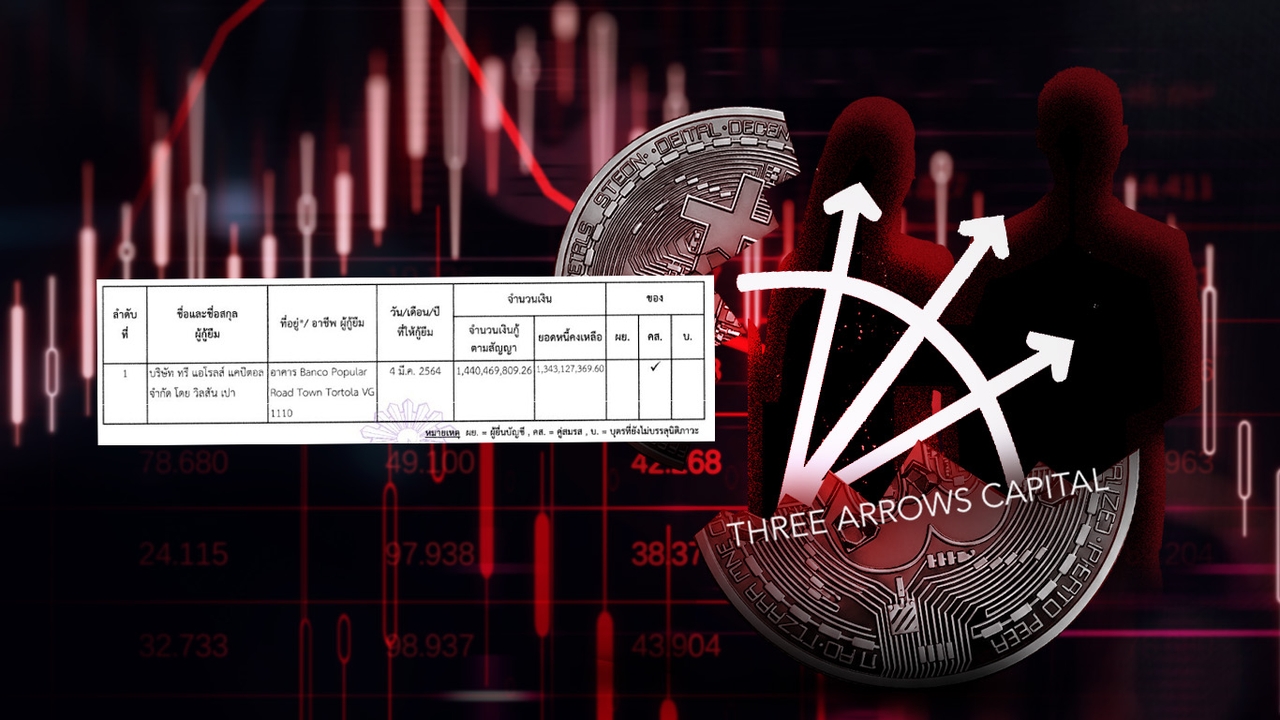
Three Arrows Capital (3AC), a crypto fund that collapsed in 2022, has resurfaced in discussions after a parliamentary debate on 1 October. Rangsiman Rome, MP from the People's Party, questioned the assets of Suchada Sang Thanthap, MP from Chaiyaphum province representing the Bhumjaithai Party, and her family, noting that 3AC was listed in their asset declarations.
According to the asset and debt declaration submitted to the National Anti-Corruption Commission (NACC), Suchada, her spouse, and their minor child have combined assets valued at over 1,974,908,877.24 baht, with debts totaling 454,286.88 baht, broken down as follows.
Most of the spouse's assets consist of loans totaling 1,440,469,309.24 baht, with an outstanding balance of 1,345,127,369.60 baht. The loan documents submitted to the NACC list the borrower as “Three Arrows Capital by Wilson Pao.”

However, as of this publication, there is no official confirmation that the individuals and companies named in these documents are the same as those referenced in international news. This article will therefore revisit the history and trajectory of Three Arrows Capital, the once high-profile crypto fund whose collapse triggered a domino effect across the industry.
Three Arrows Capital, or 3AC, was a crypto hedge fund founded in 2012 by Zhu Su and Kyle Davies. They began by trading foreign exchange derivatives. At its peak, 3AC employed dozens of staff.It managed assets valued at around 10 billion U.S. dollars (approximately 330 billion baht at the exchange rate on 2 October 2026).LinkedIn
The company’s LinkedIn page, now inactive, described its mission as seeking superior risk-adjusted returns. The fund invested in numerous blockchain companies, including technology developers, DeFi startups, and infrastructure providers.Initially operating out of Singapore, 3AC began relocating between 2021 and 2022, announcing a move to Dubai that ultimately failed, before reportedly shifting to the British Virgin Islands (BVI).3AC earned its reputation by investing in crypto markets with high conviction, taking significant risks and using heavy leverage. It borrowed substantial sums from lenders and crypto trading platforms to increase its investment positions beyond its actual capital.
Their main strategy involved borrowing funds from industry players ranging from institutions and crypto firms to individuals, then reinvesting in other crypto projects such as Web3, DeFi, and blockchain infrastructure. Many of these projects were startups or in early development stages.
The investments covered tokens, cryptocurrencies, and equity shares. However, this approach also carried risks, especially due to market volatility, regulatory uncertainty, and overall market unpredictability.
During a prolonged crypto market boom, combined with over a decade of operational experience, 3AC gained strong credibility. Its founders became recognized crypto experts with large social media followings. Their opinions attracted significant attention, boosting 3AC to become one of the world’s most prominent hedge funds.
From Terra to Liquidation
3AC's turning point came in May 2022 when Terra, a blockchain and decentralized finance (DeFi) platform developed by Terraform Labs and founded by Do Kwon, collapsed. The stablecoin TerraUSD (UST) lost its peg, while LUNA, the platform’s native token, plummeted to near zero, wiping out an estimated 40 billion U.S. dollars in market value.
As crypto prices plummeted, lenders grew concerned about 3AC’s financial health and began demanding repayments and collateral. 3AC was forced to liquidate assets and close positions to raise funds but faced a declining market simultaneously. PwC documents reveal 3AC held leveraged positions in LUNA and Bitcoin and, after LUNA’s collapse and falling crypto prices, could no longer meet margin calls.
In late June 2022, creditors filed petitions leading the BVI court to order 3AC’s liquidation, appointing Teneo as liquidator. In early July, Teneo sought Chapter 15 protection in the U.S.Later, co-founder Kyle Davies claimed that LUNA’s collapse was not the cause of 3AC’s downfall. He considered the damage insufficient to collapse the fund immediately, asserting the "final killer" was FTX forcing 3AC’s position liquidations mid-2022. Earlier, he had acknowledged to Bloomberg that Terra’s failure unsettled the fund.FTX itself collapsed in November 2022, about five months after 3AC entered liquidation.
3AC’s Creditors
Teneo’s liquidation documents state 3AC owed at least 3.5 billion U.S. dollars to at least 27 crypto firms. Several creditors faced customer withdrawals during the same period, forcing closures or bankruptcy.
Creditor names publicly disclosed include:
Genesis Asia Pacific lent about 2.3 billion U.S. dollars to 3AC.
Blockchain.com lent approximately 270 million U.S. dollars to 3AC and reportedly suffered losses.
BlockFi lent funds and held 3AC collateral, though amounts were undisclosed.
Not Just Crypto Firms: 3AC Also Borrowed from “Crypto Whales”
Besides institutions and companies, 3AC also borrowed from wealthy individuals in the crypto space, known as “Crypto Whales.”
According to The Block, one such lender was Taiyang Zhang, co-founder of the DeFi project Ren, a close friend of Zhu Su, who lent tens of millions of U.S. dollars to 3AC.
Taiyang Zhang has explained that Ren is a decentralized, open protocol designed to connect and increase liquidity across different blockchains. It allows assets to move cross-chain without intermediaries.
During the crypto boom, Ren’s token value soared, creating many millionaires.
In February 2021, Sam Bankman-Fried’s Alameda Research acquired Ren’s team through an acquihire, with Taiyang Zhang briefly serving as a venture partner at Alameda. After FTX’s collapse, Ren had to shut down its initial version.Taiyang Zhang was born in Canberra, Australia. He studied computer science but dropped out within a year. He then co-founded Neucode, a software development company, before establishing Virgil Capital, a crypto hedge fund.In 2017, he co-founded Republic Protocol with Loong Wang, later renamed Ren Protocol. He also founded several other companies, including KeeperDAO, a DeFi protocol on Ethereum, Automera, a biotech startup developing treatments for rare diseases, and collaborated again with Loong Wang to establish QDX, a quantum mechanics-based drug research firm.
However, there is no official confirmation that the individuals and companies named in the MPs’ submissions to the NACC are the same as those referenced here. Also mentioned is Wilson Pao, whose name resembles Wilson Cheuk Yao Pau, a 3AC director according to Sirichok Sopa’s Facebook post.Further updates are awaited. Rangsiman Rome has affirmed there is "evidence" and is expected to provide clarification, while Suchada Sang Thanthap is also anticipated to respond.Sources: The Block [1][2], CNBC [1][2], Bloomberg, SWFI, CoinDesk, Investopedia, Harvard, Yahoo! Finance, Medium: Taiyang Zhang
Read stock and investment news with Thairath Money to help you achieve “Good Finances, Good Life” at
https://www.thairath.co.th/money/investment
Follow Thairath Money Facebook page athttps://www.facebook.com/ThairathMoney