

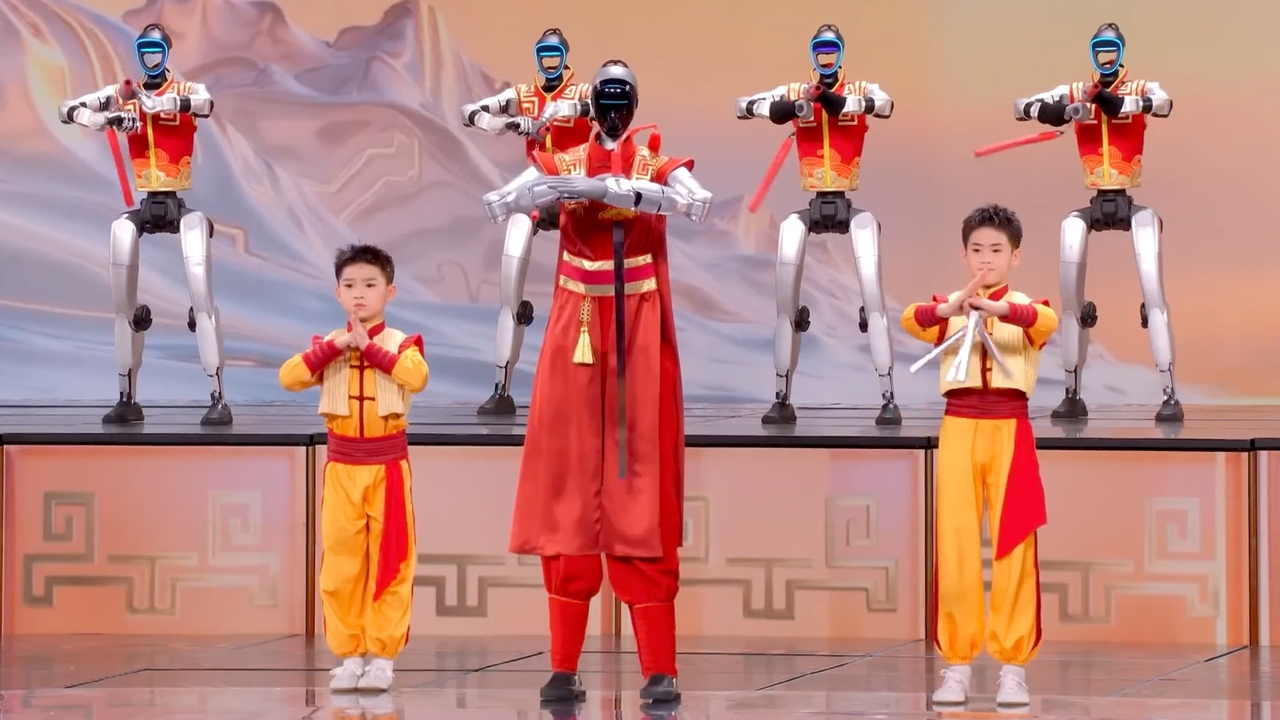
From viral clips showing humanoid robots awkwardly walking and spinning handkerchiefs on stage, to competing in sports like running and robot football that amused audiences worldwide, this year at China's annual Spring Festival Gala, humanoid robots caused a stir again—not for humor but for their advanced development. These robots now exhibit "human-like" movements and perform flawlessly, earning both admiration and concern about humanity's future.
Early in 2025, at the same Spring Festival Gala, a widely shared viral clip showed humanoid robots dressed in red holding handkerchiefs, lined up to dance waving and spinning the handkerchiefs. Behind them stood human dancers. The robots’ movements remained familiar to many: swaying slightly with limited motion.
But this year, at the same event, robots from various startups showcased abilities ranging from Kung Fu stances, flips, gymnastics, sword dancing, demonstrating proficiency with various weapons, to performing seamlessly alongside human actors—a feat requiring very high precision.
In just one year of development, these robots amazed audiences everywhere, drawing both praise for technological progress and concerns about future impacts on human labor and technological competition between the U.S. and China.
Reyk Knuhtsen, an analyst at SemiAnalysis, stated: “At this year's Spring Gala, it is clear that the robots have become slimmer, their movements smoother, and their capabilities greater.” He added: “Seeing these robots approach the physical limits achievable by humans, it becomes evident they can perform human-level activities and may eventually surpass human abilities.”
Data from Barclays indicates that China has become the leader in humanoid robot production and installation. Of approximately 15,000 humanoid robots installed worldwide in 2025, China accounts for over 85%, while the U.S. holds only 13%.
Zornitsa Todorova, Head of Thematic FICC Research at Barclays, explained: China has an advantage over the U.S. with a nearly complete supply chain. From raw materials such as rare earth minerals and high-performance magnets to physical components and batteries, combined with government support, Chinese robot manufacturers can price their products lower than competitors.
Leading Chinese humanoid robot company Unitree, which showcased its robots at the Spring Festival Gala, aims to maintain its leadership this year. The CEO told local media before the gala ended that they expect to ship between 10,000 and 20,000 robots in 2026.
Unitree prices its G1 Humanoid robot starting at $13,500 USD, whereas Tesla’s Optimus robot in the U.S., viewed as a market leader there, is expected to be priced higher. Elon Musk has mentioned production costs could drop below $20,000 USD if annual output reaches one million units, but final prices will depend on market demand.
Although the flips and weapon handling at the Spring Festival Gala demonstrate rapid innovation and high accuracy, analysts note these performances involve physically demanding tasks. Humanoids still face challenges in delicate, human-centered jobs such as household chores and healthcare assistance.
Lian Jye Su, an analyst at Omdia, said: “However, humanoid robots must still prove their reliability in unstructured, human-centered environments, especially in sensitive tasks like healthcare or household assistance.”
Ultimately, the success may depend on the AI models used to train these robots. While Chinese companies impressed with Kung Fu performances on stage, the real economic value this year lies in advances in reasoning, sustained long-term operation, and integrating multiple tasks, such as household work or diverse missions.
In the U.S. market, besides Tesla, companies like 1X Technology are developing robots named NEO specifically as household helpers. They have made significant progress and offer products priced at $20,000 USD or available by subscription at $499 USD per month.
Follow the Facebook page Thairath Money at this link -https://www.facebook.com/ThairathMoney