

As the world faces a ticking public health time bomb—from an aging society and rising deaths from chronic non-communicable diseases (NCDs) to continuously increasing healthcare expenses—the "health crisis" has become one of Thailand's major challenges. Yet, from another perspective, this crisis presents a significant opportunity for Thailand to shift from a reactive stance to creating new economic value through knowledge, research, and innovation.
This marks the beginning of the concept to turn the health crisis into Thailand’s "New Growth Engine," led by the Office of the National Science and Technology Development Agency (NSTDA). NSTDA acts as the central coordinator to design and connect the entire system, pushing the "science, research, and innovation" system beyond academic tools to become a new engine that creates economic value and simultaneously improves the quality of life for Thai people.

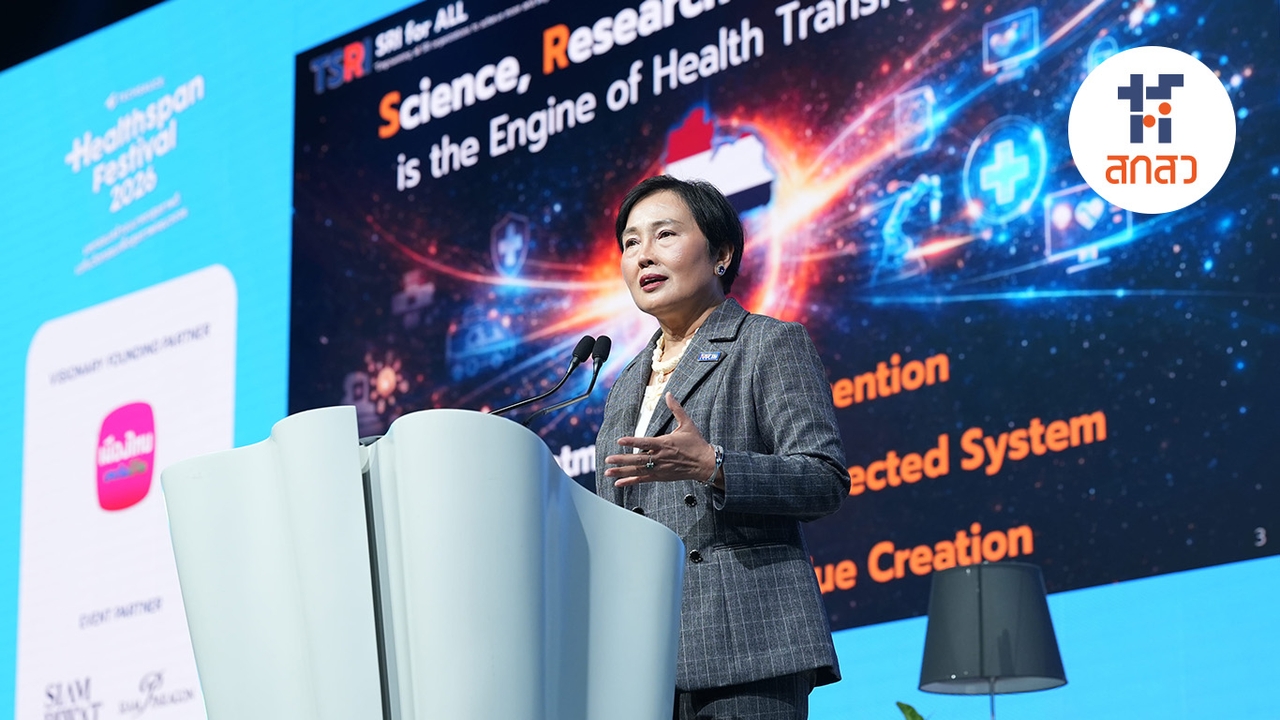
Professor Dr. Sompong Klainongsoong, Director of the Office of the National Science and Technology Development Agency (NSTDA). He revealed that during the global COVID-19 crisis, the World Health Organization (WHO) ranked Thailand among the top five countries worldwide that managed the situation effectively, thanks to an efficient healthcare and medical system. This achievement has become an important milestone.
The core of this transformation is accelerating Health Transformation by using "science, research, and innovation" as the main mechanism to create new national value and to shift from a fragmented system toward an integrated one, with NSTDA serving as the "System Integrator."
Under this strategic plan, NSTDA aims to fully connect the country's research and innovation systems within 3-4 years (2023–2027) through five key mechanisms:
This entails seamless cooperation among the public sector, private sector, researchers, and the public to close the gap where research often remains confined to laboratories. Especially, NSTDA acts as a mediator to align the needs of entrepreneurs and practicing physicians with researchers’ expertise, enabling knowledge to solve national problems and be commercially developed concretely.
"Investing in science, research, and innovation may be high risk, but it is also the highest-yield game. If successful, 'Thai people's health' will not only be about quality of life but will become a long-term economic engine for the country," he stated.

The traditional view of the healthcare system as a "cost" borne by the state is shifting to a model where health spending is an investment. Professor Dr. Sompong explained that redesigning the system to emphasize prevention, early diagnosis, and precision medicine results not only in fewer patients but also in reducing long-term budget burdens, improving workforce efficiency, and creating new industries.
He further explained that over the past six years, Thailand has invested more than 16 billion baht in health research and innovation under the Thailand RISE Fund mechanism. This investment has generated economic value on three levels:
1. Saving national funds by using domestically developed medical innovations such as X-ray machines, prosthetic feet, cranial patches, and dialysis waste bags, reducing dependence on imported medical equipment and directly lowering healthcare system costs.
2. Enhancing competitiveness by commercializing research, creating new waves in industries like BioTech & Genomics, Digital Health, and Medical AI, paving the way for startups and Thai enterprises to enter global markets.
3. Reducing costs and putting more money in citizens' pockets. A clear example is the use of Medical AI to analyze chest X-rays for early cancer screening, supporting the 30 Baht universal healthcare policy. This platform is now used in nearly every hospital nationwide, cutting diagnostic and treatment costs by approximately 500,000 baht per case.
This includes developing Telemedicine systems where village health volunteers carry portable kits to collect blood samples and measure patients’ blood pressure at home. Data is then analyzed by AI and forwarded to doctors for prompt diagnosis and prescriptions. These innovations not only generate income but also reduce travel expenses, leaving more money for people.
Beyond domestic use, this strategy targets foreign markets, especially ASEAN with its billion-strong population and physical similarities to Thais. For instance, dental scanners and grinders developed in Thailand are exported worldwide. Efforts also focus on presenting medical AI to foreign investors to expand business and attract new investments back into the country.
Ultimately, realizing a seamless health ecosystem requires coordinated efforts across all sectors—government setting direction and policy support, private sector advancing business and markets, researchers generating new knowledge, startups accelerating innovation implementation, and citizens as users and stakeholders.
Infrastructure is also crucial, including digital systems, databases, and AI platforms that enable seamless data flow, making healthcare more precise, accessible, and efficient. When true "integration" happens, valuable knowledge and research will no longer remain on shelves but will become powerful forces generating economic value, improving quality of life, and shaping Thailand’s future.
Follow the Facebook page: Thairath Money at the following link -