

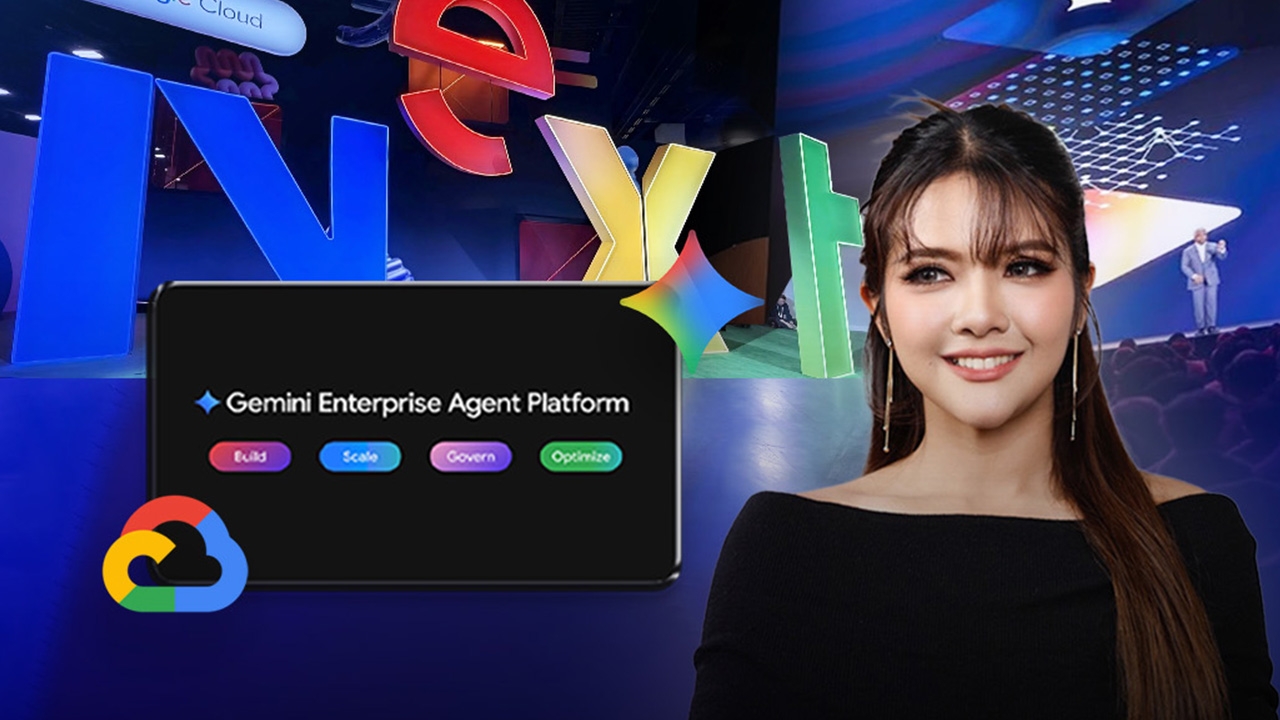
It can now be said with full confidence that AI has become an integral part of everyone's work life. In April, Las Vegas once again became a technology hub when Google Cloud held Google Cloud Next 2026, gathering tens of thousands of enterprise customers, partners, and global media to reveal how AI is transforming the business landscape.
Thairath Money reporters were invited as representatives of Southeast Asian media. Throughout the event, one term was repeatedly emphasized as the main theme: "Agentic AI," AI that can truly "take action" on behalf of humans. What we observed at the event confirms this term is far from just another buzzword. Reviewing dozens of real customer cases presented by Google Cloud revealed an interesting insight: "using AI to assist work" means different things to different companies.
Some companies use AI merely as an assistant that answers employee queries faster; others let AI handle entire processes independently; and some have advanced to having "hundreds of agents" coordinating tasks among themselves with minimal human intervention.
This article explores real cases, arranged by the "assistant level" of AI within each organization, to clearly illustrate how far business has advanced and how each company applies AI to maximize benefits. The AI assistance can be categorized into three levels.

At this level, Agentic AI is not yet autonomous decision-makers but instead "elevate" employee or customer performance by accelerating, improving accuracy, and providing instant access to insights. Most cases still involve humans making the final decisions, with AI acting as a "backup brain" available continuously. Commonly seen is AI reducing task times from hours/days/months down to seconds/minutes, while humans retain ultimate authority. Examples include:
Walmart, the world's largest retailer, equipped every store manager with Pixel Fold devices connected to corporate data and running Gemini Enterprise. The goal is to free managers from office screens to be on the shop floor assisting customers, as they can now obtain needed answers in seconds instead of hours.
Citi Wealth, which uses a similar concept for high-net-worth banking clients. The company partnered with Google Cloud and DeepMind to launch "Citi Sky," an AI team on standby 24/7, enabling customers and staff to access global insights in multiple languages on demand.
Macquarie Bank, from Australia, took a broader approach by centralizing all data on BigQuery and Spanner, equipping all employees with Gemini Enterprise, and deploying AI assistants answering banking queries for over two million customers around the clock. Remarkably, customer losses due to fraud were cut by half.
Colgate-Palmolive, where nearly everyone in the 34,000-strong workforce uses Google Workspace with AI agents analyzing decades of sales history. What once took months to develop new product concepts now takes just minutes.
Bayer Crop Science, which uses Data Agent Kit to manage data and automate model building, freeing researchers to focus fully on agricultural innovations without manual tasks.
At this stage, AI "takes over" tasks within clearly defined boundaries, operating without step-by-step human instructions and delivering results for human review. This is where "Agentic" begins to fully apply, as AI gains decision-making authority in its workflows. AI doesn't just answer questions but "executes" processes—from assembling shopping carts, processing orders, detecting fraud, to forecasting storms weeks ahead. Examples include:
The Home Depot, which developed the digital assistant "Magic Apron" to support customers throughout their journey—from home renovation inspiration to verifying DIY product compatibility. The system guides in-store navigation and product info, and online it manages after-sales services. Google highlighted a clear increase in conversion rates.
Papa John's, which built a hyper-personalized food ordering agent that remembers individual customer preferences. Previously requiring employees to ask each detail, the agent now autonomously takes orders and speeds up pizza delivery.
Reliance, in India advanced further by allowing customers to type broad requests like "plan a birthday party," with AI agents recommending cross-category products, adding them to the cart ready for checkout, significantly boosting sales per website visit.
Best Buy, uses automated AI to advise customers on complex technology specs, troubleshoot issues, and schedule technician appointments.
Citadel Securities, leverages Google TPU chips to run quantitative research in markets where speed is measured in nanoseconds. Tasks that once took weeks are completed in hours, enabling researchers to test hundreds of new ideas without system limitations.
American Express, centralizes core data on Google Cloud to enable AI systems to analyze risks and detect fraud faster worldwide. AI agents operate 24/7 without human commands. One of the most impactful cases is:
Axia Energia, a Brazilian energy company using TPU clusters to run advanced weather models, forecasting severe storms up to 10 days in advance. This allows preemptive measures that reduce power outages affecting millions.
Virgin Voyages, which created "Rovey," a personal assistant for cruise passengers, utilizing Google Distributed Cloud Edge to enable AI operation even when the ship is offline in the middle of the ocean.
This highest Agentic AI level, strongly emphasized at Google Cloud Next '26, moves beyond a single AI performing one task. Organizations build "teams of AI agents" working together like human teams—dividing roles, handing off tasks, and making collective decisions. Companies at this level create "multi-agent ecosystems" functioning with complexity akin to large human teams. Examples include:
Vodafone, which developed a global network system with "hundreds of agents" operating on BigQuery and Gemini Enterprise. These agents proactively manage network outages and self-optimize infrastructure, saving millions of dollars and improving network reliability for users.
Unilever, highlighted by Google as an exemplary multi-agent case, built a "Competitive Buying Multi-agentic Solution" on Gemini Enterprise. This solution coordinates multiple agents via a single interface, enabling procurement teams to analyze and decide on raw material sources within minutes instead of days.
A case closest to Thai people is AEON360, which partnered with Google Cloud to create a "Continuous Commerce" experience—a seamless shopping journey across AEON’s ecosystem including retail, finance, and lifestyle, starting in Malaysia and expanding throughout Southeast Asia. Simply put, when customers in Kuala Lumpur search for cooking ingredients on Google and pay at AEON MaxValu, they don’t start over at each step. Multiple agents collaborate behind the scenes: one interacts via Google Search, another manages the shopping cart, and another provides 24/7 support. All share data to anticipate customer needs along the journey. What makes this special is the use of Google’s "Universal Commerce Protocol," an open standard allowing agents to communicate across systems, from Google Search to Google Pay.
The US Department of Energy, which drives "AI scientist assistants" across its 17 national labs to accelerate scientific discovery, representing AI collaborating with human researchers to advance national science.
NASA, employs Gemini Enterprise agents in the "Artemis II" mission to verify flight readiness and ensure astronaut safety on the longest human space journey from Earth in history.
And perhaps the most relatable case for the general public is Team USA, which partnered with Google Cloud and DeepMind engineers to develop a model transforming 2D video into 3D images to analyze Olympic snowboarders’ techniques. The model calculates physics frame-by-frame—including trajectory, rotation speed, and air tuck timing—and features a "Ribbon Overlay" graphic highlighting key motion changes, enabling athletes to identify flaws and improve skills with precision.

In summary, the most interesting insight from the compilation of use cases at Google Cloud Next '26 is not merely the number of AI implementations in business but the "gap" between the levels. Using AI at the first level does not imply lagging; simply enabling 34,000 employees to access AI has already accelerated the entire organization’s workflow.
Meanwhile, organizations at the third level are transforming business operations. Seeing hundreds of agents collaborating prompts us humans to reflect on how our roles will adapt within these systems. Although answers remain elusive, one thing is clear: over the past two years, the meaning of AI in 2026 is fundamentally different from the AI we knew in 2024.