

Today, Stablecoin is expanding its role from a digital asset mainly used in crypto markets to becoming a tool for payments and moving value internationally. Its ability to transfer value via blockchain 24/7 offers businesses and financial institutions a new option to move money without fully relying on traditional processes.
However, this shift raises an important question:In an era where money can move directly through blockchain, what role will payment network giant Visa still play?
Thairath Money attended the Singapore FinTech Festival 2026 in Singapore at Visa’s invitation to track financial technology trends. We gained clearer insight into Visa’s strategy, which shows the company is not simply competing with Stablecoin but is working to connect this technology with existing financial infrastructure—from card payments, cross-border transfers, to interbank settlements.
The key goal is to link the traditional financial world, or fiat currency, with blockchain-based digital money, maintaining Visa’s role amid the evolving financial system.
Traditionally, cross-border money transfers are not always as convenient as domestic transfers, especially for businesses paying partners or employees across multiple countries. This often involves intermediary banks, currency exchanges, transaction verifications, and varying regulations in each market.
Moreover, some transfers depend on financial institutions’ operating hours or holidays, forcing businesses to hold advance cash reserves in several countries to meet payment deadlines. This ties up capital that could otherwise be used for business operations.
These limitations have led Stablecoin to be seen as an alternative for cross-border money movement.
Stablecoin is a digital asset designed to maintain value pegged to other assets, such as the U.S. dollar, and can move value via blockchain networks 24/7.
However, fast blockchain transactions don’t always mean quicker receipt of funds or lower costs, due to steps like converting Stablecoin back to fiat currency, fees, exchange rate spreads, and legal regulations. Still, Stablecoin’s potential has drawn increasing attention from major financial institutions and payment providers worldwide.
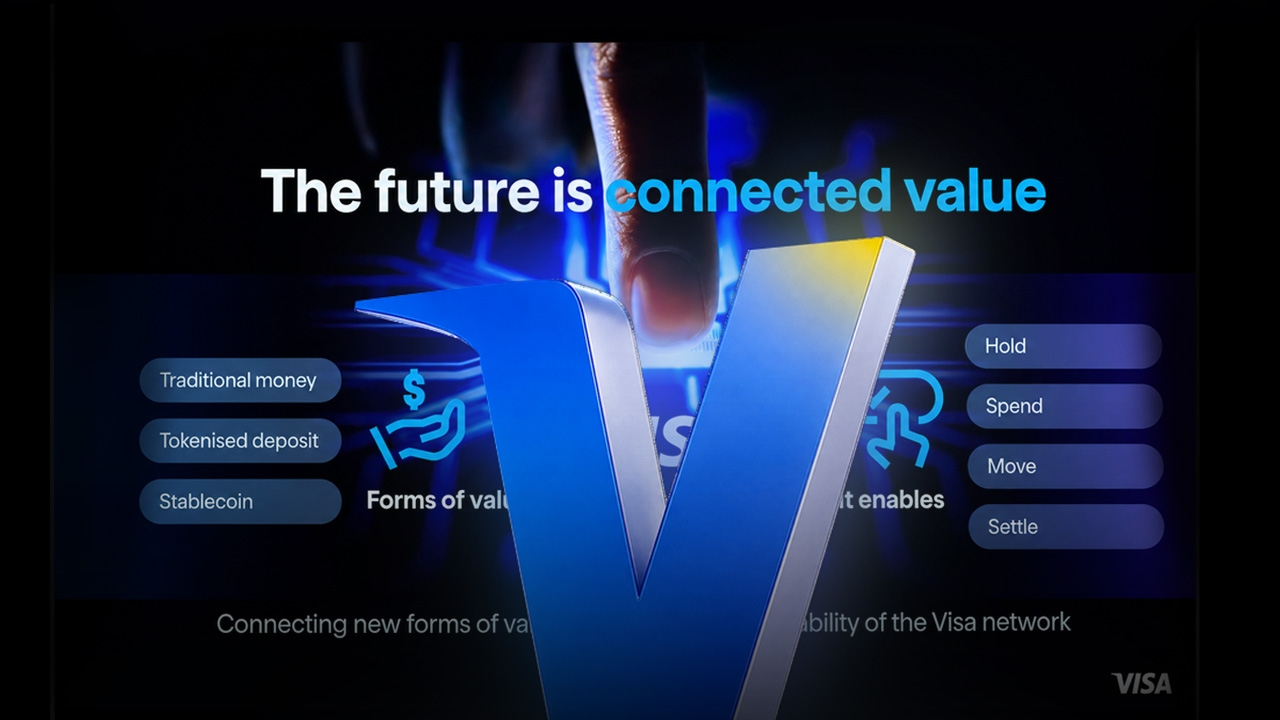
Chavi Jafa, Head of Commercial Solutions and Money Movement for Visa Asia Pacific, spoke at the Singapore FinTech Festival 2026 about Stablecoin’s shift from digital asset trading to real economic use. He described Visa’s approach:The company has defined four core Stablecoin capabilities: Hold, Spend, Move, and Settle—meaning holding, spending, moving money, and settling payments.

These capabilities mean Visa’s Stablecoin opportunities go beyond enabling consumers to pay with digital assets. They also support businesses and financial institutions in managing money and transactions between traditional finance and blockchain systems more smoothly.
A clear example is Stablecoin-linked cards, which connect a card’s balance to Stablecoin holdings, allowing cardholders to use Stablecoin value to buy goods and services via the Visa network. The system converts and settles payments so merchants receive funds in regular currency. This means merchants don’t need to accept Stablecoin directly, while consumers experience familiar card payments, even though the underlying funds are digital.
Visa’s Q4 fiscal 2026 earnings report states the company supports over 225 Stablecoin-linked card programs, covering about 5 million cards in more than 50 countries.
Annualized transaction volume settled in Stablecoin on Visa’s system exceeds $25 billion, a roughly tenfold increase from the previous year.

This figure is based on recent transaction rates projected annually, not cumulative yearly transaction value, and remains small compared to Visa’s main payment network.
Nonetheless, this growth shows Stablecoin’s rising role in Visa’s services. Notably, Visa is not pushing all consumers and merchants to switch fully to Stablecoin but is connecting existing infrastructure with new digital money forms, preserving its role as a payment network even as the money behind transactions evolves.
A key announcement at the Singapore FinTech Festival 2026 was expanding Stablecoin as a funding source for cross-border payments via Visa Direct in the Asia Pacific region.
Visa Direct is Visa’s money movement platform, connecting over 18 billion payment endpoints worldwide, including accounts, cards, and digital wallets.
This new service allows qualified business customers to use supported Stablecoins as payment sources via Visa Direct, with recipients receiving funds in regular fiat currencies.
To illustrate, a company sending money abroad might previously need to hold foreign currency liquidity through banks or remittance providers, sometimes pre-funding recipient accounts.
Under Visa’s new service, the company can use supported Stablecoins to fund payments via Visa Direct. The connected system executes processes ensuring recipients receive funds in their local currency as usual. This means Stablecoin can change backend fund management without requiring recipients to hold Stablecoin or digital wallets themselves.
Visa began piloting such Stablecoin usage in 2025, launching commercial service in the U.S. with Inyo Global in October 2026. In Asia Pacific, Visa is piloting with Singapore-based digital payments firm dtcpay, which uses supported Stablecoins as funding sources for cross-border payments via Visa Direct.
Connections to digital assets are facilitated through independent digital asset infrastructure providers. Visa clarifies it is not a regulated digital asset provider itself.
For businesses, benefits include not only faster transfers but also reduced advance capital requirements and greater flexibility in managing working capital across countries.
Visa is also advancing beyond linking Stablecoin to its own money transfer services. In July 2026, it launched the Visa Stablecoin Platform (VSP) to help financial institutions, FinTechs, and payment providers integrate Stablecoin into their business systems more easily.
VSP offers digital wallet infrastructure, access to Stablecoins like Open USD, and capabilities to hold, transfer, redeem, or exchange supported Stablecoins, supported by transaction monitoring and control tools. This is crucial because while blockchain enables direct value transfer, institutional adoption requires governance, transaction monitoring, user authentication, digital asset custody, and integration with existing accounts and financial systems.
The complexity of institutional Stablecoin use—including custody, regulation, and legacy system integration—is becoming a business opportunity for infrastructure providers like Visa, which leverages its payment network, security expertise, and risk management to expand into the on-chain world.
This shows Visa aims not just to be a network supporting Stablecoin payments but to become an infrastructure provider enabling financial institutions to use digital money in real business systems.
Visa’s new innovations—Stablecoin-linked cards, Visa Direct, and Visa Stablecoin Platform—demonstrate its advantage from a global network, strong financial institution partnerships, and security expertise, extending into new money movement infrastructure.
However, this transition faces many challenges because Stablecoins carry risks related to issuer credibility, backing assets, liquidity, redemption capability, as well as concerns over money laundering and cross-border fund transfers.
These issues have prompted regulators worldwide to develop regulatory frameworks, including Thailand’s Bank of Thailand, which is studying and seeking feedback on THB Stablecoin regulations, while the Securities and Exchange Commission focuses more on digital asset transaction oversight and financial crime prevention.
Thus, integrating Stablecoin into the real financial system is not only a technology race but also a contest of trust, regulation, and interoperability with existing systems. Ultimately, the future financial system may not see Stablecoin replacing all traditional money but rather multiple forms of money coexisting and interoperating more effectively.
Read technology and digital transformation innovation news with ThairathMoney to help you "Better Finance, Better Life" athttps://www.thairath.co.th/money/tech_innovation
Follow Thairath Money Facebook page at the link below -https://www.facebook.com/ThairathMoney